CEH

Essential Terminology in Cyber security

Here are some terms and their definition, you must know before you start studying ethical hacking. As cyber security technology grows and expands, so does the vocabulary associated with it.

Hack Value:

It is the notion among hackers that one thing is price doing or is interesting. Hack value will be a playful disruption. It’s additionally maintenance for the imagination, surprise the far side tedium of living in a client, dominated culture.It crossovers between different fields and practices, regard their achievements and approaches inhacking instead of specific genres. Like alternative chapters a number of the artworks and comes exist their own right, inside and outside of gallery context.Alternative examples either play with or disrupt things through cultural enactments of communication with others. These embody publications, farming, food distribution and public heritage sites. All the comes and works studied are social. Some are political and a few are participatory.This includes works that use digital networks and physical environments also as written matter. What binds these examples along isn’t solely the adventures. They initiate once experimenting with alternative ways that of seeing, being and thinking.They additionally share common intentions to loosen the restrictions, distractions and interactions dominating. The cultural interfaces, facades and structures in our everyday surroundings. Hack value is the notion among hackers to evaluate something that is worth doing or is interesting. Hackers derive great satisfaction from breaking down the toughest network of cyber security . They consider it their accomplishment as no one can do.

Also Read this Blog 6 Quick Methodology For Web Server Attack

Vulnerability:

Vulnerability is the existence of weakness, design when exploited, leads to an unexpected and undesirable event compromising . Simply that allows an attacker to enter the system by bypassing various user authentications. Vulnerability comes from the Latin word for “wound,” values. Vulnerability is that the state of being open to injury, or showing as if you’re. It would be emotional, like admitting that you are loving with somebody who would possibly solely such as you as a friend, or it will be literal, just like the vulnerability of a soccer goal that is unprotected by any defensive players. Vulnerability is that the existence of a weakness (design or implementation error) which will result in a surprising event compromising the protection of the system.

Exploit:

An exploit is breach of IT system security through vulnerabilities, in the context of an attack on system or network. Exploitation is that the next step in an attacker’s playbook when finding a vulnerability. Exploits are the means that through that a vulnerability may be leveraged for malicious activity by hackers; these include pieces of software system, sequences of commands, or maybe open supply exploit kits.An exploit could be a code that takes advantage of a software vulnerability or security flaw.It’s written either by cyber security researchers as a proof-of-concept threat or by malicious actors to be used in their operations. When used, exploits enable an intruder to remotely access a network and gain elevated privileges, or move deeper into the network.It also refers to malicious software or commands that can cause unanticipated behavior of legitimate software or hardware through attackers taking advantage of the vulnerabilities. Exploit could be a breach of an IT system of cyber security through vulnerabilities.

Payload:

Payload is the part of a malware or an exploit code that performs the intended malicious actions, which can include creating backdoor access to a victim’s machine, damaging or deleting files, committing data theft and hijacking computer. Hackers use various methods to execute the payload. Payload is that the part of an exploit code that performs a supposed malicious action. For example, they can activate a logic bomb, execute an infected program, or use an unprotected computer connected to a network.In computing, a payload is that the carrying capability of a packet or different transmission information unit. The term has its roots within the military and is usually related to the capability of practicable malicious code to try and do injury. Technically, the payload of a particular packet or different protocol information unit (PDU) is that the actual transmitted information sent by act endpoints; network protocols additionally specify the most length allowed for packet payloads.

Related Product Certified Ethical Hacker | CEH Certification

Zero-Day Attack:

in a Zero-Day attack, the attacker exploits vulnerabilities in a computer application before the software developer can release a patch for them.A Zero-Day attack is an attack that exploits the PC vulnerability before software engineer releases a patch.Based on common usage of exploit terms, an exploit is said as a zero-day exploit once it’s wont to attack a vulnerability that has been identified however not yet patched, additionally called a zero-day vulnerability.

Daisy Chaining:

It involves gaining access to one network and/or computer and then using the same information to gain access to multiple networks and computers that information. Daisy chaining involves gaining access to a network and /or laptop and so exploitation constant data to realize access to multiple networks and computers that contain desirable data.

Doxing:

Doxing is publication in person identifiable data concerning a private or organization. It refers to gathering and publishing personally identifiable information such as an individual’s name and email address, or other sensitive information pertaining to an entire organization. People with malicious intent collect this information from publicly accessible channels such as the databases, social media and the Internet.

Bot:

A “bot” (a contraction of “robot”) is a software application or program that can be controlled remotely to execute or automate predefined tasks. Hackers use buts as agents that carry out malicious activity over the Internet. Attackers use infected machines to launch distributed denial-of-service (DDoS) attacks, key logging, spying, etc. bot could be a software system application which will be controlled remotely to execute or alter predefined tasks.

Read More : https://www.info-savvy.com/essential-terminology-in-cyber-security/

——————————————————————————————————————-

This Blog Article is posted by

Infosavvy, 2nd Floor, Sai Niketan, Chandavalkar Road Opp. Gora Gandhi Hotel, Above Jumbo King, beside Speakwell Institute, Borivali West, Mumbai, Maharashtra 400092

Contact us – www.info-savvy.com

Cyber-security

Top 5 Key Elements of an Information Security

Top 5 Key Elements of an Information Security and its critical elements, including systems and hardware that use, store, and transmit that information. Necessary tools: policy, awareness, training, education, technology etc. IS is the application of measures to ensure the safety and privacy of data by managing its storage and distribution. Information security has both technical and also social implications. Information security system is the process of protecting and securing the data from unauthorized access, disclosure, destruction or disruption.An organization that attempt to compose a operating ISP must have well-defined objectives regarding security And strategy. On that management have reached an agreement. Any existing dissonances during this context could render the data security policy project dysfunctional. The foremost necessary factor that a security skilled should bear in mind is that his knowing. The protection management practices would allow him to include them into the documents. He’s entrusted to draft, and that could be a guarantee for completeness, quality and work ability.Simplification of policy language is one factor that will smooth away the variations and guarantee accord among management workers. Consequently, ambiguous expressions are to be avoid. Beware also of the proper that means of terms or common words. For example, “musts” categorical negotiability, whereas “should” denote certain level of discretion. Ideally, the policy should be shortly develop to the purpose. Redundancy of the policy’s wording (e.g., pointless repetition in writing) ought to be avoided. Moreover because it would create documents windy and out of correct, with illegibility that encumbers evolution. In the end, a lot of details may impede the entire compliance at the policy level.So however management views IT security looks to be one in every of the primary steps. Once someone intends to enforce new rules during this department. Security skilled ought to certify that the ISP has AN equal institutional gravity as different policies enacted within the corporation. In case corporation has size able structure, policies could take issue and so be segregated. So as to define the dealings within the supposed set of this organization.
IS is defined as “a state of well information and infrastructure in which the possibility of theft, tampering, and disruption of information and services is kept low or tolerable”. It relies on five major elements: confidentiality, integrity, availability, authenticity, and non-repudiation.

Also Read  :What is Ethical Hacking? & Types of Hacking
Related Product : Certified Ethical Hacker | CEH Certification

Following Top 5 Key Elements of an Information Security

1. Confidentiality

Data and information assets should be confine to individuals license to access and not be disclose to others; I Confidentiality assurance that the information is accessible those who are authorize to have access. Confidentiality breaches may occur due to improper data handling or a hacking attempt. It controls include data classification, data encryption, and proper equipment disposal (i.e. of DVDs, CDs, etc.), Confidentiality is roughly adore privacy. Measures undertaken to confirm confidentiality are design to prevent sensitive data from reaching the incorrect people. Whereas ensuring the correct people will really get it: Access should be restricted those licensed look at information in question. It’s common for information to be categorize consistent with quantity and kind of injury might be done. It make up unintended hands. A lot of or less rigorous measures will then be implement according to those classes.

2. Integrity

Keeping the information intact, complete and correct, and IT systems operational; Integrity is the trustworthiness of data or resources in the prevention of improper and unauthoriz changes the assurance that information is sufficiently accurate for its purpose. Measures to maintain data integrity may include a checksum (a number produced by a mathematical function to verify that a given block of data is not changed) and access control (which ensures that only the authorized people can update, add, and delete data to protect its integrity). Integrity involves maintaining the consistency, accuracy, and trustworthiness of information over its entire life cycle.Information should not be modified in transit, and steps should be taken to confirm that information can’t be altered by unauthorized people (for example, in a breach of confidentiality). These measures include file permissions and user access controls. Version management maybe won’t be able to prevent incorrect changes or accidental deletion by licensed users becoming a problem. Additionally, some means that should be in place to discover any changes in information that may occur as a results of non-human-caused events like an electromagnetic pulse (EMP) or server crash. Some information would possibly include checksum, even cryptographic checksum, for verification of integrity. Backups or redundancies should be offer to revive the affected information to its correct state.

3. Availability

An objective indicating that data or system is at disposal of license users once require. Availability is the assurance that the systems responsible for delivering, storing, and processing information are accessible when required by authorized users. Availability means data is accessible by licensed users.If AN attacker isn’t able to compromise the primary components of data security (see above) they’ll try and execute attacks like denial of service that will bring down the server, creating the web site unavailable to legitimate users because of lack of availability. Measures to maintain data availability can include redundant systems’ disk arrays and clustered Machines, anti-virus software to stop malware from destroying networks, and distributed denial-of-service (DDoS) prevention systems.

4. Authenticity

A security policy includes a hierarchical pattern. It means inferior workers is typically certain to not share the small quantity of data they need unless explicitly approved. Conversely, a senior manager might have enough authority to create a choice what information is shared and with whom, which implies that they’re not tied down by an equivalent data security policy terms. That the logic demands that ISP ought to address each basic position within the organization with specifications which will clarify their authoritative standing. Authenticity refers to the characteristic of a communication, document, or any data that ensures the quality of being genuine or corrupted. The major role of authentication is to confirm that a user is genuine, one who he / she claims to be. Controls such as bio metrics, smart cards, and digital certificates ensure the authenticity of data, transactions, communications, or documents.

Read More : https://www.info-savvy.com/top-5-key-elements-of-an-information-security/
————————————————————————————————————————–

This Blog Article is posted by

Infosavvy, 2nd Floor, Sai Niketan, Chandavalkar Road Opp. Gora Gandhi Hotel, Above Jumbo King, beside Speakwell Institute, Borivali West, Mumbai, Maharashtra 400092

Contact us – www.info-savvy.comhttps://g.co/kgs/ttqPpZ

Information security

Web Server Concept

Concept Web server hacking, first you should understand web server concepts like what a internet server is, how it functions, and therefore the other elements associated with it.This section gives a quick overview of the online server and its architecture. it’ll &so explain common reasons or mistakes made that allow attackers to hack an internet server successfully. This section also describes the impact of attacks on the online server.

Web Server OperationsA Concept web server may be a computing system that stores, processes, and delivers sites to the global clients via HTTP protocol. generally , a client initiates the communication process through HTTP requests. When a client wants to access any resource like sites , photos, videos, and so on, then the client’s browser generates an HTTP request to the online server, depending on the request, the online server collects the requested information/content from the data storage or from the appliance servers and responds to the client’s request with an appropriate HTTP response. If an internet server cannot find the requested information, then it generates a mistake message.

Components of a Web Server

A web server consists of the following components: Document Root

Document root is one of the web server’s root file directories that stores critical HTivl files related to the web pages of a domain name that will serve in response to the requests.

  • Server Root

It is the top-level root directory under the directory tree during which the server’s configuration and error, executable, and log files are stored. It consists of the code that implements the server. The server root, generally , consists of 4 files where one file is dedicated to the code that implements the server and other three are subdirectories, namely, -conf, -logs, and -cgi-bin used for configuration information, store logs, and executables, respectively.

  • Virtual Document Tree

Virtual document tree provides storage on a different machine or a disk after the original disk is filled-up. It is case sensitive and can be used to provide object-level security.

  • Virtual Hosting

It is a technique of hosting multiple domains or websites on the same server. This allows sharing of resources between various servers. It is employed in large-scale companies where the company resources are intended to be accessed and managed globally.Following are the types of virtual hosting: Name-based hosting– IP-based hosting– Port-based hosting

  • Web Proxy

A proxy server sits in between the web client and web server, Due to the placement of web proxies, all the requests from the clients will be passed on to the web server through the web proxies. They are used to prevent IP blocking and maintain anonymity.

Open-source Web Server Architecture

Concept Open-source web server architecture typically uses Linux, Apache, My SQL, and PHP (LAMP) as principal components.
Following are the functions of principal components in open source web server architecture:
• Linux is that the server’s OS that provides secure platform for the online server
• Apache is that the web server component that handles each HTTP request and response
• MySQL may be a relational database wont to store the online server’s content and configuration information
• PHP is that the application layer technology wont to generate dynamic web page

IIS Web Server Architecture

Internet information Service (IIS) may be a web server application developed by Microsoft for Windows. IIS for Windows Server may be a flexible, secure, and easy-to-manage web server for hosting anything on the online . It supports HTTP, HTTPS, FTP, FTPS, SMTP, and NNTP.
It has several components, including a protocol listener like HTTP.sys and services like World Wide Web Publishing Service (WWW Service) and Windows Process Activation Service WAS). Each component functions in application and web server roles. These functions may include listening to requests, managing processes, reading configuration files, and so on.

Web Server Security Issue

A Concept web server may be a hardware/software application that hosts websites and makes them accessible over the web . an internet server, along side a browser, successfully implements client-server model architecture during which the online server plays the server part within the model and therefore the browser acts because the client. To host websites, an internet server actually stores various sites of the websites and delivers the particular website upon request. Each web server has a domain name and therefore the IP address related to that name . an internet server can host quite one website. Any computer can act as an internet server if it’s specific server software (a web server program) installed in it and is connected to the web .
Concept Web servers are chosen based on their capability to handle server-side programming, security characteristics, publishing, program , and site-building tools. Apache, Microsoft IIS Nginx, Google, and Tomcat are some of the most widely used concept web servers. An attacker usually targets vulnerability that exists within the software component and configuration errors to compromise web servers.
Organizations can defend most network level and OS-level attacks by using network security measures like firewalls, IDS, IPS, then on and by following security standards and guidelines. This forces attackers to turn their attention to perform web server and web application-level attacks as web server hosting web applications is accessible from anywhere over the internet.

———————————————————————————————————— 

This Blog Article is posted by

Infosavvy, 2nd Floor, Sai Niketan, Chandavalkar Road Opp. Gora Gandhi Hotel, Above Jumbo King, beside Speakwell Institute, Borivali West, Mumbai, Maharashtra 400092

Contact us – www.info-savvy.com

https://g.co/kgs/ttqPpZ

Information security

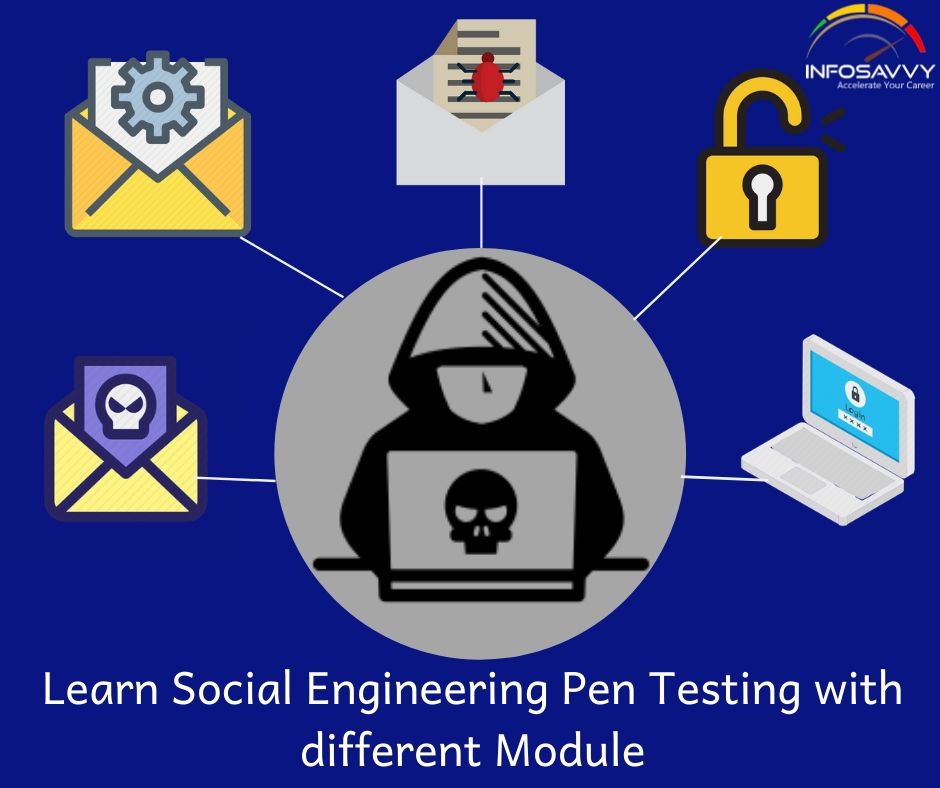
Learn Social Engineering Pen Testing with different Module

Learn Social Engineering Pen Testing with different Module-infosavvy

This article is explaining Whole concept of Social Engineering Pen Testing, There skills and Behaviors at risk of Attacks etc.

 What is Social Engineering Pen Testing?

Considering that you just are now familiar with all the mandatory concepts of social engineering, techniques to perform social engineering, and countermeasures to implement various threats, we are going to proceed to penetration testing. Social engineering pen testing is that the process of testing the target’s security against social engineering by simulating the actions of an attacker.This section describes social-engineering pen testing and also the steps to conduct the test.

The main objective of social-engineering pen testing is to check the strength of human factors during a security chain within the organization. Social-engineering pen testing helps to lift the extent of security awareness among employees. The tester should demonstrate extreme care and professionalism within the social engineering pen test, because it might involve legal issues like violation of privacy, and will lead to an embarrassing situation for the organization.

Pen Tester Skills:

  •  Good interpersonal skills
  •  Good communication skills
  •  Creative
  •  Talkative and friendly

 Social Engineering Concepts

There is no single security mechanism that can protect from social-engineering techniques employed by attackers. Only educating employees on a way to recognize and answer social-engineering attacks can minimize attackers’ chances of success. Before going ahead with this module, let’s first discuss various social engineering concepts.This section describes social-engineering, frequent targets of social-engineering, behaviors susceptible to attacks, factors making companies susceptible to attacks, why  It’s effective, and phases of a social-engineering attack.

Learn more in practical about network sniffing by becoming an EC-Council Certified Ethical Hacker from Infosavvy, Mumbai

“Social engineering bypasses all technologies, including firewalls.”

What are the Common Targets of Social Engineering?

A social engineer uses the vulnerability of human nature as their best tool, usually, people believe and trust others and derive fulfillment from helping the needy.

Discussed below are the foremost common targets of social engineering in an organization:

Receptionists and Help-Desk Personnel: Social engineers generally target service-desk or help-desk personnel of the target organization by tricking them into divulging tip about the organization. To extract information, like a number or a password, the attacker first wins the trust of the individual with the data. On winning their trust, the attacker manipulates them to induce valuable information. Receptionists and help-desk staff may readily share information if they feel they’re doing so to assist a customer.

Technical Support Executives: Another target of social-engineers are technical support executives, The social-engineers may take the approach of contacting technical support executives to get sensitive information by pretending to be a senior management, customer, vendor, and so on.

System Administrators: A computer user in a company is chargeable for maintaining the systems and thus he/she may have critical information like the sort and version of OS, admin passwords, and so on, that would be helpful for an attacker in planning an attack.

Users and Clients: Attackers could approach users and clients of the target organization, pretending to be a tech support person to extract sensitive information.

Vendors of the Target Organization: Attackers can also target the vendors of the organization to realize critical information that would be helpful in executing other attacks.

Click here for continue Reading:- https://www.info-savvy.com/learn-social-engineering-pen-testing-with-different-module/


This Blog Article is posted by
Infosavvy, 2nd Floor, Sai Niketan, Chandavalkar Road Opp. Gora Gandhi Hotel, Above Jumbo King, beside Speakwell Institute, Borivali West, Mumbai, Maharashtra 400092

Contact us – www.info-savvy.com
https://g.co/kgs/ttqPpZ

Information security

10 Types of Identity Theft You Should Know About

Identity Theft is an article to learn about This & its types, Indication with different types of techniques which is used by attackers etc.

What is identity theft?

Identity theft could be a problem that several consumers face today. Within the us, some state legislators have imposed laws restricting employees from providing their SSNs (Social Security Numbers) during their recruitment. Identity theft frequently figures in news reports. Companies should learn about identity theft, so they do not endanger their own anti-fraud initiatives.

This section discusses identity theft, identity theft statistics, techniques for obtaining personal information for fraud and therefore the various steps involved in stealing an identity.

The fraud and Assumption Deterrence Act of 1998 define identity theft as the illegal use of someone’s identification. Identity theft occurs when someone steals others personally identifiable information for fraudulent purposes. Attackers illegally obtain personally identifying information to commit fraud or other criminal acts. Learn more about identity theft in CEH from Infosavvy.

“The more quickly you detect Identity Theft, The Easier It is to Recover”

Types of personally identifiable information stolen by identity thieves:

Attacker steals people’s identity for fraudulent purposes such as:

  Opening a brand new credit card accounts within the name of the user without paying the bills
 Opening a new phone or wireless account in the user’s name, or running up charges on his/her existing account- Using victims’ information to get utility services like electricity, heating, or cable TV
  Opening bank accounts for writing bogus checks using victims’ information
  Cloning an ATM or open-end credit to form electronic withdrawals from victims’ accounts
Obtaining loans those victims are liable
  Obtaining driving licenses, passport, or other official ID cards that contain victims’ data but attackers’ photos
Using victims’ names and social security numbers to receive their government benefits
  Impersonating employees of a target organization to physically access its facility
–  Taking over insurance policies- Selling personal information
  Ordering goods online employing a drop-site
  Hijacking email accounts
  Obtaining health services
  Submitting fraudulent tax returns
 Committing other crimes, then providing victims’ names to the authorities during their arrest, rather than their own

What are the types of identity theft?

Identity theft is consistently increasing and the identity thieves are finding new ways or techniques to steal different sort of target’s information. a number of the identity theft types are as follow:

Child identity theft:- This type of identity theft occurs when the identity of a minor is stolen because it goes undetected for an extended time. After birth, parents apply for a SSN or Social Security Number of their child which along with a special date of birth is used by identity thieves to use for credit accounts, loans or utility services, or to rent an area to measure and apply for state benefits.

Criminal identity theft:- This is one in all the most common and damaging kind of fraud where a criminal uses identity of somebody else’s and escapes criminal charges. When he’s caught or arrested, he provides the fake identity. The simplest way of protection against criminal fraud is to stay your personal information secure that has following safe Internet practices and being cautious of “shoulder surfers”.

Financial identity theft:- This type of fraud occurs when a victim’s checking account and MasterCard information are stolen and used illegally by a thief. He can reach MasterCard and withdraw money from the account or he can use the stolen identity to open a replacement account, get new credit cards and take loans. The knowledge that’s required to hack into the victim’s account and steal his information is obtained by the thieves through viruses, phishing attacks or data breaches.

Driver’s License fraud:- This type of fraud is that the easiest because it requires touch sophistication. an individual can lose his/her driver’s license or it are often easily stolen. Once it falls into the incorrect hands, the perpetrator can sell the driver’s license or misuse the fake driver license by committing traffic violations, of which victim is unaware of and fails to pay fine, and find you in having his license suspended or revoked.

Insurance identity theft:- This type of identity theft is closely associated with medical fraud; it takes place when a perpetrator unlawfully takes the victim’s medical information so as to access his insurance for a medical treatment. Its effects include difficulties in settling medical bills, higher insurance premiums and doubtless trouble in acquiring medical coverage afterward.

Medical identity theft:- This is the foremost dangerous sort of identity theft where the perpetrator uses victim’s name or information without the victim’s consent or knowledge so as to get medical products and claim insurance or healthcare services. Medical fraud leads to frequent erroneous entries within the victim’s medical records, which could lead on to false diagnosis and life-threatening decisions by the doctors.

Tax identity theft:- This type of identity theft occurs when perpetrator steals the victim’s Social Security Number or SSN so as to file fraudulent tax returns and acquire fraudulent tax refunds. It creates difficulties for the victim in accessing the legitimate tax refunds and leads to a loss of funds. Phishing emails are one among the most ricks employed by the criminal to steals a target’s information, Therefore, protection from such fraud includes adoption of safe Internet practices.

Identity Cloning and Concealment:- This is a kind of identity theft which encompasses all sorts of identity theft where the perpetrators plan to impersonate somebody else so as to easily hide their identity. These perpetrators might be illegal immigrants or those hiding from creditors or just want to become “anonymous” thanks to another reasons.

Synthetic identity theft:- This is one among the foremost sophisticated sorts of identity theft where the perpetrator obtains information from different victims to make a replacement identity. Firstly, he steals a Social Security Number or SSN and uses it with a mixture of faux names, date of birth, address and other details required for creating new identity. The perpetrator uses this new identity to open new accounts, loans, credit cards, phones, other goods and services. Learn more about types of identity theft in CEH from infosavvy.

Social identity theft:- This is another most typical sort of identity theft where the perpetrator steals victim’s Social Security Number or SSN so as to derive various benefits like selling it to some undocumented person, use it to defraud the govt by getting a replacement checking account, loans, credit cards or for passport.

“If we don’t act now to safeguard our privacy, we could all become victims of identity Theft”
                                                                                                        – Bill Nelson

What are different techniques attackers use to get personal information for identity theft?

Discussed below are some methods by which attackers steal targets’ identities, which successively allow them to commit fraud and other criminal activities.
Theft of wallets, computers, laptops, cell phones, backup media, and other sources of private information Physical theft is common. Attackers steal hardware from places like hotels and recreational places, like clubs, restaurants, parks, and beaches. Given adequate time, they will recover valuable data from these sources.

Internet Searches:- Attackers can gather a substantial amount of sensitive information via legitimate websites, using search engines like Google, Bing, and Yahoo!

Social Engineering:- Social engineering is that the art of manipulating people into performing certain actions or divulging personal information, and accomplishing the task without using cracking methods.

Dumpster Diving and Shoulder Surfing:- Attackers rummage through household garbage and trash bins of a corporation, ATM centers, hotels, and other places to get personal and financial information for fraudulent purposes.

Criminals may find user information by glancing at documents, personal identification numbers (PINS) typed into an cash machine (ATM), or by overhearing conversations.

Phishing:- The “fraudster” may pretend to be from a financial organization or other reputable organization and send spar or pop-up messages to trick users into revealing their personal information.

Skimming:- Skimming refers to stealing credit/debit card numbers by using special storage devices called skimmers or wedges when processing the cardboard.

Pretexting:- Fraudsters may pose as executives from financial institutions, telephone companies, and so on, who believe “smooth talking” and win the trust of a private to reveal sensitive information.

Pharming:- Pharming also referred to as domain spoofing, is a complicated sort of phishing during which the attacker redirects the connection between the IP address and its target server. The attacker may use cache poisoning (modifying the web address thereto of a rogue address) to do so. When the users type within the Internet address, it redirects them to a rogue website that resembles the first website.

Hacking:- Attackers may compromise user systems and route information using listening devices like sniffers and scanners. They gain access to an abundance of knowledge, decrypt it (if necessary), and use it for identity theft.

Key loggers and Password Stealers (Malwares):- An attacker may infect the user’s computer with Trojans, viruses, and so on, and then collect the keyword strokes to steal passwords, user names, and other sensitive information of private, financial, or business importance.

Attackers can also use err ails to send fake forms like tax income Service (IRS) forms to collect information from the victims.

War driving:- Attackers look for unsecure Wi-Fi wireless networks in moving vehicles containing laptops, smartphones, or PDAs. Once they find unsecure networks, they access sensitive information stored in users’ devices on those networks.

Mail Theft and Rerouting:- Often, mailboxes contain bank documents (credit cards or account statements), administrative forms, and more. Criminals use this information to get MasterCard information, or to reroute the mail to a replacement address. 

What are Indications of identity theft?

People don’t realize that they’re the victim of identity theft until they experience some unknown and unauthorized issues occurring thanks to their stolen identity. Therefore, it’s of paramount importance that folks should be careful for the warning signs for his or her identities that are compromised. Listed below are a number of signs showing you’re a victimof an identity theft?

click here for continue blog:- https://www.info-savvy.com/10-types-of-identity-theft-you-should-know-about/

This Blog Article is posted byInfosavvy, 2nd Floor, Sai Niketan, Chandavalkar Road Opp. Gora Gandhi Hotel, Above Jumbo King, beside Speakwell Institute, Borivali West, Mumbai, Maharashtra 400092

Contact us – www.info-savvy.comhttps://goo.gl/maps/vYF7s2sje1vUdi3S6

https://goo.gl/maps/vYF7s2sje1vUdi3S6

Information security

Introduction of USB Spyware and It’s types

In this Spyware artical you will learn about USB, Spyware Engendering, Types of USB,Types of Spyware like Desktop, Email,Child-Observing, Internet etc.

What is USB Spyware ?
USB spyware screens and breaks down information moved between any USB gadget associated with a PC and its applications. It helps in application improvement, USB gadget driver or equipment advancement and offers an incredible stage for successful coding, testing, and streamlining.

Coming up next is the rundown of USB spyware:
• USB Analyzer
• USB Screen
• USB Review
• Advanced USB Port Screen
• USB Screen Professional
• Free USB Analyzer
• USBlyzer
• Usb Sniffer for Windows
• USB Trace
• Key Carbon LAB
• USB 2GB Key logger Wife

USB spyware may be a program intended for keeping an eye on the PC that duplicates spyware records from a USB gadget onto the hard circle with no solicitation and warning. It runs in concealed mode, so clients won’t know about the spyware or the observation.
USB spyware gives a multifaceted arrangement within the area of USB interchanges, because it is fit checking USB devices’ movement without making extra channels, gadgets, etc which will harm the framework driver structure.
USB spyware allows you to catch, show, record, and examine the information moved between any USB gadget associated and a PC and its applications. This empowers it to require a shot at gadget drivers or equipment improvement, therefore giving an incredible stage to viable coding, testing, and advancement, and makes it an extraordinary instrument for investigating programming.
Learn in Details about Investigation techniques in CEH Mumbai,

“The purpose of technology is not to confuse the brain but to serve the body”

It catches all of the correspondences between a USB gadget and its host and spares it into a shrouded document for later audit. A nitty gritty log displays an outline of each datum exchange, alongside its help data. The USB spyware utilizes low framework assets of the host PC. This works with its own timestamp to log all of the exercises within the correspondence succession. USB spyware doesn’t contain any adware or other spyware.

It works with latest variations of Windows.
• USB spyware duplicates records from USB gadgets to your hard plate in concealed mode with no solicitation
• It makes a shrouded document/index with this date and starts the foundation replicating process
• It enables you to catch, show, record, and break down information moved between any USB gadget related to a PC and applications

What are types of USB Spyware?

Audio Spyware
Sound spyware may be a sound reconnaissance program intended to record sound onto the PC. The aggressor can introduce the spyware on the PC without the authorization of the PC client during a quiet way without sending any notice to the client. The sound spyware runs out of sight to record circumspectly. Utilizing sound spyware doesn’t require any regulatory benefits.
Sound spyware screens and records an assortment of sounds on the PC, sparing them during a concealed document on the neighborhood circle for later recovery. Subsequently, assailants or malignant clients utilize this sound spyware to snoop and screen gathering accounts, telephone calls, and radio stations which will contain the private data.
It is fit recording and spying voice visit messages of different well known moment couriers. With this sound spyware, individuals can look out for their workers or kids and see with whom they’re discussing.
It screens advanced sound gadgets, for instance , different delivery people, amplifiers, and mobile phones. It can record sound discussions by spying and screen all ingoing and active calls, instant messages, etc. they allow ive call checking, sound observation, track SMS, logging all calls, and GPR5 following.

Video Spyware Video spyware is programming for video reconnaissance introduced on the target PC without the user’s information. All video movement are often recorded by a modified timetable. The video spyware runs straightforwardly out of sight, and furtively screens and records webcams and video IM transformations. The remote access highlight of video spyware enables the aggressor to accompany the remote or target framework to actuate alarms and electric gadgets, and see recorded pictures during a video document or maybe get live pictures from all of the cameras related to this framework utilizing an online browser, for instance , Web Adventurer.

Print Spyware
Aggressors can screen the printer use of the target association remotely by utilizing print spyware. Print spyware is printer use checking programming that screens printers within the association. Print spyware gives exact data about print exercises for printers within the workplace or nearby printers, which helps in advancing printing, sparing expenses, etc. It records all data identified with the printer exercises, spares the info in encoded log, and sends the log document to a predetermined email address over the web. The log report comprises of the definite print work properties, for instance , number of pages printed, number of duplicates, content printed, the date and time at which the print move made spot.
Print spyware records the log reports in various arrangements for various purposes, for instance , a web position for sending the reports to an email through the web or the web and in covered up scrambled organization to store on the neighborhood plate. The log reports produced MI help assailants in examining printer exercises. The log report shows what number of records every representative or workstation printed, alongside the time frame. These aides in checking printer utilization and to make a decision how representatives are utilizing the printer. This software also allows limiting access to the printer. This log report helps attackers to trace out information about sensitive and secret documents printed.

Telephone/Mobile phone Spyware
Phone/mobile phone spyware may be a product instrument that provides you full access to screen a victim’s telephone or cell. it’ll totally conceal itself from the client of the telephone. it’ll record and log all action on the telephone, for instance , Web use, instant messages, and telephone calls. At that time you’ll get to the logged data by means of the software’s principle site, or you can likewise get this following data through SMS or email. Typically, this spyware screens and track telephone utilization of workers. In any case, assailants are utilizing this spyware to follow data from their objective person’s or organization’s phones/PDAs. Utilizing this spyware doesn’t require any approved benefits.

“Know who you are buying from. These are interesting times with loats of risks.”

Most normal phone cell phone spyware highlights include:Call History: Enables you to see the whole call history of the telephone (both approaching and active calls).
View Instant messages: Empowers you to see all approaching and active instant messages. It even shows erased messages in the log report.
Web Webpage History: Records the whole history of all sites visited through the telephone in the log report document.
GPS Following: Gives you where the telephone is progressively. There is additionally a log of the cell phone’s area so you can see where the telephone has been.

Click here for continue blog– https://www.info-savvy.com/introduction-of-usb-spyware-and-its-types/

This Blog Article is posted by,
Infosavvy, 2nd Floor, Sai Niketan, Chandavalkar Road Opp. Gora Gandhi Hotel, Above Jumbo King, beside Speakwell Institute, Borivali West, Mumbai, Maharashtra 400092


Contact us – www.info-savvy.com

Information security

Everything You Need To Know About Sniffing – Part 1

What is a sniffer in hacking?This section describes network sniffing and threats, how a sniffer works, active and passive sniffing, how an attacker hacks a network using sniffers, protocols susceptible to sniffing, sniffing within the data link layer of the OSI model, hardware protocol analyzers, SPAN ports, wiretapping, and lawful interception.

Network SniffingPacket sniffing may be a process of monitoring and capturing all data packets passing through a given network sniffer by using a software application or a hardware device, Sniffing is simple in hub-based networks, because the traffic on a segment passes through all the hosts related to that segment. However, most networks today work on switches. A switch is a complicated computer networking device.

the main difference between a hub and a switch is that a hub transmits line data to every port on the machine and has no line mapping, whereas a switch looks at the Media Access Control (MAC) address related to each frame passing through it and sends the data to the specified port.

A MAC address may be a hardware address that uniquely identifies each node of a network,An attacker must manipulate the functionality of the switch so as to see all the traffic passing through it. 

packet sniffing program (also known as a Ip sniffer) can capture data packets only from within a given subnet, which suggests that it cannot sniff packets from another network. Often, any laptop can plug into a network and gain access to it. Many enterprises’ switch ports are open.

A packet sniffer placed on a network in promiscuous mode can capture and analyze all of the network traffic. Sniffing programs close up the filter employed by Ethernet network interface cards (NICs) to stop the host machine from seeing other stations’ traffic. Thus, sniffing programs can see everyone’s traffic.Though most networks today employ switch technology, packet sniffing remains useful.

This is often because installing remote sniffing programs on network components with heavy traffic flows like servers and routers is comparatively easy. It allows an attacker to watch and access the whole network traffic from one point. Packet sniffers can capture data packets containing sensitive information like passwords, account information, syslog traffic, router configuration, DNS traffic, Email traffic, web traffic, chat sessions, FTP password, etc. It allows an attacker to read passwords in clear-text, the particular emails, credit card numbers, financial transactions, etc.

It also allows an attacker to smell SMTP, POP, IMAP traffic, POP, IMAP, HTTP Basic, Telnet authentication, SQL database, SMB, NFS, and FTP traffic. An attacker can gain a lot of data by reading captured data packets then use that information to interrupt into the network.An attacker carries out attacks that are simpler by combining these techniques with the active transmission. You can learn more in practical about network sniffing by becoming an EC-Council Certified Ethical Hacker from Infosavvy, Mumbai.

Read more for continue blog:- https://www.info-savvy.com/everything-you-need-to-know-about-sniffing-part-1/

This Blog Article is posted byInfosavvy2nd Floor, Sai Niketan, Chandavalkar Road Opp. Gora Gandhi Hotel, Above Jumbo King, beside Speakwell Institute, Borivali West, Mumbai, Maharashtra 400092

visit:- https://www.info-savvy.com/

Uncategorized

Planning a Threat Intelligence Program

Implementation of a threat intelligence program is a dynamic process that gives organizations with valuable insights based on the investigation of discourse threats and risks that area unit used to enhance the safety posture. Before implementing the threat intelligence program, organizations have to be compelled to prepare associate acceptable set up. Firstly, the organization has to decide the aim of extracting threat intelligence and who are going to be concerned in planning the threat intelligence program.

This section provides a summary of various topics associated with coming up with and development of a threat intelligence program. It discusses concerning getting ready folks, processes, and technology; developing a set plan; planning the threat intelligence program; coming up with the budget; developing a communication attempt to update achieve stakeholders; and concerns for aggregating threat intelligence and factors for choosing threat intelligence platform. It conjointly discusses concerning totally different goals for intense threat intelligence and track metrics to stay stakeholder’ ship to.
Prepare folks, Processes, and Technology
Threat intelligence is useful for a company to develop a security infrastructure, however this data alone cannot give enough edges if it’s while not the support of a right team of individuals, integrated processes, and technology. Preparation is crucial for a corporation to confirm that it’s able to consume, analyze, and take actions upon threat intelligence.
• People
An organization could appoint an indoor threat intelligence team or incorporate sure duties into existing roles.
The cyber threat intelligence team should fulfill the subsequent responsibilities:
• Cyber forensics
• Malware reverse-engineering
• Managing threat intelligence operations
Threat assessment
• Collection, analysis, and dissemination of threat data
• Collaborating with all data security groups among a corporation
• Processes
Information security processes will derive advantages from threat intelligence. The organization must establish an explicit set of processes that needs input from threat intelligence and more perceive however the intelligence should be given for that purpose. With the threat info, the organization will enhance the safety posture of the network by developing effective security policies and methods.
For example, an data assurance team will develop a defense-in-depth strategy be victimization the intelligence on famous attacks, threat actors, and ways wont to launch an attack. Similarly, an event notice ion and response team will use indicators derived from threat intelligence to detect and defend the organization network against varied attacks.
In-depth analysis is needed for understanding the requirements the wants and requirements of the audience for threat intelligence. Most of the organizations use managed Security Service supplier 1%+155P) that helps in providing recommendations on integration threat intelligence into their surroundings.
• Technology
Proper utilization of threat intelligence needs effective use of producers and shoppers of threat intelligence.
Discussed below area unit the producers and shoppers of threat intelligence:
• Raw information Producers
Raw data producer’s area unit security systems or devices like proxy servers or firewalls. These devices monitor the work on activities and manufacture log files or capture packets.
In. Threat information shoppers
Threat information shopper’s area unit mental health systems or devices that take input from threat information so as to notice and forestall the network against malicious activities. The shoppers of threat information embrace proxy servers, firewalls, and intrusion interference systems. Relying upon the threat information, firewalls will embrace sure rules to notice and block incoming malicious traffic from unknown scientific discipline addresses. Similarly, proxy servers and intrusion interference systems use varied rules to observe the network against suspicious traffic and block it if necessary.
Threat Intelligence shoppers
Threat intelligence client may be a remote management platform to manage threat intelligence: for instance, SI EM solutions.
Threat Intelligence Producers
Threat intelligence producer may be a threat intelligence cooperative platform or threat intelligence feed.
Threat intelligence are often wont to improve the safety infrastructure of the structure network and improve the aptitude of security devices to defend against attacks. It are often achieved IN translating the threat intelligence to threat information and so feeding it into the safety devices. The threat information includes all malicious activities to appear for within the network. To effectively defend the organization’s assets against attacks, security devices should be deployed strategically throughout the network. Though the safety devices deployed at the perimeter of the network will stop some attacks,
The organization ought to assure that the attackers will still defeat them to achieve access to the network. The presence of multiple layers of defenses throughout the network will effectively cut back AN attacker’s ability to stay undiscovered for an extended amount of your time.
With the advancement in threat intelligence method, the rise within the size of the threat information and intelligence will create manual handling of knowledge a troublesome method. Therefore, organizations should ask for to modify the method of overwhelming and distributing threat intelligence to the safety devices.
Given below area unit some area unit as that are relevant to automation:
• Using normal formats
• Using a threat intelligence platform .0 Subscribing to a threat intelligence feed

Uncategorized

Understanding Indicators of Compromise

The Indicators of Compromise play a serious role in building and enhancing the cyber security posture of a company. Monitoring IOCs helps analysts find and answer varied security incidents quickly. Identification of continual concerns of explicit loCs helps the safety groups in enhancing the protection mechanisms and policies to shield and stop varied evolving attacks. This section provides an outline of IOCs and also the in importance, types of IOCs Key IOCs and also the pyramid of pain.

Indicators of Compromise

Cyber threats are endlessly evolving with the newer TTPs custom-made supported the vulnerabilities of the target organization. the safety analysts got to perform continuous observation of loCs to effectively and expeditiously find and answer the evolving cyber threats. Indicators of Compromise area unit the clues/artifact/ items of forensic knowledge that ar found on a network or OS of a company that indicates a possible intrusion or malicious activity in organization’s infrastructure .

However, loCsar itself not intelligence in reality, IoCs act as a odd supply of information of knowledgeof knowledge regarding threats that function data points within the intelligence method. unjust threat intelligence extracted from loCs helps organizations enhance incident-handling methods. Cyber security professionals use varied machine-driven tools to watch loCs to find and stop varied security breaches to the organization. ObservationloCs additionally helps the protection groups enhance

the security controls and policies of the organization to find and block the suspicious traffic to thwart any attacks. to beat the threats related to loCs, some organizations like STIX and TAXl l have developed standardized reports that contain condensed knowledge associated with the attack and shared it with others to leverage the incident response.

AnloC is outlined as associate atomic indicator, computed indicator, or activity indicator. it’s the data concerning suspicious or malicious activities that is collected from varied security institutions during a network infrastructure. Atomic indicators ar those who can not be metameric into smaller components, associated their which means isn’t modified within the context of an intrusion. samples of atomic indicators ar informatics address, email address, etc. Computed indicators ar that obtained from the info extracted from a security incident. Samples of computed indicators ar hash values and regular expressions. Activity indicators check with a grouping of each atomic and computed indicators combined supported some logic.

Why Indicators of Compromise Important?

Indicators of Compromise act as a chunk of forensic information that helps organizations discover malicious activity at an initial section. These activities that are sometimes labelled as red flags indicate associate anack that has the potential of compromising system or will cause a knowledge breach.

loCs will be as easy as information or as difficult as malicious code. Therefore, it’s troublesome to notice them. Threat analysts sometimes correlate varied loCs and mixture them to investigate a possible threat or an event. Using loCs, organizations will find, identify, and answer anacks or threats before they harm the network. Therefore, observance loCs is important to the organization from security compromises.

Following are the explanations why analysing loCs is crucial for the organization:

. Helps security analysts in detection information breaches, malware immersion makes an attempt, or different threat activities

. Assists security analysts in knowing “what happened” regarding the attack and helps the analysts observe the behaviour and characteristics of malware

. Helps improve latency still as upgrade the detection rate of the threats

. Provides security analysts with information feeds that may be fed into the organization’s auto­ response mechanism or machine-controlled security devices. It helps them perform scans automatically to find if those attacks exist in the setting or not. onceloCs follow some pattern or show revenant behaviour, analysts will update tools and security policies supported that specific behaviour of malware .

Helps analysts to find answers to the subsequent questions:

Does the file include malicious content?

Does the organization network compromised?

however did the network get infected?

what’s the history of a selected information processing address?

. Assists analysts in following a uniform approach for documentation of every specific threat which will be simply shared with team members

. Provides a better method for the detection of zero-day attacks that detection rules have to be compelled to be developed for the prevailing security tools

. Provides a decent supply of information and a decent place to begin for concluding investigation method.

Uncategorized

Definition of Cyber Threat Intelligence

According to Oxford dictionary, a threat is defined as the possibility of a malicious attempt to damage or disrupt a computer network or system.” Threat is a potential occurrence of an undesired event t hat can eventually damage and interrupt the operational and functional activities of an organization. A threat can affect t he integrity and availability factors of an organization. The impact of threats is very high, and it can affect t he existence of the physical IT assets in an organization. The existence of threats may be accidental, intentional, or due to the impact of some other action.

T he threat intelligence, usually known as CTI, is defined as t he collection and analysis of information about threats and adversaries and drawing patterns t hat provide an ability to make knowledgeable decisions for the preparedness, prevent ion, and response actions against various cyber attacks. It is t he process of recognizing or discovering any “unknown threats” t hat an organization can face so t hat necessary defense mechanisms can be applied to avoid such occurrences. It involves collecting, researching, and analyzing trends and technical developments in t he field of cyber threats (i.e., cybercrime, hacktivism, espionage, etc.). Any knowledge about threats t hat result in the planning and decision- ma king in an organization to handle it is a threat Intelligence. T he main aim of t he CTI is to make the organization aware of t he existing or emerging threats and prepare them to develop a proactive cyber security posture in advance before these threats could exploit them. This process, where the unknown threats are converted into the possibly known ones, helps anticipating the attack before it could happen and ultimately results in better and secured system in the organization. Thus, threat Intelligence is useful in achieving secured data sharing and transactions among organizations globally.

Threat intelligence process can be used to identify t he risk factors t hat are responsible for malware attacks, SQL injections, we b application attacks, data leaks, phishing, denial-of-service attack, etc. Such risks, after being filtered out, can be put on a checklist and handled appropriately. Threat intelligence is beneficial for an organization 17to handle cyber threats with effective planning and execution along with thorough analysis of t he threat; it also strengthens the organization’s defense system, creates awareness about the impending risks, and aids in responding against such risks.

In cyber threat intelligence, analysis often hinges on the triad of actors, intent, and capability, with consideration given to their tactics, techniques, and procedures (TTPs), motivations, and access to the intended targets. By studying this triad it is often possible to make informed, forward-leaning strategic, operational, and tactical assessments.

Strategic intelligence assesses disparate bits of information to form integrated views. It informs decision and policy makers on broad or long-term issues and/or provides a timely warning of threats. Strategic cyber threat intelligence forms an overall picture of the intent and capabilities of malicious cyber threats, including the actors, tools, and TTPs, through the identification of trends, patterns, and emerging threats and risks, in order to inform decision and policy makers or to provide timely warnings.

Operational intelligence assesses specific, potential incidents related to events, investigations, and/or activities, and provides insights that can guide and support response operations. Operational or technical cyber threat intelligence provides highly specialized, technically-focused, intelligence to guide and support the response to specific incidents; such intelligence is often related to campaigns, malware, and/or tools, and may come in the form of forensic reports.

Tactical intelligence assesses real-time events, investigations, and/or activities, and provides day-to-day operational support. Tactical cyber threat intelligence provides support for day-to-day operations and events, such as the development of signatures and indicators of compromise (IOC). It often involves limited application of traditional intelligence analysis techniques.

Cyber threat intelligence has proved beneficial to every level of state, local, tribal, and territorial (SLTT) government entities from senior executives, such as Chief Information Security Officers (CISOs), police chiefs, and policy makers, to those in the field, such as information technology specialists and law enforcement officers. In addition, it provides value for other experts as well, such as security officers, accountants, and terrorism and criminal analysts. Properly applied cyber threat intelligence can provide greater insight into cyber threats, allowing for a faster, more targeted response as well as resource development and allocation. For instance, it can assist decision makers in determining acceptable business risks, developing controls and budgets, in making equipment and staffing decisions (strategic intelligence), provide insights that guide and support incident response and post-incident activities (operational/technical intelligence), and advance the use of indicators by validating, prioritizing, specifying the length of time an indicator is valid (tactical intelligence). Over the next several years the inclusion of cyber threat intelligence into SLTT government operations will become increasingly important, as all levels and employees are forced to respond to the cyber threat.

In cyber threat intelligence, analysis often hinges on the triad of actors, intent, and capability, considerately given to their ways, techniques, and procedures (TTPs), motivations, and access to the supposed targets. By finding out this triad it’s usually possible to create informed, forward-leaning strategic, operational, and plan of action assessments.

• Strategic intelligence assesses disparate bits of data to make integrated views. It informs decision and policy manufacturers on broad or long-run problems and/or provides a timely warning of threats. Strategic cyber threat intelligence forms an overall image of the intent and capabilities of malicious cyber threats, as well as the actors, tools, and TTPs, through the identification of trends, patterns, and rising threats and risks, in order to inform decision and policy manufacturers or to produce timely warnings.

• Operational intelligence assesses specific, potential incidents related to events, investigations, and/or activities, and provides insights which will guide and support response operations. Operational or technical cyber threat intelligence provides extremely specialised, technically-focused, intelligence to guide and support the response to specific incidents; such intelligence is usually related to campaigns, malware, and/or tools, and will come in the form of forensic reports.

• Tactical intelligence assesses real-time events, investigations, and/or activities, and provides day-to-day operational support. tactical cyber threat intelligence provides support for daily operations and events, like the development of signatures and indicators of compromise (IOC). It usually involves limited application of ancient intelligence analysis techniques.

Cyber threat intelligence has established beneficial to each level of state, local, tribal, and territorial (SLTT) government entities from senior executives, like Chief data Security Officers (CISOs), police chiefs, and policy manufacturers, to those within the field, like data technology specialists and law enforcement officers. additionally, it provides price for alternative consultants yet, like security officers, accountants, and terrorist act and criminal analysts. Properly applied cyber threat intelligence will offer larger insight into cyber threats, granting a quicker, additional targeted response yet as resource development and allocation. as an example, it will assist decision manufacturers in determining acceptable business risks, developing controls and budgets, in creating equipment and staffing choices (strategic intelligence), offer insights that guide and support incident response and post-incident activities (operational/technical intelligence), and advance the use of indicators by verifying, prioritizing, specifying the length of your time an indicator is valid (tactical intelligence). Over future many years the inclusion of cyber threat intelligence into SLTT government operations can become increasingly important, as all levels and employees are forced to respond to the cyber threat