For a hacker, chaos isn’t a pit, Chaos is ladder this idea is explained during this article with the assistance of some hacker and their terms.
“To better describe hacking, one needs to first understand hackers.”
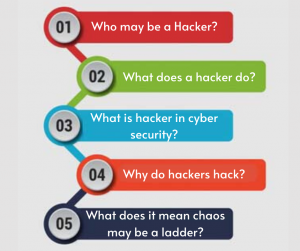
Who may be a Hacker?
A hacker is a private who uses computer, networking or other skills to beat a technical problem. The term hacker may ask anyone with technical skills, but it often refers to an individual who uses his or her abilities to realize unauthorized access to systems or networks so as to commit crimes. A hacker may, for instance , steal information to harm people via fraud , damage or bring down systems and, often, hold those systems hostage to gather ransom.
What does a hacker do?
Computer hackers are unauthorized users who forced an entry computer systems so as to steal, change or destroy information, often by installing dangerous malware without your knowledge or consent. Their clever tactics and detailed technical knowledge help them access the knowledge you actually don’t need them to possess.
“Most hackers are young because children tend to be adaptable. As long as you remain adaptable, you’ll always be an honest hacker.” ? Emmanuel Goldstein
What is hacker in cyber security?
A hacker is a private who uses computer, networking or other skills to beat a technical problem. The term hacker may ask anyone with technical skills, but it often refers to an individual who uses his or her abilities to realize unauthorized access to systems or networks so as to commit crimes
Motives. Four primary motives are proposed as possibilities for why hackers plan to forced an entry computers and networks. First, there’s a criminal gain to be had when hacking systems with the precise purpose of stealing mastercard numbers or manipulating banking systems.
What does it mean chaos may be a ladder?
The climb may be a metaphor for achieving power, and therefore the ladder (chaos) is how Littlefinger climbs. When things are in disarray it allows him to control in order that he’s ahead. Chaos means the good houses overlook his birth, because they have him.
Hackingis an attempt to exploit a computer system or a private network inside a computer. Simply put, it is the unauthorised access to or control over computer network security systems for some illicit purpose.
Infosavvy CEH certification training course provides you the hands-on training required to master the techniques hackers use to penetrate network systems and fortify your system against it. This ethical hacking course is aligned with the latest CEHv10 training and certification with Infosavvy in Mumbai Location and accreditation by EC-COUNCIL will adequately prepare you to increase skills.
“Chaos isn’t a pit. Chaos may be a ladder.” -Petyr Baelish
Chaos isn’t a pit. Chaos may be a ladder. many that attempt to climb it fail, and never get to undertake again. the autumn breaks them. and a few are given an opportunity to climb, but refuse. They hold close the realm, or love, or the gods…illusions. Only the ladder is real. The climb is all there’s . But they’ll never know this. Not until it’s too late.
What hackers do is find out technology and experiment with it in ways many of us never imagined. They even have a robust desire to share this information with others and to elucidate it to people whose only qualification could also be the will to find out .
Here are some terms and their definition, you must know before you start studying ethical hacking. As cyber security technology grows and expands, so does the vocabulary associated with it.
Hack Value:
It is the notion among hackersthat one thing is price doing or is interesting. Hack value will be a playful disruption. It’s additionally maintenance for the imagination, surprise the far side tedium of living in a client, dominated culture.It crossovers between different fields and practices, regard their achievements and approaches inhackinginstead of specific genres. Like alternative chapters a number of the artworks and comes exist their own right, inside and outside of gallery context.Alternative examples either play with or disrupt things through cultural enactments of communication with others. These embody publications, farming, food distribution and public heritage sites. All the comes and works studied are social. Some are political and a few are participatory.This includes works that use digital networks and physical environments also as written matter. What binds these examples along isn’t solely the adventures. They initiate once experimenting with alternative ways that of seeing, being and thinking.They additionally share common intentions to loosen the restrictions, distractions and interactions dominating. The cultural interfaces, facades and structures in our everyday surroundings. Hack value is the notion among hackers to evaluate something that is worth doing or is interesting. Hackersderive great satisfaction from breaking down the toughest network of cyber security . They consider it their accomplishment as no one can do.
Vulnerability is the existence of weakness, design when exploited, leads to an unexpected and undesirable event compromising . Simply that allows an attacker to enter the system by bypassing various user authentications. Vulnerability comes from the Latin word for “wound,” values. Vulnerability is that the state of being open to injury, or showing as if you’re. It would be emotional, like admitting that you are loving with somebody who would possibly solely such as you as a friend, or it will be literal, just like the vulnerability of a soccer goal that is unprotected by any defensive players. Vulnerability is that the existence of a weakness (design or implementation error) which will result in a surprising event compromising the protection of the system.
Exploit:
An exploit is breach of IT system security through vulnerabilities, in the context of an attack on system or network. Exploitation is that the next step in an attacker’s playbook when finding a vulnerability. Exploits are the means that through that a vulnerability may be leveraged for malicious activity by hackers; these include pieces of software system, sequences of commands, or maybe open supply exploit kits.An exploit could be a code that takes advantage of a software vulnerability or security flaw.It’s written either by cyber security researchers as a proof-of-concept threat or by malicious actors to be used in their operations. When used, exploits enable an intruder to remotely access a network and gain elevated privileges, or move deeper into the network.It also refers to malicious software or commands that can cause unanticipated behavior of legitimate software or hardware through attackers taking advantage of the vulnerabilities. Exploit could be a breach of an IT system of cyber security through vulnerabilities.
Payload:
Payload is the part of a malware or an exploit code that performs the intended malicious actions, which can include creating backdoor access to a victim’s machine, damaging or deleting files, committing data theft and hijacking computer. Hackers use various methods to execute the payload. Payload is that the part of an exploit code that performs a supposed malicious action. For example, they can activate a logic bomb, execute an infected program, or use an unprotected computer connected to a network.In computing, a payload is that the carrying capability of a packet or different transmission information unit. The term has its roots within the military and is usually related to the capability of practicable malicious code to try and do injury. Technically, the payload of a particular packet or different protocol information unit (PDU) is that the actual transmitted information sent by act endpoints; network protocols additionally specify the most length allowed for packet payloads.
in a Zero-Day attack, the attacker exploits vulnerabilities in a computer application before the software developer can release a patch for them.A Zero-Day attack is an attack that exploits the PC vulnerability before software engineer releases a patch.Based on common usage of exploit terms, an exploit is said as a zero-day exploit once it’s wont to attack a vulnerability that has been identified however not yet patched, additionally called a zero-day vulnerability.
Daisy Chaining:
It involves gaining access to one network and/or computer and then using the same information to gain access to multiple networks and computers that information. Daisy chaining involves gaining access to a network and /or laptop and so exploitation constant data to realize access to multiple networks and computers that contain desirable data.
Doxing:
Doxing is publication in person identifiable data concerning a private or organization. It refers to gathering and publishing personally identifiable information such as an individual’s name and email address, or other sensitive information pertaining to an entire organization. People with malicious intent collect this information from publicly accessible channels such as the databases, social media and the Internet.
Bot:
A “bot” (a contraction of “robot”) is a software application or program that can be controlled remotely to execute or automate predefined tasks. Hackers use buts as agents that carry out malicious activity over the Internet. Attackers use infected machines to launch distributed denial-of-service (DDoS) attacks, key logging, spying, etc. bot could be a software system application which will be controlled remotely to execute or alter predefined tasks.
This article explains 5 steps of Hacking phases taking an example of a Hacker trying to hack… for example Reconnaissance, Scanning, Gaining Access, Maintaining Access, Fearing Tracks…
There are five Hacking phases:
Reconnaissance
Scanning
Gaining Access
Maintaining Access
Clearing Tracks
Hacking Phase 1: Reconnaissance
Reconnaissance refers to the preparatory phase in which an attacker gathers as much information as possible about the target prior to launching the attack. In this phase, the attacker draws on competitive intelligence to learn more about the target. It could be the future point of return, noted for ease of entry for an attack when more about the target is known on a broad scale. Reconnaissance target range may include the target organization’s clients, employees, operations, network, and systems.This phase allows attackers to plan the attack. This may take some time as the attacker gathers as much information as possible. Part of this reconnaissance may involve social engineering. A social engineer is a person who convinces people to reveal information such as unlisted phone numbers, passwords, and other sensitive information. For instance, the hacker could call the target’s Internet service provider and, using whatever personal information previously obtained, convince the customer service representative that the Hackingphases is actually the target, and in doing so, obtain even more information about the target.Another reconnaissance technique is dumpster diving. Dumpster diving is, simply enough, looking through an organization’s trash for any discarded sensitive information. Attackers can use the Internet to obtain information such as employees’ contact information, business partners, technologies currently in use, and other critical business knowledge. But dumpster diving may provide them with even more sensitive information, such as user names, passwords, credit card statements, bank statements, ATM receipts, Social Security numbers, private telephone numbers, checking account numbers, and any number of other things.Searching for the target company’s web site in the Internet’s Who is database can easily provide hackers with the company’s IP addresses, domain names, and contact information.
Hacking Phase 2: Gaining Access
during this Hacking phases designs the blueprint of the network of the target with the assistance of information collected throughout section one and section two. The hacker has finished enumerating and scanning the network and currently decides that they need a some choices to achieve access to the network.This section is wherever an attacker breaks into the system/network exploitation numerous tools or strategies. once getting into a system, he has got to increase his privilege to administrator level therefore he will install an application he desires or modify information or hide information. In section three the attacker would exploit a vulnerability to achieve access to the target. This usually involves taking management of 1 or a lot of network devices to extract information from the target or use that device to perform attacks on alternative targets.
Hacking Phase 3: Scanning
Scanning is the phase immediately preceding the attack. Here, the attacker uses the details gathered during reconnaissance to scan the network for specific information. Scanning is a logical extension of active reconnaissance, and in fact, some experts do not differentiate scanning from active reconnaissance. There is a slight difference, however, in that scanning involves more in-depth probing on the part of the attacker. Often the reconnaissance and scanning phases overlap, and it is not always possible to separate the two. An attacker can gather critical network information such as the mapping of systems, routers, and firewalls by using simple tools such as the standard Windows utility Trace route. Alternatively, they can use tools such as Cheops to add additional information to trace route’s results.Port scanners detect listening ports to find information about the nature of services running on the target machine. The primary defense technique against port scanners is to shut down services that are not required, as well as to implement appropriate port filtering. However, attackers can still use tools to determine the rules implemented by the port filtering.
Maintaining access refers to the phase when the attacker tries to retain his or her ownership of the system. Once an attacker gains access to the target system with administrator level privileges (thus owning the system), he or she is able to use both the system and its resources at will, and can either use the system as a launch pad to scan and exploit other systems, or to keep a low profile and continue exploiting the system. Both these actions can cause a great amount of damage. For instance, the hacker could implement a sniffer to capture all network traffic, including Telnet and FTP (file transfer protocol) sessions with other systems, and then transmit that data wherever he or she pleases.Attackers who choose to remain undetected remove evidence of their entry and install a backdoor or a Trojan to gain repeat access. They can also install rootkits at the kernel level to gain full administrative access to ten target computer. Rootkits gain access at the operating system level, while a Trojan horse gains access at the application level. Both rootkits and Trojans require users to install them locally. In Windows systems, most Trojans install themselves as a service and run as local system, with administrative access.
Many approaches exist to gain access are different types of attacks on a system. One common requirement for all such approaches is that the attacker finds and exploits a system’s weakness or vulnerability.
Types of attacks on a system
1. Operating System Attacks
Today’s Operating Systems (OS) are loaded with features and are increasingly complex. While users take advantage of these features, they are prone to more vulnerabilities, thus enticing attackers. Operating systems run many services such as graphical user interfaces (GUIs) that support applications and system tools, and enable Internet access. Extensive tweaking is required to lock them down. Attackers constantly look for OS vulnerabilities that allow them to exploit and gain access to a target system or network. To stop attackers from compromising the network, the system or network administrators must keep abreast of various new exploits and methods adopted by attackers, and monitor the networks regularly.By default, most operating systems’ installation programs install a large number of services and open ports. This situation leads attackers to search for vulnerabilities. Applying patches and hot fixes is not easy with today’s complex networks. Most patches and fixes tend to solve an immediate issue. In order to protect the system from operating system attacks in general, it is necessary to remove and/or disable any unneeded ports and services.
Some OS vulnerabilities include: – Buffer overflow vulnerabilities – Bugs in the operating system – An unmatched operating systemAttacks performed at the 05 level include: – Exploiting specific network protocol implementations – Attacking built-in authentication systems – Breaking file-system security – Cracking passwords and encryption mechanisms
2. Misconfiguration Attacks
Security misconfiguration or poorly configured security controls might allow attackers to gain unauthorized access to the system, compromise files, or perform other unintended actions. Misconfiguration vulnerabilities affect web servers, application platforms, databases, networks, or frameworks that may result in illegal access or possible system takeover. Administrators should change the default configuration of the devices before deploying them in the production network. To optimize the configuration of the machine, remove any unneeded services or software. Automated scanners detect missing patches, misconfigurations, use of default accounts, unnecessary services, and so on.
Software developers are often under intense pressure to meet deadlines, which can mean they do not have sufficient time to completely test their products before shipping them, leaving undiscovered security holes. This is particularly troublesome in newer software applications that come with a large number of features and functionalities, making them more and more complex. An increase in the complexity means more opportunities for vulnerabilities. Attackers find and exploit these vulnerabilities in the applications using different tools and techniques to gain unauthorized access and steal or manipulate data.Security is not always a high priority to software developers, and they handle it as an “add-on” component after release. This means that not all instances of the software will have the same level of security. Error checking in these applications can be very poor (or even nonexistent), which leads to:
Buffer overflow attacks
Sensitive information disclosure
Denial-of-service attacks
SQL injection attacks
Cross-site scripting
Phishing
Session hijacking
Parameter/form tampering
Man-in-the-middle attacks
Directory traversal attacks
SQL injection attacks
4. Shrink-Wrap Code Attacks
Software developers often use free libraries and code licensed from other sources in their programs to reduce development time and cost. This means that large portions of many pieces of software will be the same, and if an attacker discovers vulnerabilities in that code, many pieces of software are at risk. Attackers exploit default configuration and settings of the off-the-shelf libraries and code. The problem is that software developers leave the libraries and code unchanged. They need to customize and fine-tune every part of their code in order to make it not only more secure, but different enough so that the same exploit will not work. An attack can be active or passive. An “active attack” attempts to alter system resources or affect their operation. A “passive attack” attempts to learn or make use of information from the system but does not affect system resources (e.g., wiretapping).you can learn all types of attack in CEH v10 location in Mumbai. The infosavvy provides the certified Ethical hacking training and EC Council Certification.
5. Man-in-the-middle (MitM) attack
A MitM attack occurs when a hacker inserts itself between the communications of a client and a server. Here are some common types of man-in-the-middle attacks:Session hijackingIn this type of MitM attack, an attacker hijacks a session between a trusted client and network server. The attacking computer substitutes its IP address for the trusted client while the server continues the session, believing it’s communicating with the client. as an example , the attack might unfold like this:1. A client connects to a server. 2. The attacker’s computer gains control of the client. 3. The attacker’s computer disconnects the client from the server. 4. The attacker’s computer replaces the client’s IP address with its own IP address and spoofs the client’s sequence numbers. 5. The attacker’s computer continues dialog with the server and therefore the server believes it’s still communicating with the client.
IP Spoofing
IP spoofing is used by an attacker to convince a system that it’s communicating with a known, trusted entity and provide the attacker with access to the system. The attacker sends a packet with the IP source address of a known, trusted host rather than its own IP source address to a target host. The target host might accept the packet and act upon it.
Replay
A replay attack occurs when an attacker intercepts and saves old messages then tries to send them later, impersonating one among the participants. this sort can be easily countered with session timestamps or nonce (a random number or a string that changes with time).Currently, there’s no single technology or configuration to stop all MitM attacks. Generally, encryption and digital certificates provide an efficient safeguard against MitM attacks, assuring both the confidentiality and integrity of communications. But a man-in-the-middle attack are often injected into the center of communications in such how that encryption won’t help — for instance , attacker “A” intercepts public key of person “P” and substitute it together with his own public key. Then, anyone wanting to send an encrypted message to P using P’s public key’s unknowingly using A’s public key. Therefore, A can read the message intended for P then send the message to P, encrypted in P’s real public key, and P will never notice that the message was compromised. additionally , A could also modify the message before resending it to P. As you’ll see, P is using encryption and thinks that his information is protected but it’s not, due to the MitM attack.So, how can you confirm that P’s public key belongs to P and to not A? Certificate authorities and hash functions were created to solve this problem. When person 2 (P2) wants to send a message to P, and P wants to be sure that A won’t read or modify the message which the message actually came from P2, the following method must be used:
P2 creates a symmetric key and encrypts it with P’s public key.
P2 sends the encrypted symmetric key to P.
P2 computes a hash function of the message and digitally signs it.
P2 encrypts his message and therefore the message’s signed hash using the symmetric key and sends the whole thing to P.
P is able to receive the symmetric key from P2 because only he has the private key to decrypt the encryption.
P, and only P, can decrypt the symmetrically encrypted message and signed hash because he has the symmetric key.
he’s ready to verify that the message has not been altered because he can compute the hash of received message and compare it with digitally signed one.
P is additionally ready to convince himself that P2 was the sender because only P2 can sign the hash in order that it’s verified with P2 public key.
6. Phishing and spear phishing attacks
Phishing attack is that the practice of sending emails that appear to be from trusted sources with the goal of gaining personal information or influencing users to do something. It combines social engineering and technical trickery. It could involve an attachment to an email that loads malware onto your computer. It could even be a link to an illegitimate website which will trick you into downloading malware or handing over your personal information.Spear phishing may be a very targeted sort of phishing activity. Attackers take the time to conduct research into targets and make messages that are personal and relevant. due to this, spear phishing are often very hard to spot and even harder to defend against. one among the only ways in which a hacker can conduct a spear phishing attack is email spoofing, which is when the information within the “From” section of the e-mail is falsified, making it appear as if it’s coming from someone you recognize , like your management or your partner company. Another technique that scammers use to add credibility to their story is website cloning — they copy legitimate websites to fool you into entering personally identifiable information (PII) or login credentials.
To reduce the danger of being phished, you’ll use these techniques:
Critical thinking — don’t accept that an email is that the real deal just because you’re busy or stressed otherwise you have 150 other unread messages in your inbox. Stop for a moment and analyze the e-mail.
Hovering over the links — Move your mouse over the link, but don’t click it! Just let your mouse cursor h over over the link and see where would actually take you. Apply critical thinking to decipher the URL.
Analyzing email headers — Email headers define how an email need to your address. The “Reply-to” and “Return-Path” parameters should lead to the same domain as is stated within the email.
Sandboxing — you’ll test email content during a sandbox environment, logging activity from opening the attachment or clicking the links inside the e-mail .



 Infosavvy Cyber Security & IT Management Trainings