The fall of security questions or password reset question based on this topic article is written basically security this very important from anywhere and any field also for maintaining security we create the password but some time it happens to forgot password at that time there should be some questions to maintain security zone once asked question would be right then and then only that particular user can create a new password.
I think we’ve reached some extent during which organizations and individuals need their security inquiries to produce more formidable hurdles for would-be hackers. The challenge for organizations is to not make the safety questions so difficult that users are unable to recollect their answers later.
To be useful, a far better security question should:
Be fairly easy to recollect , even years later.
Contain thousands of possible answers, so it isn’t easily guessed.
Not be a subject frequently found on social media.
Have a solution that never changes
There could also be times once you forget your password. you’ll recover it by answering secret questions that you simply found out yourself. you’ll add up to 3 secret questions. one among these questions are going to be presented if you click the Forgot Password? Suppose you forgot the solution to a specific question, system will ask another one among your secret questions. After you answer the key question, you’ll receive e-mail notification of your new password. It is recommended that you simply found out the key questions in order that you’ll reset your own password.
“Security Can Protect Your Business”
There are some questions with answers related to security question and why it is need, password reset question is secure or not such type of thing explained.
1. What is security question and answer?
A security question is sort of shared secret used as an authenticator. it’s commonly employed by banks, cable companies and wireless providers as an additional security layer. Financial institutions have used inquiries to authenticate customers since a minimum of the first 20th century.
2. Why can we ask security questions?
Security questions can add an additional layer of certainty to your authentication process. Security questions are an alternate way of identifying your customers once they have forgotten their password, entered the incorrect credentials too repeatedly , or tried to log in from an unfamiliar device or location.
The purpose of security is to stay you, your family, and your properties safe from burglaries, theft and other crimes. Private residential security guards make sure the safety of all the residents living within the community they serve.
4. Why is security so important?
Information securityperforms four important roles: Protects the organisation’s ability to function. Enables the safe operation of applications implemented on the organisation’s IT systems. Protects the info the organisation collects and uses.
5. What is a password reset question?
Password recovery questions, more commonly called security questions (or secret questions and answers), are wont to verify you because the legitimate owner of a web account when you’ve forgotten your password or are otherwise trying to recover a web account.
the problem with all security questions, regardless of how difficult they’re , is that they are intended to be simpler to use than passwords because the question itself is meant to trigger your memory. To combat the more simplistic nature of security questions administrators often ask, end users might consider protecting themselves further by providing random answers that can’t be researched or guessed. In effect, we are suggesting that your answers be more random in order that they act more sort of a password.
For a hacker, chaos isn’t a pit, Chaos is ladder this idea is explained during this article with the assistance of some hacker and their terms.
“To better describe hacking, one needs to first understand hackers.”
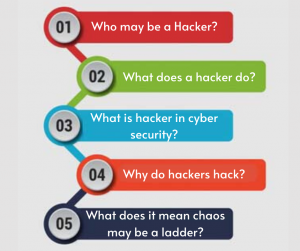
Who may be a Hacker?
A hacker is a private who uses computer, networking or other skills to beat a technical problem. The term hacker may ask anyone with technical skills, but it often refers to an individual who uses his or her abilities to realize unauthorized access to systems or networks so as to commit crimes. A hacker may, for instance , steal information to harm people via fraud , damage or bring down systems and, often, hold those systems hostage to gather ransom.
What does a hacker do?
Computer hackers are unauthorized users who forced an entry computer systems so as to steal, change or destroy information, often by installing dangerous malware without your knowledge or consent. Their clever tactics and detailed technical knowledge help them access the knowledge you actually don’t need them to possess.
“Most hackers are young because children tend to be adaptable. As long as you remain adaptable, you’ll always be an honest hacker.” ? Emmanuel Goldstein
What is hacker in cyber security?
A hacker is a private who uses computer, networking or other skills to beat a technical problem. The term hacker may ask anyone with technical skills, but it often refers to an individual who uses his or her abilities to realize unauthorized access to systems or networks so as to commit crimes
Motives. Four primary motives are proposed as possibilities for why hackers plan to forced an entry computers and networks. First, there’s a criminal gain to be had when hacking systems with the precise purpose of stealing mastercard numbers or manipulating banking systems.
What does it mean chaos may be a ladder?
The climb may be a metaphor for achieving power, and therefore the ladder (chaos) is how Littlefinger climbs. When things are in disarray it allows him to control in order that he’s ahead. Chaos means the good houses overlook his birth, because they have him.
Hackingis an attempt to exploit a computer system or a private network inside a computer. Simply put, it is the unauthorised access to or control over computer network security systems for some illicit purpose.
Infosavvy CEH certification training course provides you the hands-on training required to master the techniques hackers use to penetrate network systems and fortify your system against it. This ethical hacking course is aligned with the latest CEHv10 training and certification with Infosavvy in Mumbai Location and accreditation by EC-COUNCIL will adequately prepare you to increase skills.
“Chaos isn’t a pit. Chaos may be a ladder.” -Petyr Baelish
Chaos isn’t a pit. Chaos may be a ladder. many that attempt to climb it fail, and never get to undertake again. the autumn breaks them. and a few are given an opportunity to climb, but refuse. They hold close the realm, or love, or the gods…illusions. Only the ladder is real. The climb is all there’s . But they’ll never know this. Not until it’s too late.
What hackers do is find out technology and experiment with it in ways many of us never imagined. They even have a robust desire to share this information with others and to elucidate it to people whose only qualification could also be the will to find out .
This article is based on Top 12 Common cybersecurity analyst Interview Questions with Answers as well as job related Introduction.
Introduction
Cybersecurity jobs became one among the foremost in-demand jobs within the IT industry today. With demand, there’s also competition, and to urge employment in Cybersecurity, you would like to be one among the simplest . While having the required Cybersecurity skills is half job done, cracking the interview is another chapter altogether. And to assist you crack the interview, we’ve compiled this list of top Cybersecurity interview questions and answers.
“Skills matter then does Certification!”
Through Live Online cybersecurity training and certifications Learn skills and upgrade yourself. There are lots of courses in cyber security certification, Infosavvy is offering in Mumbai that are CCISO, CEH, CTIA, ECIH, and ECSA .
Top 12 Common Cybersecurity Analyst Interview Questions with Answers
1. How does one define risk, vulnerability and threat on a network?
Threat: A threat is takes on many various forms. It might be one individual, a technology like malware or maybe natural disasters like earthquakes and floods. Anything that has the potential to cause damage to a computing system like a network, server or a corporation as an entire might be classified as a threat
Vulnerability: A vulnerability may be a gap within the security of a system that would be employed by cybercriminals or malware (threats) to realize unauthorized entry into a system, like an unpatched server, a weak password or an open port on an unsupervised computer on your network
Risk: Risk might be seen because the potential for loss or damage when a threat is administered against a vulnerability on your network. this is often the worst-case scenario and is employed as a way to assist motivate for any security-related issues to be detected, prevented or resolved.
2. What does one realize cybersecurity frameworks?
This is one among the foremost common attacks on the web and is typically wont to take down an internet site . DDoS stands for distributed denial of service. The attack uses an outsized number of clients that flood the affected server with numerous requests that it eventually stops responding to them. This makes actual users that are just sending standard requests to access the web resource unable to attach , thus taking the server offline.
In this scenario, there are a couple of techniques that you simply can use to mitigate a DDoS attack on an internet site . the primary thing that you simply should try is minimize your website’s exposure to potential attacks. this is often done by reducing the amount of ports and resources that are exposed on to the web . Only essential services that expect communications should be internet-facing; everything else should be locked down.
DNS monitoring is just how for you to check connectivity between your local connections and therefore the remainder of the web . DNS monitoring is vital because it gives you a far better idea of the present state of your connections, helping you to troubleshoot issues once they occur. this is often especially helpful from a cybersecurity perspective if you think any malicious activity.
5. what’s the CIA triad?
CIA stands for Confidentiality, Integrity, and Availability. CIA may be a model that’s designed to guide policies for Information Security. it’s one among the foremost popular models employed by organizations.
Confidentiality:-The information should be accessible and readable only to authorized personnel. It shouldn’t be accessible by unauthorized personnel. the knowledge should be strongly encrypted just just in case someone uses hacking to access the info in order that albeit the info is accessed, it’s not readable or understandable.
Integrity:- Making sure the info has not been modified by an unauthorized entity. Integrity ensures that data isn’t corrupted or modified by unauthorized personnel. If a licensed individual/system is trying to switch the info and therefore the modification wasn’t successful, then the info should be reversed back and will not be corrupted.
Top 5 Firefox extensions for Secure Browsing this article is based on Firefox extensions basically 5 Firefox extensions is explained as well as Firefox concept is defined.
What is Firefox
Mozilla Firefox may be a browser that’s already documented for its commitment to protecting user privacy. there are tons of optional add-ons for Firefox to form your connection safer . Many of them pull double duty by optimizing the browsing experience additionally to reinforcing privacy or security measures .
These browser extensions will enhance your device’s security while also helping to take care of your privacy.
1. Cookie AutoDelete
Cookie AutoDelete may be a good way to reinforce your privacy on Firefox. A cookie may be a small piece of knowledge from an internet site that’s stored on your computer. Your browser looks for this data whenever you come back to an internet site , so it can populate the page together with your information. In theory, cookies make websites easier to use. In practice, however, businesses can use these cookies to trace activity and populate your browser windows with targeted ads.
Your browser cache stores all of the cookies from websites you’ve visited. Firefox uses this information so it doesn’t need to reload an equivalent data once you re-visit an internet site . This accelerates your browser, but it allows the cache to share your browsing history with any website. this is often why you ought to regularly clear your cache.
With Cookie AutoDelete, you not need to remember to manually delete your cookies at regular intervals. Even better, Cookie AutoDelete gives users the choice of customizing their cookie rules.
There are different way to gain knowledge.Learn more concepts from best cyber security institute . Join Infosavvy LIVE Online training’s with certifications .
2. uBlock Origin
uBlock Origin is one among the foremost popular ad blockers available for Firefox, and permanently reason. It blocks both ads and third-party network requests with a minimal CPU footprint. uBlock Origin goes beyond the fundamentals by offering users thousands of custom filters. you’ve got the choice of selecting exactly which ads you’d wish to block, whether it’s all of them or simply the foremost dangerous ones.
“Software updates often fix security problems, so download updates as soon as they become available” – California SBDC
Another important feature uBlock Origin offers is that the ability to disable web trackers. This keeps your browsing data private, removing the probabilities that your every move are going to be recorded to send you tailored ads.
3. Hush
Hush allows users to make encrypted bookmarks for pages opened in our private browser. The bookmarks are protected with both encryption and a password, so only you’ve got the power to use them. They’re also locally stored, so there are not any issues with cloud hacking. Albeit you aren’t watching anything dangerous, using encrypted bookmarks adds an additional level of privacy to your internet experience.
Though Hush isn’t also referred to as another extensions, it comes from a trustworthy developer that keeps the code regularly updated.
We like LastPass especially thanks to its excellent features and intuitive interface. to urge started, you select one master password to recollect . this is often the sole password that LastPass won’t store. The extension then encrypts and backs up all of your current passwords. If you would like a replacement one, LastPass creates strong passwords and stores them automatically. Additionally, it’s a mobile app that permits offline access to your password data wherever you’re .
LastPass is way quite an easy password manager, however. It allows you to securely manage your accounts from shopping and billing information to your bank information. Plus, you’ll keep documents and other records safe within the vault. Choosing strong and unique passwords is one among the primary steps to keeping your accounts secure. A trustworthy password manager like LastPass simplifies this task.
There are a lot of courses in cyber security certification CEH is the basic program to enter cyber security world. Get training and certification and Improve your knowledge of risks and vulnerabilities from best cyber security institute in mumbai.
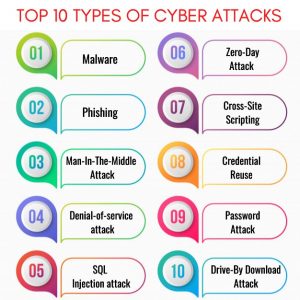
2020 Top 10 Cyber Attacks in India most typical forms of It like Malware, Phishing, Man-In-The-Middle Attack, Denial-of-service attack etc. Such are the Attacks that you’ll learn in this article as well as you’ll get to understand what are cyber attacks with the assistance of its types.
What are the Cyber Attacks?
A Cyber Attack is defined as an attack originated by a digital system against another digital device, website, or the other digital system and compromises its privacy, reliability or the info stored in it. A cyber attack can maliciously disable computers, steal data, or use a breached computer as a launch point for other attacks.
Types of Cyber Attacks
Cyber-attacks are often of varied types. you would like to remember of all those sorts of cyberattacks to ensure your highest safety and security.
Malware is taken under consideration as software that’s intentionally developed to disrupt computer, server, client, or network. Malware is often within the type of scripts, executable codes, active content, and other malicious software.
These codes are often computer worms, viruses, ransomware, Trojan horses, adware, spyware, or scareware. Malware, because the name suggests, is meant with a malicious intent to cause damage to the website/computer user.
The most prominent damages caused by malware are:
As ransomware, it blocks access to key components of the network.
Installs harmful software/malware
As spyware, they’re going to steal valuable information from your system (spyware) ;
They will damage certain hardware components of your system and make them inoperable.
2) Phishing
The main aim of Phishing is to steal restricted and private information like MasterCard details, login ids, and passwords, etc. By impersonating oneself as a reliable establishment in transmission. it’s usually done through email spoofing or instant messaging. They carry a link that directs users to a fake website which looks almost like the legitimate site and asks them to enter personal and secure information. it’s a fraudulent activity intended to cheat users. They bait the users by claiming to be from a reliable third group like auction sites, online payment processors, social internet sites, banks, or IT administrators. You need to be aware and acknowledged with such fraudulent activities to bypass any such fraud activities.
3) Man-In-The-Middle Attack
In Man-in-the-middle (MitM) the invader covertly modifies the chats and dialogues between two people that are communicating with one another. In a Man-in-the-middle attack, the communicators are made to believe that they’re directly communicating with one another with none interference from any third party. But the reality is that the entire communication is controlled by the invader while making the communicators believe that they’re talking to one another. it’s also referred to as eavesdropping.
The Entry Points For MITM
The invaders can easily take control of o private chats over an unsecured public Wi-Fi. Invaders can inset between the device and therefore the network and may take control of the private hats within the network. The communicators without having any idea pass all the conversation to the invaders.
It also can be done through malware. In such cases, the invader installs software on the victim’s device to process all his information.
What are the Cyber attack is a part Certified Ethical Hacking v10(CEH v10) training you learn the cyber security attacks and their impact.
4) Denial-of-service attack
In denial-of-service attack (DoS attack) the offender tries to form digital assets inaccessible to its anticipated users. The offender provisionally interrupts services of a number who is linked to the online. It involves overflowing the besieged machine with surplus applications to burden it from fulfilling the legitimate requests.
A Structured command language (SQL) injection attack allows the intruders to run malicious SQL statements. These SQL statements can require over the database server. Using SQL injection intruders can overcome application security measures. It allows them to undergo the validation and approval process of any web application. It also allows them to recover the whole data from their database. It also gives access to intruders to feature, modify, and delete data within the database. An SQL Injection allows intruders to fiddle with various databases including MySQL, Oracle, SQL Server, or others. it’s widely used by attackers to urge access over:
This article explains 5 steps of Hacking phases taking an example of a Hacker trying to hack… for example Reconnaissance, Scanning, Gaining Access, Maintaining Access, Fearing Tracks…
There are five Hacking phases:
Reconnaissance
Scanning
Gaining Access
Maintaining Access
Clearing Tracks
Hacking Phase 1: Reconnaissance
Reconnaissance refers to the preparatory phase in which an attacker gathers as much information as possible about the target prior to launching the attack. In this phase, the attacker draws on competitive intelligence to learn more about the target. It could be the future point of return, noted for ease of entry for an attack when more about the target is known on a broad scale. Reconnaissance target range may include the target organization’s clients, employees, operations, network, and systems.This phase allows attackers to plan the attack. This may take some time as the attacker gathers as much information as possible. Part of this reconnaissance may involve social engineering. A social engineer is a person who convinces people to reveal information such as unlisted phone numbers, passwords, and other sensitive information. For instance, the hacker could call the target’s Internet service provider and, using whatever personal information previously obtained, convince the customer service representative that the Hackingphases is actually the target, and in doing so, obtain even more information about the target.Another reconnaissance technique is dumpster diving. Dumpster diving is, simply enough, looking through an organization’s trash for any discarded sensitive information. Attackers can use the Internet to obtain information such as employees’ contact information, business partners, technologies currently in use, and other critical business knowledge. But dumpster diving may provide them with even more sensitive information, such as user names, passwords, credit card statements, bank statements, ATM receipts, Social Security numbers, private telephone numbers, checking account numbers, and any number of other things.Searching for the target company’s web site in the Internet’s Who is database can easily provide hackers with the company’s IP addresses, domain names, and contact information.
Hacking Phase 2: Gaining Access
during this Hacking phases designs the blueprint of the network of the target with the assistance of information collected throughout section one and section two. The hacker has finished enumerating and scanning the network and currently decides that they need a some choices to achieve access to the network.This section is wherever an attacker breaks into the system/network exploitation numerous tools or strategies. once getting into a system, he has got to increase his privilege to administrator level therefore he will install an application he desires or modify information or hide information. In section three the attacker would exploit a vulnerability to achieve access to the target. This usually involves taking management of 1 or a lot of network devices to extract information from the target or use that device to perform attacks on alternative targets.
Hacking Phase 3: Scanning
Scanning is the phase immediately preceding the attack. Here, the attacker uses the details gathered during reconnaissance to scan the network for specific information. Scanning is a logical extension of active reconnaissance, and in fact, some experts do not differentiate scanning from active reconnaissance. There is a slight difference, however, in that scanning involves more in-depth probing on the part of the attacker. Often the reconnaissance and scanning phases overlap, and it is not always possible to separate the two. An attacker can gather critical network information such as the mapping of systems, routers, and firewalls by using simple tools such as the standard Windows utility Trace route. Alternatively, they can use tools such as Cheops to add additional information to trace route’s results.Port scanners detect listening ports to find information about the nature of services running on the target machine. The primary defense technique against port scanners is to shut down services that are not required, as well as to implement appropriate port filtering. However, attackers can still use tools to determine the rules implemented by the port filtering.
Maintaining access refers to the phase when the attacker tries to retain his or her ownership of the system. Once an attacker gains access to the target system with administrator level privileges (thus owning the system), he or she is able to use both the system and its resources at will, and can either use the system as a launch pad to scan and exploit other systems, or to keep a low profile and continue exploiting the system. Both these actions can cause a great amount of damage. For instance, the hacker could implement a sniffer to capture all network traffic, including Telnet and FTP (file transfer protocol) sessions with other systems, and then transmit that data wherever he or she pleases.Attackers who choose to remain undetected remove evidence of their entry and install a backdoor or a Trojan to gain repeat access. They can also install rootkits at the kernel level to gain full administrative access to ten target computer. Rootkits gain access at the operating system level, while a Trojan horse gains access at the application level. Both rootkits and Trojans require users to install them locally. In Windows systems, most Trojans install themselves as a service and run as local system, with administrative access.
Climbing the Cyber Security Certification Ladder It is a way of Cyber Security in India ranks 3rd in terms of the highest number of internet users in the world after USA and China, the number has grown 6-fold between 2012 and 2017 with a compound annual growth rate of 44%. India secures a spot among st the highest ten spam-sending countries in the world alongside USA, India was graded among the highest 5 countries to be affected by cyber crime, consistent with a 22 October report by onlinesecurity firm ”Symantec Corp”.
Information Security and Cyber Security are the most demanding areas of current and future Information Technology space.
There is a huge demand in Cyber Security space in all domains like Finance Services
CEH v10 is a course which is well known and trusted, ethical in Hacking Training Program which is obtained by demonstrating knowledge of assessing the security of computer systems. This program is legitimate and lawfully allows you to practice in any company which needs to access and assess the security of any target system. Infosavvy raises the bar again for certification and training of ethical hacking programs with the all new C|EH v10! This program will make you involve deeply into Hacker Mindset which will teach you how to think like a hacker, it puts you in a position where you have all the commands and knowledge in employing the ethical hacking process.
ECSA training from Infosavvy provides an absolute learning progress continuing where the CEH program left off. This new ECSAv10 program has updated syllabus and an industry recognized comprehensive penetration testing methodology. Inclusive of all the above mentioned topics certifies the learner to elevate their abilities by applying these skills learned through intensive practical labs and challenges. Various methods are covered by ECSA in this course which has different requirements across all the verticals. ECSA is an amalgamation of both manual and automated penetration testing.
CCISO Certification is an up skill to be succeeded at the highest levels of information security. It’s first of its kind training certification program aimed at producing top-level information security executives. It not only concentrates on technical knowledge but also on the application security management principles from an executive management point of view. The program consists of three committees: Training, Body of Knowledge and the C|CISO Exam. Every element of this program was developed with the aspiring CISO keeping in minds and looks to spread the knowledge of seasoned professionals to the next generation in the arena that are most critical in the growth sector and maintenance of a successful information securityprogram. For more information on Cyber Security courses, please visit www.Info-savvy.com
Top 10 Most Common Types of Cyber Attacks has various categories of information security threats, such as network threats, host threats, and application threats, and various attack vectors, such as viruses, worms, botnets, that might affect an organization’s information security.This section introduces you to the motives, goals, and objectives of information security Cyber Attacks, top information security attack vectors, information security threat categories, and the types of Cyber Attacks on a system Below is a list of information security attack vectors through which an attacker can gain access to a computer or network server to deliver a payload or malicious outcome.
A cyber attack is any sort of offensive action that targets computer information systems, infrastructures, computer networks or personal computer devices, using various methods to steal, alter or destroy data or information systems. These cyber attacks you can learn in CEH v10.
Top 10 Most Common Types of Cyber Attacks
1.Cloud Computing Threats:
Cloud computing provides several benefits, like speed and efficiency via dynamic scaling. However it additionally raises a number of issues regarding security threats, like information breaches, human error, malicious insiders, account hijacking, and DDoS attacks. Clouded computing is an on-demand delivery of IT capabilities in which IT infrastructure and applications are provided to subscribers as a metered service over a network. Clients can store sensitive information on the cloud. Flaw in one Client’s application cloud could potentially allow attackers to access another client’s data.
2.Advanced Persistent Threats (APT):
Advanced Persistent Threat (APT) is an Cyber attacks that focuses on stealing information from the victim machine without its user being aware of it. These attacks are generally targeted at large companies and government networks. APT attacks are slow in nature, so the effect on computer performance and Internet connections is negligible. APTs exploit vulnerabilities in the applications running on a computer, operating system, and embedded systems.
3.Viruses and Worms:
Viruses and worms are the most prevalent networking threats, capable of infecting a network within seconds. A virus is a self-replicating program that produces a copy of itself by attaching to another program, computer boot sector or document. A worm is a malicious program that replicates,Executes and spreads across network connections. A computer worm could be a standalone malware computer program that replicates itself so as to unfold to alternative computers. Often, it uses a computer network to spread itself, looking forward to security failures on the target computer to access it. Viruses make their way into the computer when the attacker shares a malicious file containing it with the victim through the Internet, or through any removable media. Worms enter a network when the victim downloads a malicious file, opens a Spam mail or browses a malicious website.
4.Ransomware:
Ransom ware is a type of a malware, which restricts access to the computer system’s files and folders and demands an online ransom payment to the malware creator(s) in order to remove the restrictions. Ransom ware could be a subset of malware during which the information on a victim’s computer is locked, usually by encoding, and payment is demanded before the ransomed information is decrypted and access is came back to the victim. The motive for ransom ware attacks is almost continually financial, and in contrast to alternative kinds of Cyber Attacks, the victim is sometimes notified that AN exploit has occurred and is given directions for the way to endure the attack It is generally spread via malicious attachments to email messages, infected software applications, infected disks or compromised websites.
5.Mobile Threats:
Attackers are increasingly focusing on mobile devices, due to the increased Adoption of smart phones for business and personal use and their comparatively fewer security controls. Users may download malware applications (APKs) onto their smartphones, which can damage other applications and data and convey sensitive information to attackers. Attackers can remotely access a smartphone’s camera and recording app to view user activities and track voice communications, which can aid them in an attack.Like viruses and spyware that may infect your computer, there are a variety of security threats that may have an effect on mobile devices. We tend to divide these mobile threats into many categories: application-based threats, web-based threats, network-based threats and physical threats.
6.Botnet:
An attacker can usually target computers not safeguarded with firewalls and/or anti-virus software. A botnet manipulator will get management of a computer in a variety of ways in which, however most often will therefore via viruses or worms. Botnets are important as a result of they need become tools that each hackers and arranged crime use to perform extralegal activities on-line. As an example, hackers use botnets to launch coordinated denial-of-service attacks, while organized crime uses botnets as ways in which to spam, or send a phishing attack that’s then used for determine theft. A botnet is a huge network of compromised systems used by attackers to perform denial-of-service attacks. Bots, in a botnet, perform tasks such as uploading viruses, sending mails with botnets attached to them, stealing data, and so on. Antivirus programs might fail to find—or even scan for—spyware or botnets. Hence, it is essential to deploy programs specifically designed to find and eliminate such threats.
Insiders that perform attacks have a definite advantage over external attackers because they need approved system access and additionally is also familiar with network architecture and system policies/procedures. Additionally, there is also less security against insider attacks as a result of several organizations specialize in protection from external attacks.An insider attack is an attack by someone from within an organization who has authorized access to its network and is aware of the network architecture.Insider threatsto your network usually involve those who work as workers or contractors of your company. They belong in your facilities and that they often have user accounts in your networks. They understand things regarding your organization that outsiders sometimes don’t–the name of your network administrator, that specific applications you use, what variety of network configuration you’ve got, that vendors you’re employed with.
10 steps to cyber security During this blog, we explain and provide advice on the way to start Risk management regime, Secure configuration, Home and mobile working, Incident management, Malware prevention, Managing user privileges, Monitoring, Network security, etc…
10 steps to cyber security is a part Certified Ethical Hacking v10(CEH v10) training you learn the cyber security attacks and their impact.
As technology continues to evolve so also do the opportunities and challenges it provides. We are at a crossroads as we move from a society already entwined with the internet to the coming age of automation, Big Data, and the Internet of Things (IoT).Despite the threat of viruses and malware almost since the dawn of computing, awareness of the security and sanctity of data with computer systems didn’t gain traction until the explosive growth of the internet, whereby the exposure of so many machines on the web provided a veritable playground for hackers to test their skills – bringing down websites, stealing data, or committing fraud. It’s something we now call cyber crime.Since then, and with internetpenetrationglobally at an estimated 3.4 billion users (approximately 46% of the world’s population2), the opportunities for cyber crime have ballooned exponentially.Combating this is a multi-disciplinary affair that spans hardware and software through to policy and people – all of it aimed at both preventing cyber crime occurring in the first place, and minimizing its impact when it does. This is the practice of cyber security.
Defining and communicating your Board’s Information Risk Management Regime is central to your organisation’s overall cyber security. CESG recommend you review this regime – together with the nine associated security area described below – in order to protect your business against the majority ofcyber threats.
Following 10 Steps to Cyber Security
Network Security Protect your networks against external and internal attack. Manage the network primer. Filter out unauthorized access and malicious contents. Monitor and test security controls.
Malware Protection Produce relevant policy and establish anti-malware defenses that are applicable and relevant to all business areas. Scan for malware across the organisation.
Monitoring Establish a monitoring strategy and produce supporting policies. Continuously monitor all ICT system and networks. Analyse logs for unusual activity that could indicate an attack.
Incident Management Establish an incident response and disaster recover capability. Produce and test incident management plans. Provide specialist training to the incident management team. Report criminal incidents to law enforcement
User Education and Awareness Produce user policies covering acceptable and secure use of the organisation’s systems. Establish a staff training programmer. Maintain user awareness of the cyber risks.
Home and Mobile Working Develop a mobile working policy and train staff to adhere to it. Apply the secure baseline to all devices. Protect data both in transit and at rest 10 Steps to Cyber Security
Secure Configuration Apply security patches and ensure that the secure configuration of all ICT systems is maintained. Create a system inventory & define a base line build for all ICT devices.
Removable Media Controls Produce a policy to control all access to removable media. Limit media types and use. Scan all media for malware before imported on the corporate system.
Managing User Privileges Establish account management processes and limit the number of privileged accounts. Limit user privileges and monitor user activity. Control access to activity and audit logs.
Information Risk Management Regime Establish and effective governance structure and determine your risk appetite. Maintain boards engagement with cyber risk. Produce supporting information risk management policies.
Many approaches exist to gain access are different types of attacks on a system. One common requirement for all such approaches is that the attacker finds and exploits a system’s weakness or vulnerability.
Types of attacks on a system
1. Operating System Attacks
Today’s Operating Systems (OS) are loaded with features and are increasingly complex. While users take advantage of these features, they are prone to more vulnerabilities, thus enticing attackers. Operating systems run many services such as graphical user interfaces (GUIs) that support applications and system tools, and enable Internet access. Extensive tweaking is required to lock them down. Attackers constantly look for OS vulnerabilities that allow them to exploit and gain access to a target system or network. To stop attackers from compromising the network, the system or network administrators must keep abreast of various new exploits and methods adopted by attackers, and monitor the networks regularly.By default, most operating systems’ installation programs install a large number of services and open ports. This situation leads attackers to search for vulnerabilities. Applying patches and hot fixes is not easy with today’s complex networks. Most patches and fixes tend to solve an immediate issue. In order to protect the system from operating system attacks in general, it is necessary to remove and/or disable any unneeded ports and services.
Some OS vulnerabilities include: – Buffer overflow vulnerabilities – Bugs in the operating system – An unmatched operating systemAttacks performed at the 05 level include: – Exploiting specific network protocol implementations – Attacking built-in authentication systems – Breaking file-system security – Cracking passwords and encryption mechanisms
2. Misconfiguration Attacks
Security misconfiguration or poorly configured security controls might allow attackers to gain unauthorized access to the system, compromise files, or perform other unintended actions. Misconfiguration vulnerabilities affect web servers, application platforms, databases, networks, or frameworks that may result in illegal access or possible system takeover. Administrators should change the default configuration of the devices before deploying them in the production network. To optimize the configuration of the machine, remove any unneeded services or software. Automated scanners detect missing patches, misconfigurations, use of default accounts, unnecessary services, and so on.
Software developers are often under intense pressure to meet deadlines, which can mean they do not have sufficient time to completely test their products before shipping them, leaving undiscovered security holes. This is particularly troublesome in newer software applications that come with a large number of features and functionalities, making them more and more complex. An increase in the complexity means more opportunities for vulnerabilities. Attackers find and exploit these vulnerabilities in the applications using different tools and techniques to gain unauthorized access and steal or manipulate data.Security is not always a high priority to software developers, and they handle it as an “add-on” component after release. This means that not all instances of the software will have the same level of security. Error checking in these applications can be very poor (or even nonexistent), which leads to:
Buffer overflow attacks
Sensitive information disclosure
Denial-of-service attacks
SQL injection attacks
Cross-site scripting
Phishing
Session hijacking
Parameter/form tampering
Man-in-the-middle attacks
Directory traversal attacks
SQL injection attacks
4. Shrink-Wrap Code Attacks
Software developers often use free libraries and code licensed from other sources in their programs to reduce development time and cost. This means that large portions of many pieces of software will be the same, and if an attacker discovers vulnerabilities in that code, many pieces of software are at risk. Attackers exploit default configuration and settings of the off-the-shelf libraries and code. The problem is that software developers leave the libraries and code unchanged. They need to customize and fine-tune every part of their code in order to make it not only more secure, but different enough so that the same exploit will not work. An attack can be active or passive. An “active attack” attempts to alter system resources or affect their operation. A “passive attack” attempts to learn or make use of information from the system but does not affect system resources (e.g., wiretapping).you can learn all types of attack in CEH v10 location in Mumbai. The infosavvy provides the certified Ethical hacking training and EC Council Certification.
5. Man-in-the-middle (MitM) attack
A MitM attack occurs when a hacker inserts itself between the communications of a client and a server. Here are some common types of man-in-the-middle attacks:Session hijackingIn this type of MitM attack, an attacker hijacks a session between a trusted client and network server. The attacking computer substitutes its IP address for the trusted client while the server continues the session, believing it’s communicating with the client. as an example , the attack might unfold like this:1. A client connects to a server. 2. The attacker’s computer gains control of the client. 3. The attacker’s computer disconnects the client from the server. 4. The attacker’s computer replaces the client’s IP address with its own IP address and spoofs the client’s sequence numbers. 5. The attacker’s computer continues dialog with the server and therefore the server believes it’s still communicating with the client.
IP Spoofing
IP spoofing is used by an attacker to convince a system that it’s communicating with a known, trusted entity and provide the attacker with access to the system. The attacker sends a packet with the IP source address of a known, trusted host rather than its own IP source address to a target host. The target host might accept the packet and act upon it.
Replay
A replay attack occurs when an attacker intercepts and saves old messages then tries to send them later, impersonating one among the participants. this sort can be easily countered with session timestamps or nonce (a random number or a string that changes with time).Currently, there’s no single technology or configuration to stop all MitM attacks. Generally, encryption and digital certificates provide an efficient safeguard against MitM attacks, assuring both the confidentiality and integrity of communications. But a man-in-the-middle attack are often injected into the center of communications in such how that encryption won’t help — for instance , attacker “A” intercepts public key of person “P” and substitute it together with his own public key. Then, anyone wanting to send an encrypted message to P using P’s public key’s unknowingly using A’s public key. Therefore, A can read the message intended for P then send the message to P, encrypted in P’s real public key, and P will never notice that the message was compromised. additionally , A could also modify the message before resending it to P. As you’ll see, P is using encryption and thinks that his information is protected but it’s not, due to the MitM attack.So, how can you confirm that P’s public key belongs to P and to not A? Certificate authorities and hash functions were created to solve this problem. When person 2 (P2) wants to send a message to P, and P wants to be sure that A won’t read or modify the message which the message actually came from P2, the following method must be used:
P2 creates a symmetric key and encrypts it with P’s public key.
P2 sends the encrypted symmetric key to P.
P2 computes a hash function of the message and digitally signs it.
P2 encrypts his message and therefore the message’s signed hash using the symmetric key and sends the whole thing to P.
P is able to receive the symmetric key from P2 because only he has the private key to decrypt the encryption.
P, and only P, can decrypt the symmetrically encrypted message and signed hash because he has the symmetric key.
he’s ready to verify that the message has not been altered because he can compute the hash of received message and compare it with digitally signed one.
P is additionally ready to convince himself that P2 was the sender because only P2 can sign the hash in order that it’s verified with P2 public key.
6. Phishing and spear phishing attacks
Phishing attack is that the practice of sending emails that appear to be from trusted sources with the goal of gaining personal information or influencing users to do something. It combines social engineering and technical trickery. It could involve an attachment to an email that loads malware onto your computer. It could even be a link to an illegitimate website which will trick you into downloading malware or handing over your personal information.Spear phishing may be a very targeted sort of phishing activity. Attackers take the time to conduct research into targets and make messages that are personal and relevant. due to this, spear phishing are often very hard to spot and even harder to defend against. one among the only ways in which a hacker can conduct a spear phishing attack is email spoofing, which is when the information within the “From” section of the e-mail is falsified, making it appear as if it’s coming from someone you recognize , like your management or your partner company. Another technique that scammers use to add credibility to their story is website cloning — they copy legitimate websites to fool you into entering personally identifiable information (PII) or login credentials.
To reduce the danger of being phished, you’ll use these techniques:
Critical thinking — don’t accept that an email is that the real deal just because you’re busy or stressed otherwise you have 150 other unread messages in your inbox. Stop for a moment and analyze the e-mail.
Hovering over the links — Move your mouse over the link, but don’t click it! Just let your mouse cursor h over over the link and see where would actually take you. Apply critical thinking to decipher the URL.
Analyzing email headers — Email headers define how an email need to your address. The “Reply-to” and “Return-Path” parameters should lead to the same domain as is stated within the email.
Sandboxing — you’ll test email content during a sandbox environment, logging activity from opening the attachment or clicking the links inside the e-mail .








 Infosavvy Cyber Security & IT Management Trainings