ISO 27001

ISO 27001 Annex : A.9.2.5 Review of User Access Rights & A.9.2.6 Removal or Adjustment of Access Rights

In this article ISO 27001 Annex : A.9.2.5 Review of User Access Rights & A.9.2.6 Removal or Adjustment of Access Rights these two topic has been explained.

A.9.2.5 Review of User Access Rights

Control- Access rights of users should be reviewed regularly by asset owners.

Implementation Guidance- The following should be considered while reviewing the access rights:-

  1. Access rights of users should be reviewed at regular intervals and after any changes, such as promotion, demotion or job termination;
  2. User access rights for moving from one role to another within the same organization should be reviewed and re-allocated;
  3. The privileged access rights authorizations should be reviewed frequently
  4. The allocation of access rights should be regularly reviewed to ensure that unauthorized privileges are not obtained;
  5. Regular reviews should be registered for changes to privileged accounts.

Other Information- This control probably accounts for potential weaknesses in the execution of the 9.2.19.2.2 and 9.2.6 controls.

Related Product : ISO 27001 Lead Auditor Training And Certification ISMS

A.9.2.6 Removal or Adjustment of Access Rights

Control- Access rights of all employees and external users to information and information processing facilities should be waived upon termination of jobs, contract or agreement, or changed upon adjustment.

Implementation Guidance- Upon termination, an individual’s access rights to information and assets associated with the facilities and services for information processing should be removed or suspended. Whether access rights should be removed will be determined. Changes in employment should be reflected in removing all access rights which have not been approved for the new job. The access rights which should be removed or adjusted include the physical and logical access rights. The removal or adjustment of keys, identification cards, information processing facilities, or subscriptions may be done by removal, revocation, or replacement. Any documentation identifying employees and contractors’ access rights should reflect removal or adjustment of access rights. If a departing employee or external user has identified passwords that are still active for user IDs, these should be updated after termination or change of job, contract, or agreement.

Also Read : ISO 27001 Annex : A.9.2.3 Management of Privileged Access Rights & A.9.2.4 Management of Secret Authentication Information of Users

Access rights for information and assets related to information processing facilities should be restricted or withdrawn before the termination or change of jobs, based on the following risk factors :

  1. Whether termination or alteration is initiated by the employee, external user or management team, and the reason for termination;
  2. Current responsibilities of client, external user or some other user;
  3. Price of currently available assets.

In the current era, it’s always advisable to limit and control access privileges. For an organization, it’s really important that its information assets and accessibility to those assets should always be protected. There should exist Access rights to particular users and should be reviewed regularly. Annex 9.2 covers the guidelines and implementation of controls to safeguard data getting accessed by unauthorized users or to users who are departed from the organization. Infosavvytraining institute in Mumbai provides certification for IRCA CQI ISO 27001:2013 Lead Auditor (LA) and ISO 27001 Lead Implementer (LI) (TÜV SÜD Certification). This certification covers various controls that should be implemented in an organization to keep it away from destructors also trainers in Infosavy are well-skilled and experienced in providing proper guidance and knowledge for keeping the Information security management system secure. This will help the applicant to develop the expertise necessary to carry out the ISMS audit by applying broadly recognized audit principles, procedures, and techniques.

Other Information- Access rights can be divided under some circumstances on the grounds that more people are eligible than the leaving employee or external user, e.g. group IDs. In these cases, departing individuals should be excluded from all group access lists, and arrangements should be made to warn all other employees and external party users concerned not to share this information with the departing person.

Read More : https://www.info-savvy.com/iso-27001-annex-a-9-2-5-review-of-user-access-rights-a-9-2-6-removal-or-adjustment-of-access-rights/


Infosavvy, 2nd Floor, Sai Niketan, Chandavalkar Road Opp. Gora Gandhi Hotel, Above Jumbo King, beside Speakwell Institute, Borivali West, Mumbai, Maharashtra 400092

Contact us – www.info-savvy.com

https://g.co/kgs/ttqPpZ

ISO 27001

ISO 27001 Annex : A.9 Access Control

A.9.1 Business Requirements of Access Control

ISO 27001 Annex : A.9 Access Control Its Objective is limiting the access to information and information processing facilities.

A.9.1.1 Access Control Policy

Control- An access control policy with supporting business and information security requirements should be established, documented, and reviewed.

Implementation Guidance- Asset owners should lay down appropriate rules for access control, access rights, and limits on particular user roles to their assets, with the level of info and the strictness of controls representing the related information security risks. Access controls are both logical as well as practical, so they should be taken together. Users and service providers should be provided with a clear, transparent statement of the business requirements that access controls should meet.

The inbox is always open in my brain, and anyone can get in any time and access me. Turning it off is taking back control. I decide who gets in. It’s about privacy, having a self.
-Jill Soloway

The policy should take note of:

  1. Security requirements applied to business applications;
  2. Information dissemination and authorization procedures, e.g. the need-to-know concept and extent of information access and information classification;
  3. Consistency between access rights and policies on the classification of information systems and networks;
  4. related legislation and other contractual obligations pertaining to information or information access controls;
  5. Access rights management in distributed and networked environments which recognizes the kinds of available connections;
  6. Segregation of access management functions, e.g. access request, access authorization, access administration;
  7. formal authorization requirements for access applications;
  8. Requirements for periodic review of the rights to access;
  9. Removing access rights
  10. Archiving details of all important incidents relating to the use and management of user identity and secret authentication information;
  11. Organization’s role with privileged access.

Related Product : ISO 27001 Lead Auditor Training And Certification ISMS

Other Information- When defining rules on access control, care needs to be taken to understand the following implications:

  • Establishing rules underpinned by the principle “Everything is generally prohibited unless expressly authorized” rather than the weaker rule “Everything is generally permitted unless expressly prohibited”;
  • Changes to information labels automatically introduced by information processing facilities and those implemented at the user’s discretion;
  • User authorization changes that are automatically initiated by an administrator and the information system;
  • Rules requiring specific prior approval and those without approval
  • Regulations on access control should be assisted by defined and structured procedures.
  • Access management based on responsibilities is a method that many organizations have successfully used in relating access rights to business roles.

Also Read : ISO 27001 Annex : A.8.3 Media Handling

In the guidelines of access control policy, two of the common principles are:

  1. Need-to-know: only the information you need to execute your tasks is accessible to you (specific tasks/roles mean different needs-to-know and therefore different access profiles);
  2. Need-to-use: you grant access to information processing facilities (IT software, programs, protocols, rooms) that you would need to execute your task/job/role.

In order to keep the organization’s assets (IT, software, programs, and protocols) safe, certain access controls are required to prevent unauthorized users from accessing your assets. The criteria for access management, access rights, and limitations of specific user roles on their assets are being defined in Annex 9 of Standard 27002. At Infosavvywe do have certain standards to follow to ensure that our assets remain secure and that we apply for one of the most important information security certificates. i.e. IRCA CQI ISO 27001:2013 Lead Auditor (LA) and ISO 27001 Lead Implementer (LI) (TÜV SÜD Certification) . Our well-trained and professional trainers will help you by providing you with comprehensive information and several examples to enhance an applicant’s ability to handle security management, to ensure the right access to the right user.

Read More : https://www.info-savvy.com/iso-27001-annex-a-9-access-control/


Infosavvy, 2nd Floor, Sai Niketan, Chandavalkar Road Opp. Gora Gandhi Hotel, Above Jumbo King, beside Speakwell Institute, Borivali West, Mumbai, Maharashtra 400092

Contact us – www.info-savvy.com
https://g.co/kgs/ttqPpZ

AWS

Amazon simple storage service Lifecycle

Amazon simple storage service Lifecycle

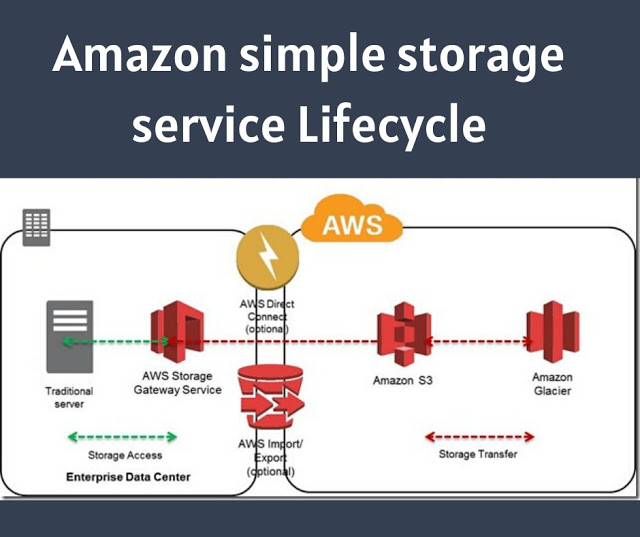
Amazon simple storage service Lifecycle offers more than one class of storage for your objects. The class you choose will depend on how critical it is that the data survives no matter what (durability), how quickly you might need to retrieve it (availability), and how much money you have to spend.

1. Durability

S3 measures durability as a percentage. For instance, the 99.999999999 percent durability guarantee for most S3 classes and Amazon Glacier is as follows:
“. . . corresponds to an average annual expected loss of 0.000000001% of objects.
For example, if you store 10,000,000 objects with Amazon S3, you can on average expect to incur a loss of a single object once every 10,000 years.”
Source: https://aws.amazon.com/s3/faqs
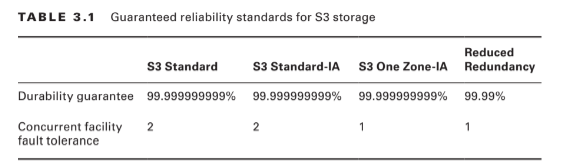
In other words, realistically, there’s pretty much no way that you can possibly lose data stored on one of the standard S3/Glacier platforms because of infrastructure failure. However, it would be irresponsible to rely on your S3 buckets as the only copies of important data. After all, there’s a real chance that a misconfiguration, account lockout, or unanticipated external attack could permanently block access to your data. And, as crazy as it might sound right now, it’s not unthinkable to suggest that AWS could one day go out of business. Kodak and Blockbuster Video once dominated their industries, right? The high durability rates delivered by S3 are largely because they automatically replicate your data across at least three availability zones. That means that even if an entire AWS facility was suddenly wiped off the map, copies of your data would be restored from a different zone. There are, however, two storage classes that aren’t quite so resilient. Amazon S3 One Zone-Infrequent Access (S3 One Zone-IA), as the name suggests, stores data in only a single availability zone. Reduced Redundancy Storage (RRS) is rated at only 99.99 percent durability (because it’s replicated across fewer servers than other classes). You can balance increased/decreased durability against other features like availability and cost to get the balance that’s right for you. All S3 durability levels are shown in Table 3.1.

2. Availability

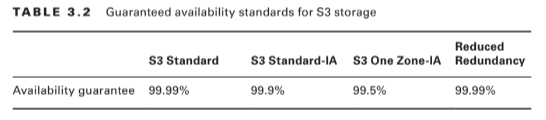
Object availability is also measured as a percentage, this time though, it’s the percentage you can expect a given object to be instantly available on request through the course of a full year. The Amazon S3 Standard class, for example, guarantees that your data will be ready whenever you need it (meaning: it will be available) for 99.99% of the year. That means there will be less than nine hours each year of down time. If you feel down-time has exceeded that limit within a single year, you can apply for a service credit. Amazon’s durability guarantee, by contrast, is designed to provide 99.999999999% data protection. This means there’s practically no chance your data will be lost, even if you might sometimes not have instance access to it. Table 3.2 illustrates the availability guarantees for all S3 classes.

3. Eventually Consistent Data

It’s important to bear in mind that S3 replicates data across multiple locations. As a result, there might be brief delays while updates to existing objects propagate across the system. Uploading a new version of a file or, alternatively, deleting an old file altogether can result in one site reflecting the new state with another still unaware of any changes. To ensure that there’s never a conflict between versions of a single object—which could lead to serious data and application corruption—you should treat your data according to an Eventually Consistent standard. That is, you should expect a delay (usually just two seconds or less) and design your operations accordingly. Because there isn’t the risk of corruption, S3 provides read-after-write consistency for the creation (PUT) of new objects.

Also Read : Amazon Simple Storage Service
Related Product : AWS Certified Solutions Architect | Associate

4. S3 Object Lifecycle

Many of the S3 workloads you’ll launch will probably involve backup archives. But the thing about backup archives is that, when properly designed, they’re usually followed regularly by more backup archives. Maintaining some previous archive versions is critical, but you’ll also want to retire and delete older versions to keep a lid on your storage costs. S3 lets you automate all this with its versioning and lifecycle features.

5. Versioning

Within many file system environments, saving a file using the same name and location as a pre-existing file will overwrite the original object. That ensures you’ll always have the most recent version available to you, but you will lose access to older versions—including versions that were overwritten by mistake. By default, objects on S3 work the same way. But if you enable versioning at the bucket level, then older overwritten copies of an object will be saved and remain accessible indefinitely. This solves the problem of accidentally losing old data, but it replaces it with the potential for archive bloat. Here’s where lifecycle management can help.

6. Lifecycle Management

You can configure lifecycle rules for a bucket that will automatically transition an object’s storage class after a set number of days. You might, for instance, have new objects remain in the S3 Standard class for their first 30 days after which they’re moved to the cheaper One Zone IA for another 30 days. If regulatory compliance requires that you maintain older versions, your fi les could then be moved to the low-cost, long-term storage service Glacier for 365 more days before being permanently deleted.

Accessing S3 Objects

If you didn’t think you’d ever need your data, you wouldn’t go to the trouble of saving it to S3. So, you’ll need to understand how to access your S3-hosted objects and, just as important, how to restrict access to only those requests that match your business and security needs.

7. Access Control

Out of the box, new S3 buckets and objects will be fully accessible to your account but to no other AWS accounts or external visitors. You can strategically open up access at the bucket and object levels using access control list (ACL) rules, finer-grained S3 bucket policies, or Identity and Access Management (IAM) policies. There is more than a little overlap between those three approaches. In fact, ACLs are really leftovers from before AWS created IAM. As a rule, Amazon recommends applying S3 bucket policies or IAM policies instead of ACLs. S3 bucket policies—which are formatted as JSON text and attached to your S3 bucket— will make sense for cases where you want to control access to a single S3 bucket for multiple external accounts and users. On the other hand, IAM policies—because they exist at the account level within IAM—will probably make sense when you’re trying to control the way individual users and roles access multiple resources, including S3. The following code is an example of an S3 bucket policy that allows both the root user and the user Steve from the specified AWS account to access the S3 MyBucket bucket and its contents.

Read More : https://www.info-savvy.com/aws-elastic-block-storage-volumes-and-its-features/

———————————————————————————————————————————-

This Blog Article is posted by

Infosavvy, 2nd Floor, Sai Niketan, Chandavalkar Road Opp. Gora Gandhi Hotel, Above Jumbo King, beside Speakwell Institute, Borivali West, Mumbai, Maharashtra 400092

Contact us – www.info-savvy.com