Uncategorized

ISO 27001 Annex : A.13.2.3 Electronic Messaging & A.13.2.4 Confidentiality or Non-Disclosure Agreements

In this article explain ISO 27001 Annex : A.13.2.3 Electronic Messaging & A.13.2.4 Confidentiality or Non-Disclosure Agreements .

A.13.2.3  Electronic Messaging

Control- Electronic messaging information should be adequately protected.

Implementation Guidance – The following should include information security aspects for electronic messages:

  1. Protecting messages against unauthorized access, change or denial of services in line with the organization’s classification scheme;
  2. ensure that the message is correctly addressed and transported;
  3. Service reliability and availability;
  4. Legal considerations, such as electronic signature requirements;
  5. Approval before using external public authorities, such as instant messaging, social networking or sharing of files;
  6. Stronger standards of publicly accessible network authentication access management.

Other Information – There are various kinds of messages, such as e-mail systems, an exchange of electronic data, and social networking.

Related Product : ISO 27001 Lead Auditor Training And Certification ISMS

A well-known ISO 27001 Lead Auditor and ISO 27001 Lead Implementer certificate that mainly covers information security clauses and their implementation, i.e., controls which should be implemented by the organization to preserve the CIA triad, Confidentiality, Integrity, and Availability to maintain their critical, sensitive information in a secure manner. Infosavvy, a Mumbai- based institute, provides multi-domain certifications and training, which include IRCA CQI ISO 27001:2013 Lead Auditor (LA) and ISO 27001 Lead Implementer (LI) (TÜV SÜD Certification). Infosavvy will help you to understand and recognize the full scope of your organization’s security checks to protect your organization’s activities and information equipment (assets) from attacks, and also to illustrate the backup policy to safeguard if data gets lost due to intentional or natural hazards. It also helps to understand how the operating systems and software integrity can be controlled or administered when they are transferred from one system to another or even from outside the organization, as well as the types of controls required to safeguard the access to confidential information and software. We have trainers with extensive expertise and experience to ensure the efficient handling of the security of information. Consequently, the applicant will gain the necessary skills for the ISMS audit by using commonly agreed audit concepts, procedures and techniques

Also Read : ISO 27001 Annex : A.13.2 Information Transfer

A.13.2.4  Confidentiality or Non-Disclosure Agreements

Control- Information protection requirements of the organization for confidentiality or non-disclosure agreements should be identified, regularly reviewed, and documented.

Implementation Guidance – The requirement to protect confidential information by legal enforceability should be addressed by confidentiality or non-disclosure agreements. Confidentiality or non-disclosure provisions extend to third parties or to the organization’s employees. In view of the kind of the other party and its allowed access or handling of confidential information, elements should be selected or added. to identify confidentiality requirements or non-disclosure agreements,

It should be considered the following elements:

  1. Definition of protected information ( e.g. confidential information);
  2. Expected duration of an agreement, including cases of permanent confidentiality;
  3. the actions needed for termination of an agreement;
  4. Signatory responsibilities and actions to prevent unauthorized disclosure of information;
  5. Information ownership, business secrets and intellectual property, as well as how this relates to privacy;
  6. Made use of the details of confidentiality and signatory ‘s rights to use the data;
  7. the right to audit and monitor confidential information activities;
  8. the notification and reporting process of unauthorized disclosure or leakage of confidential information;
  9. Conditions for the return or destruction of information on cessation of agreement;
  10. Expected measures should only be taken if an agreement is violated.

Other elements may be included during the confidentiality or non-disclosure agreement depending on the information security requirements of an organization.

Confidentiality and non-disclosure agreements would comply with all the laws and codes of integrity applicable to them.

Confidentiality and non-disclosure agreements provisions should be regularly reviewed and these conditions should be impacted when there are changes.

Other Information – Confidentiality and non-disclosure agreements protect organizational information and inform signatory in an authorized and accountable fashion of their responsibility to protect the use of and disclosure of information.

Read More : https://info-savvy.com/iso-27001-annex-a-13-2-3-electronic-messaging-a-13-2-4-confidentiality-or-non-disclosure-agreements/


This Blog Article is posted by

Infosavvy, 2nd Floor, Sai Niketan, Chandavalkar Road Opp. Gora Gandhi Hotel, Above Jumbo King, beside Speakwell Institute, Borivali West, Mumbai, Maharashtra 400092
Contact us – www.info-savvy.com

Uncategorized

15 Benefits Of Security Certifications to Upgrade Career Path 2020

In this article you will learn, benefits of Security Certification for elevate your career path etc.

Benefits Of Security Certifications That May Upgrade your career path

Professional & Technical certifications are well known and highly esteemed in industries like IT, Business, Management, and Teaching. If you belong to at least one of those industries, a certification will boost your career and open a wealth of latest opportunities for you.The expansion of technology in recent times has fundamentally changed the ways during which businesses operate. Organizations of all sizes are finding that emerging technologies are positively enabling growth, and are realizing that it pays to speculate in professionals who are well equipped through the proper certifications to explore this technology.

All the professionals already working in Cyber-security must remember that this domain is developing each day and to be useful within the system professionals ought to upgrade/update their knowledge fairly often. there’s one important factor we should always not miss is that Cyber Security may be a huge field that has space for professionals with various types of skills in Application Security, Networks, Information Security, Cyber Espionage, bio-metric, etc. So if a certification did wonders for your friend doesn’t mean it might assist you within the exact manner unless you belong to an equivalent arena of security. to assist you to settle on the simplest certification for boost your career in 2020.“At the end of the Day, The Goals are Simple Safety and Security”

Benefits of IT certifications, Technical Certifications & Business Certifications for people.

1. Expand  your employment opportunities
Having an IT certification in your field of study positions you before your peers. this is often very true if you’re checking out jobs. Hiring managers always hunt for professionals with up-to-date knowledge in their niche specializations. this implies you may be preferred over people who don’t have certifications.

2. Get increased knowledge and qualifications
A professional certification gives you a qualification which you’ll be able to use anywhere within the world. It shows you’ve got improved your knowledge during a specific domain and this prepares you for more job responsibilities. this is often invaluable within the current digital world.

3. Raise your income prospects
Certified professionals earn quite their non-certified counterparts. So, you’re likely to urge a rise in your salary.

4. Gain professional credibility
Certified IT professionals show dedication and motivation to professional development. this is often the rationale companies support employees who are certified by raising their salaries.

5. Avail of greater networking opportunities
When you are a licensed IT professional, you become a vicinity of a bunch of certified professionals. This group are often a priceless resource that you simply can connect with, whenever you would like help in solving one problem or the opposite. you’ll learn the way to boost your career or to create on your professional expertise through support from your network

6. Get 1.65x times increase in your income/salary potential compared to non-certified individuals
When you are employed as a technology certified professional, your income is high. Your employer will more likely pay more cash because you’ve got demonstrated that you simply have undergone focused study to reinforce your skills. A Peer impact survey 2016 revealed that certified professionals get 1.65x pay raise as compared to their non-certified counterparts. for instance , PMP® certified professionals on a mean receive 20% more income than their non-certified peers. Companies are able to pay you what you’re worth because you’ve got more to supply .

7. Complete projects with greater efficiency
Tech certified professionals are likely to complete their projects with greater efficiency because they need gained the needed hands-on skills during the training. they need been exposed to ideas and approaches that may make their work easier.

8. Make your employer more likely to retain you
Employers are more likely to retain certified professionals than their non-certified peers. this is often because they’re always looking for ways to cut back operating costs by hiring certified professionals rather than hard currency on training existing employees. Getting certified as an IT professional means your skills and knowledge are enhanced, making you more useful to the corporate.

9. Increase your job security & job stability
Getting your certification as a technology professional means you have got gained more knowledge within the technological field, which might be leveraged to stabilize your position within the company. Therefore, certification adds both job security and stability.

10. Increase the marketability of your resume by standing out from the crowd!
Certifications differentiate you from your peers. they create you stand out from the gang , and you may become more marketable to employers than your peers who aren’t certified.

Click here for continue blog:-https://www.info-savvy.com/15-benefits-of-security-certifications-to-upgrade-career-path-2020/

This Blog Article is posted by
Infosavvy, 2nd Floor, Sai Niketan, Chandavalkar Road Opp. Gora Gandhi Hotel, Above Jumbo King, beside Speakwell Institute, Borivali West, Mumbai, Maharashtra 400092

Contact us – www.info-savvy.com

https://g.co/kgs/ttqPpZ

Uncategorized

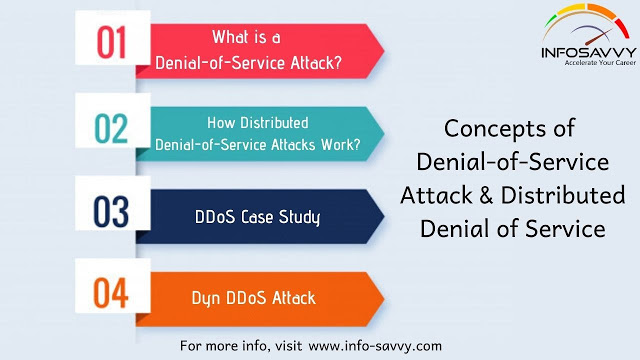
Concepts of Denial-of-Service Attack & Distributed Denial of Service

For better understanding of Denial-of-Service Attack & Distributed Denial of Service (DoS/DDoS) attacks, one must be familiar with their concepts beforehand. This module discusses about what a DoS attack is, what a DDoS attack is, and how the DDoS attacks work.

What is a Denial-of-Service Attack?

DoS is an attack on a computer or network that reduces, restricts, or prevents accessibility of system resources to its legitimate users. In a DOS attack, attackers flood a victim’ssystem with non-legitimate service requests or traffic to overload its resources, bringing the system down, leading to unavailability of the victim’s website or at least significantly slowing the victim’s system or network performance. The goal of a DoS attack is not to gain unauthorized access to a system or to corrupt data; it is to keep the legitimate users away from using the system.

Following are the examples of types of DoS attacks:
  • Flooding the victim’s system with more traffic than can be handled
  • Flooding a service (e.g., internet relay chat (IRC)) with more events than it can handle
  • Crashing transmission control protocol (TCP/Internet protocol OP) stack by sending corrupt packets
  • Crashing a service by interacting with it in an unexpected way
  • Hanging a system by causing it to go into an infinite loop

In general,Denial-of-Service Attack DoS attacks target network bandwidth or connectivity. Bandwidth attacks overflow the network with a high volume of traffic using existing network resources, thus depriving legitimate users of these resources, Connectivity attacks overflow a computer with a large amount of connection requests, consuming all available resources of the OS so that the computer cannot process legitimate users’ requests.Imagine a pizza delivery company, which does much of its business over the phone. If an attacker wanted to disrupt this business, he could figure out a way to tie up the company’s phone lines, making it impossible for the company to do business. That is how a DoS attack works—the attacker uses up all the ways to connect to the system, making legitimate business impossible, DoS attacks are a kind of security break that does not generally result in the theft of information. However, these attacks can harm the target in terms of time and resources. However, failure might mean the loss of a service such as email. In a worst-case scenario, a DOS attack can mean the accidental destruction of the files and programs of millions of people who happen to be surfing the Web at the time of attack.A Distributed Denial of Service DDoS attack is a large-scale, coordinated attack on the availability of services on a victim’s system or network resources, launched indirectly through many compromised computers (botnets) on the Internet.

How Distributed Denial-of-Service Attacks Work?

In a Distributed Denial of Service DDoS attack, many applications found the target browser or network with fake exterior requests that make the system, network, browser, or site slow, useless, and disabled or unavailable.The attacker initiates the DDoS attack by sending a command to the zombie agents. These zombie agents send a connection request to a large number of reflector systems with the spoofed IP address of the victim. The reflector systems see these requests as coming from the victim’s machine instead of the zombie agents due to spoofing of source IP address. Hence, they send the requested information (response to connection request) to the victim. The victim’s machine is flooded with unsolicited responses from several reflector computers at once. This either may reduce the performance or may cause the victim’s machine to shut down completely.

Learn more about identity theft in CEH from Infosavvy.“The first step toward change is awareness. The second step is acceptance”-Nathaniel Branden

Module Objectives

Denial-of-Service (DOS) and Distributed Denial-of-Service (DDoS) attacks became a serious threat to computer networks. These attacks attempt to make a machine or network resource unavailable to its authorized users. Usually DoS/DDoS attacks exploit vulnerabilities within the implementation of TCP/IP model protocol or bugs in a specific OS.This module starts with a summary of DoS and DDoS attacks. It provides an insight into different DoS/DDoS attack techniques. Later, it discusses about botnet network, DoS/DDoS attack toolstechniques to detect DoS/DDoS attacks, and DoS/DDoS countermeasures. The module ends with a summary of penetration testing steps an ethical hacker should follow to perform a security assessment of the target.At the end of this module, you’ll be ready to perform the following:

  • Describe the DoS/DDoS concepts
  • Perform DoS/DDoS using various attack techniques
  • Describe Botnets
  • Describe DoS/DDoS case studies
  • Explain different DoS/DDoS attack tools
  • Apply best practices to mitigate Do5IDD05 attacks
  • Perform DoS/DDoS penetration testing

click here for continue blog:- https://www.info-savvy.com/concepts-of-denial-of-service-attack-distributed-denial-of-service/


This Blog Article is posted by

Infosavvy, 2nd Floor, Sai Niketan, Chandavalkar Road Opp. Gora Gandhi Hotel, Above Jumbo King, beside Speakwell Institute, Borivali West, Mumbai, Maharashtra 400092

Contact us – www.info-savvy.com
https://g.co/kgs/ttqPpZ

Uncategorized

Planning a Threat Intelligence Program

Implementation of a threat intelligence program is a dynamic process that gives organizations with valuable insights based on the investigation of discourse threats and risks that area unit used to enhance the safety posture. Before implementing the threat intelligence program, organizations have to be compelled to prepare associate acceptable set up. Firstly, the organization has to decide the aim of extracting threat intelligence and who are going to be concerned in planning the threat intelligence program.

This section provides a summary of various topics associated with coming up with and development of a threat intelligence program. It discusses concerning getting ready folks, processes, and technology; developing a set plan; planning the threat intelligence program; coming up with the budget; developing a communication attempt to update achieve stakeholders; and concerns for aggregating threat intelligence and factors for choosing threat intelligence platform. It conjointly discusses concerning totally different goals for intense threat intelligence and track metrics to stay stakeholder’ ship to.
Prepare folks, Processes, and Technology
Threat intelligence is useful for a company to develop a security infrastructure, however this data alone cannot give enough edges if it’s while not the support of a right team of individuals, integrated processes, and technology. Preparation is crucial for a corporation to confirm that it’s able to consume, analyze, and take actions upon threat intelligence.
• People
An organization could appoint an indoor threat intelligence team or incorporate sure duties into existing roles.
The cyber threat intelligence team should fulfill the subsequent responsibilities:
• Cyber forensics
• Malware reverse-engineering
• Managing threat intelligence operations
Threat assessment
• Collection, analysis, and dissemination of threat data
• Collaborating with all data security groups among a corporation
• Processes
Information security processes will derive advantages from threat intelligence. The organization must establish an explicit set of processes that needs input from threat intelligence and more perceive however the intelligence should be given for that purpose. With the threat info, the organization will enhance the safety posture of the network by developing effective security policies and methods.
For example, an data assurance team will develop a defense-in-depth strategy be victimization the intelligence on famous attacks, threat actors, and ways wont to launch an attack. Similarly, an event notice ion and response team will use indicators derived from threat intelligence to detect and defend the organization network against varied attacks.
In-depth analysis is needed for understanding the requirements the wants and requirements of the audience for threat intelligence. Most of the organizations use managed Security Service supplier 1%+155P) that helps in providing recommendations on integration threat intelligence into their surroundings.
• Technology
Proper utilization of threat intelligence needs effective use of producers and shoppers of threat intelligence.
Discussed below area unit the producers and shoppers of threat intelligence:
• Raw information Producers
Raw data producer’s area unit security systems or devices like proxy servers or firewalls. These devices monitor the work on activities and manufacture log files or capture packets.
In. Threat information shoppers
Threat information shopper’s area unit mental health systems or devices that take input from threat information so as to notice and forestall the network against malicious activities. The shoppers of threat information embrace proxy servers, firewalls, and intrusion interference systems. Relying upon the threat information, firewalls will embrace sure rules to notice and block incoming malicious traffic from unknown scientific discipline addresses. Similarly, proxy servers and intrusion interference systems use varied rules to observe the network against suspicious traffic and block it if necessary.
Threat Intelligence shoppers
Threat intelligence client may be a remote management platform to manage threat intelligence: for instance, SI EM solutions.
Threat Intelligence Producers
Threat intelligence producer may be a threat intelligence cooperative platform or threat intelligence feed.
Threat intelligence are often wont to improve the safety infrastructure of the structure network and improve the aptitude of security devices to defend against attacks. It are often achieved IN translating the threat intelligence to threat information and so feeding it into the safety devices. The threat information includes all malicious activities to appear for within the network. To effectively defend the organization’s assets against attacks, security devices should be deployed strategically throughout the network. Though the safety devices deployed at the perimeter of the network will stop some attacks,
The organization ought to assure that the attackers will still defeat them to achieve access to the network. The presence of multiple layers of defenses throughout the network will effectively cut back AN attacker’s ability to stay undiscovered for an extended amount of your time.
With the advancement in threat intelligence method, the rise within the size of the threat information and intelligence will create manual handling of knowledge a troublesome method. Therefore, organizations should ask for to modify the method of overwhelming and distributing threat intelligence to the safety devices.
Given below area unit some area unit as that are relevant to automation:
• Using normal formats
• Using a threat intelligence platform .0 Subscribing to a threat intelligence feed

Uncategorized

Understanding the Volatile evidence assortment

Most of the systems store information associated with this session in temporary type across registries, cache, and RAM. This information is well lost once the user switches the system off, leading to loss of the session data. Therefore, the primary responders got to extract it as a priority.This section explains why volatile information is vital, order of volatility, volatile information assortment methodology, and collection volatile data alongside tools.

Why Volatile information Important?

Volatile data refers to the data hold on within the registries, cache, and RAM of digital devices. This data is lost or erased whenever the system is turned off or rebooted. The volatile data is dynamic in nature and keeps on dynamic with time; therefore, the incident responders/investigators ought to be able to collect the information in real time.
Volatile information exists within the physical memory or RAM and consists of method data, process-to-port mapping, method memory, network connections, writing board contents, state of the system, and so on. The incident responders/investigators should collect this information throughout the live information acquisition method.
The first step to require when the tending security incident report is to amass volatile information. Volatile information is vital for investigation the crime scene as a result of it contains helpful data.

Volatile data includes:
Running processes                                  
Passwords in clear text                          
Instant messages (IMs)                          
Executed console commands                
Internet Protocol (IP) addresses          
Trojan horse(s)                                      
Unencrypted data

Additional useful volatile data includes:
Logging information
Open ports and listening
applications
Registry information
System information
Attached devices
This information assists in determinative a logical timeline of the safety incident and also the doable users accountable.

Order of Volatility

Incident responders/investigators should keep in mind that the whole information don’t have an equivalent level of volatility and collect the foremost volatile information initial, throughout live acquisitions.

The order of volatility for a typical computer system is as follows:

Registers and cache

The information within the registers or the processor cache on the pc exists around for a matter of nanoseconds. They are there forever ever-changing and are the foremost volatile information.

Routing table, method table, kernel statistics, and memory

A routing table, ARP cache, kernel statistics data is within the normal memory of the pc. These are a small amount less volatile than the data within the registers, with the life associate usually nanoseconds.

Temporary file systems

Temporary file systems term to be gift for a extended time on the pc compared to routing tables, ARP cache, and so on. These systems square measure eventually over written or modified, generally in seconds or minutes later.

Disk or different storage media

Anything hold on a disk stays for a short time. However, sometimes, things might fail and erase or write over that information. Therefore, disk information also are volatile with a time period of some minutes.

Remote work and observance information associated with the target system

The data that goes through a firewall generates logs during a router or during a switch. The Totem may store these logs away. the matter is that these logs will over Write themselves, generally every day later, associate hour later, or per week later. However, usually they’re less volatile than a tough drive.

Physical configuration and topology

Physical configuration and topology are less volatile and have additional lifetime than another logs.

Archival media

A DVD-ROM, a fixed storage or a tape will have the smallest amount volatile information as a result of the digital data isn’t planning to amendment in such information sources mechanically any time unless broken beneath a physical force.

Volatile information assortment Methodology

The volatile information assortment plays a serious role within the crime scene investigation. to confirm no loss occur throughout the gathering of vital proof, the investigators or incident responders ought to follow the right methodology and supply a documented approach for playing activities during a accountable manner.

Discussed below is that the bit-by-bit procedure for the volatile information assortment methodology:

Step 1: Incident Response Preparation

Eliminating or anticipating every kind of security incident or threat isn’t doable. However, to gather every kind of volatile information, responders should be able to react to the safety incident with success. The incident responders attempting to assemble volatile information should have expertise in collection volatile information, correct permissions, and authorization from incident manager or security administrator or an individual in authority should be taken before assembling information.

The following things ought to be in situ before an event occurs:
At least answerer toolkit response disk
An incident response team IRT or selected 1st answerer
Forensic-related policies that leave rhetorical information assortment

Step 2: Incident Documentation

Ensure to store the logs and profiles in organized and decipherable format. as an example, use naming conventions for rhetorical tool output, record time stamps of log activities and embrace the identity of the rhetorical investigator or incident answerer. Document all the knowledge concerning the safety incident wants and maintain a book to record all actions throughout the forensic assortment. Mistreatment the primary answerer toolkit book helps to decide on the most effective tools for the investigation.

Step 3: Policy Verification

Ensure that the actions planned don’t violate the present network and laptop usage policies and any rights of the registered owner or user likewise.

Points to think about for policy verification:
Read and examine all the policies signed by the user of the suspicious laptop
Determine the rhetorical capabilities and limitations of the incident answerer by decisive the legal rights together with a review of federal statutes of the user

Step 4: Volatile information assortment Strategy

Security incidents don’t seem to be similar. the primary answerer toolkit book and also the queries from the graphic to form the volatile information assortment strategy that suits true and leaves a negligible quantity of footprint on the suspicious system ought to be used.
Devise a method supported concerns like the sort of volatile information, the supply of the info, kind of media used, and sort of association. make certain to possess enough area to repeat the whole info.

Step 5: Volatile information assortment Setup

Volatile information assortment setup includes following steps:
Establish a trustworthy command shell
Do not open or use a command shell or terminal from the suspicious system. This minimizes the footprint on the suspicious system and restricts the triggering of any reasonably malware put in crime the system.

Establish the transmission and storage methodology
Identify and record the information the info the information transmission from the live suspicious laptop to the remote data assortment system, as there’ll not be enough area on response disk to gather rhetorical tool output. For example: internet cat and crypt cat that transmit information remotely via a network.

Ensure the integrity of forensic tool output
Compute AN MD5 hash, of the forensic tool output to confirm integrity and acceptableness.

Step 6: Volatile information assortment method

Record the time, date, and command history of the system
To establish AN audit path generate dates and times whereas capital punishment every rhetorical tool or command
Start a command history to document all the forensic assortment activities. Collect all doable volatile info from the system and network
Do not shut clown or restart a system beneath investigation till all relevant volatile information has been recorded
Maintain a log of all actions conducted on a running machine
Photograph the screen of the running system to document its state
Identify the OS running on the suspect machine
Note system date, time and command history, if shown on screen, and record with the current actual time
Check the system for the utilization of whole disk or tile encoding
Do not use the executive utilities on the compromised system throughout an investigation, and significantly use caution once running diagnostic utilities
As every forensic tool or command is dead, generate the date and time to ascertain an audit path
Dump the RAM from the system to a forensically sterile removable storage device
Collect different volatile CAS information and save to a removable memory device
Determine proof seizure methodology of hardware and any extra artifacts on the disc drive which will be determined to be of evidentiary value}
Complete a full report documenting all steps and actions taken.

Uncategorized

Data Leakage Defined

Data leakage is that the unauthorized transmission of knowledge from at intervals and organization to an external destination or recipient. The term are often used to describe knowledge that’s transferred electronically or physically. Knowledge escape threats sometimes occur via the web and email, however may occur via mobile knowledge storage devices like optical media, USB keys, and laptops.

Barely daily goes by while not a confidential knowledge breach hitting the headlines. Knowledge escape, conjointly called low and slow knowledge theft, is a vast drawback for knowledge security, and therefore the injury caused to any organization, despite size or industry, are often serious. From declining revenue to a tarnished reputation or massive monetary penalties to crippling lawsuits, this can be a threat that any organization can want to shield themselves from.

Data leakage refers to unauthorized access or disclosure of sensitive or confidential data. Advancement in information technology has made data vulnerable to various malware attacks leading to the leakage of sensitive and confidential data to the attacker. Data leakage may happen electronically through an email or malicious link or via some physical method such as device theft, hacker break-ins, etc.

Threats Insider 
Most of the data attacks come from the insiders only making it much more difficult to prevent or detect them. Disgruntled or negligent employees may leak sensitive data knowingly or unknowingly to the outside world incurring huge financial losses and business interruptions. Employees may use various techniques such as eavesdropping, shoulder surfing, dumpster diving, etc. to gain unauthorized access to information in violation of corporate policies. System misconfiguration and technology failures also enable insiders to steal sensitive information. Insider threats are difficult to thwart because insiders are mostly aware of the security loopholes of the organization and they exploit them to steal confidential information.

Types of Data Leakage
There an many various sorts of knowledge escape associate degreed it’s necessary to know that the matter are often initiated via an external or internal supply. Protecting measures need to address all areas to confirm that the foremost common knowledge escape threats are prevented.

The Accidental Breach
“Unauthorized” knowledge escape doesn’t essentially mean meant or malicious. The great news is that the majority of knowledge escape incidents are accidental. As an example, a worker might accidentally select the incorrect recipient once sending an email containing confidential knowledge. Unfortunately, unintentional knowledge escape will still end in a similar penalties and reputational injury as they are doing not mitigate legal responsibilities.

The Disgruntled or Ill-Intentioned Employee
When we consider knowledge leakages, we predict concerning knowledge endured stolen or misplaced laptops or knowledge that’s leaked over email. However, the overwhelming majority of knowledge loss doesn’t occur over associate degree electronic medium; it occurs via printers, cameras, photocopiers, removable USB drives and even Dumpster diving for discarded documents. Whereas a worker might have signed an employment agreement that effectively signifies trust between leader and worker, there’s nothing to prevent them from later un seaworthy guidance out of the building if they’re discontented or secure a hefty payout by cyber criminals. This sort of knowledge information escape is usually referred to as data exfiltration.

Electronic Communications with Malicious Intent
Many organizations give employees access to the internet, email, and instant messaging as a part of their role. The matter is that each one of those mediums area unit capable of file transfer or accessing external sources over the net. Malware is usually accustomed target these mediums and with a high success rate. As an example, a cyber criminal may quite simply spoof a legitimate business email account and request sensitive info to be sent to them. The user would unknowingly send the data that may contain monetary knowledge or sensitive evaluation info.

Phishing attacks area unit another cyber-attack methodology with a high knowledge escape success rate. Just by clicking on a link and visiting an online page that contains malicious code may permit an assailant to access a laptop or network to retrieve the data they have.

Uncategorized

Anti-Forensics Techniques

• Data hiding in file system Structures
Data hiding is one in all the anti-forensic techniques utilized by attackers to form knowledge inaccessible. NTFS-based exhausting disks contain unhealthy clusters during a data file as $BadClus and also the MFT entry eight represents these bad clusters. $BadClus could be a sparse file, that permits attackers to cover unlimited information further as portion a lot of clusters to $BadClus to cover a lot of information.

• Trail Obfuscation
Trail Obfuscation is one in every of the anti-forensic techniques that attackers use to mislead, complicate, disorient, sidetrack, and/or distract the rhetorical examination method. the method involves totally different techniques and tools, such as:

  • Log cleaners
  • Spoofing
  • Misinformation
  • Backbone hopping
  • Zombie accounts
  • Trojan commands

 In this method, the attackers delete or modify information of some vital files so as to confuse the incident res-ponders. They modify header data and file extensions exploitation varied roles. Timestamp, that is a component of the Metasploit Framework, is one in every of the path obfuscation tool that attackers use to switch, edit, and delete the date and time of a information and build it useless for the incident answer-er transfigure is another tool accustomed perform path obfuscation.

Using the Time-stomp application, one will modification the changed date and time stamp fully, thereby unsupported the validity of the document and deceptive the investigation method.

Overwriting Data/Metadata:
Intruders use various programs to write information on a memory device, creating it tough or not possible to recover. These programs will write information, metadata, or each to avert forensics investigation method. Overwriting programs add 4 modes :

  •  Overwrite entire media
  •  Overwrite individual files
  •  Overwrite deleted files on the media
  •  Overwriting information will be accomplished by using disk sanitizes

Overwriting Metadata:
Metadata refers to the data that stores details of knowledge. It plays a vital role within the comp. Her forensics investigation method by providing details like time of creation, names of the systems used for creation and modification, author name, time and date of modification, names of the users UN agency had changed the file and different details.Incident res-ponders will produce a timeline of attackers’ actions by organizing the file’s timestamps and different details in ordered order.

• Encryption
Encryption is that the method of translating the information into a secret code in order that solely the licensed personnel will access it. it’s an efficient thanks to secure the info. To browse the encrypted file, users need a secret key or a countersign that may rewrite the file. Therefore, most attackers use coding technique mutually of the most effective anti-forensic technique.Data coding is one of the usually used techniques to defeat rhetorical investigation method and involves coding of codes, files, folders, and typically complete exhausting disks. Intruders use sturdy coding algorithms to encipher information of investigatory price, that renders it just about unclear while not the selected key. Some algorithms avert the investigation processes by acting extra functions as well as use of a key file, full-volume coding, and plausible deniability.

 Encrypted Network Protocols
Attackers use the encrypted network protocols to protect the identification of the network traffic in addition as its content from forensic examination. Few cryptographic encapsulation protocols like SSL and SSH will solely shield the content of the traffic. However, to protect against the traffic analysis, attackers should also anonymize themselves whenever possible .Attackers use virtual routers like, the Onion routing approach, that provides multiple layers of protection. Onion routing is that the technique used for secret communication over a network. This network encapsulates messages in layers of coding, similar to the layers of an onion and employs a worldwide volunteer network of routers that serve to anonymize the supply and destination of communications. Therefore, tracing this sort of communication and attributing it to a supply is incredibly tough for incident res-ponders.

• Buffer Overflow against forensic Tools
In the buffer overflow exploit attack, the .attackers use buffer overflows as entry to a distant system to inject and run the code within the address house of a running program, thereby with success fixing the victim program’s behavior. Usually, attackers use buffer overflows to access the remote system, once that they transfer attack tools,  that get saved within the target machine’s hard disk.

• Detecting Forensic Tool Activities
Attackers are absolutely awake to the PC forensic tools that incident res-ponders use to search out and analyze proof from a victim’s ‘computer or network. Therefore, they struggle to include rhetorical tools and method identification programs into the system or malware they’re using. These programs act intelligently and alter behavior on detective work the CFT.

Uncategorized

Performing of evidence Analysis

Evidence is not static and not focused at one purpose on the network. the variability of hardware and code found on the network makes the evidence-gathering method tougher. when gathering proof, proof analysis helps to reconstruct the crime to provide a clearer image of the crime and determine the missing links within the image.

Evidence Analysis: Preparations
Preparation takes several steps before beginning an actual proof analysis. the primary communicator has to prepare and check many conditions like the provision of tools, reportage demand, and legal clearances so as to conduct a eminent invest igat particle . it’s necessary to arrange and consult w it h the involved persons, that is needed before, during, and when the investigation. proof analysis helps during analyzing the proof to search out the attackers and technique of attacks in a lawfully sound manner.

As a district of an proof analysis, the primary responders can perform following preparations:
• Understand the investigation needs and situations
• Check w it h the lawyer/organization for any specific analysis needs
• Have a replica of organization’s rhetorical investigation policy
• Transport proof to a secure location or rhetorical investigation science lab
• Check the la b facilities before beginning the analysis
• Prepare the proof analysis toolkit containing imaging, recovery, and analysis tools

Forensic Analysis Tools
Forensics analysis tools facilitate 1st responders in collect image, managing, transferring, and storing necessary info needed throughout forensics investigation. using these tools, a primary respondent will act quickly throughout investigation a security incident. a complicated investigation toolkit will cut back the incident impact by stopping the incident from spreading through the systems. this can minimize the organization’s injury and a id the investigation method additionally.

Forensic mortal
Forensic mortal recovers and analyzes hidden and system files, deleted files, file and disk slack and unallocated clusters. Rhetorical mortal could be a tool for the preservation, analysis, and presentation of electronic proof. the first users of this tool area unit investigation agencies that facilitate in acting analysis of electronic proof.

• Event Log mortal
Event Log mortal could be a software system answer for viewing, monitoring, and analyzing events recorded in security, system, application, and different logs of Microsoft Windows operational systems. It helps to quickly browse, find, and report on issues, security warnings, and every one different events that area unit generated inside Windows.

Features:

  1. Use a multiple-document or tabbed-document interface, counting on user preferences.
  2. Favorite computers and their logs ar classified into a tree o duplicate event logs manually and mechanically.
  3. Event descriptions and binary knowledge ar within the log window.
  4. Advanced filtering is feasible by any criteria, as well as event description text.
  5. The fast Filter feature permits you to change event log in an exceedingly few mouse clicks.

• OSForensics
It helps discover relevant forensic knowledge faster with high performance file searches and categorization moreover as restores deleted files. It identifies suspicious files and activity with hash matching, drive signature comparisons and appears into e-mails, memory and binary information. It conjointly manages digital investigation, organizes info and creates reports concerning collected rhetorical information.
• Helix3
Helix3 is a simple to use cyber security answer integrated into your network supplying you with visibility across your entire infrastructure revealing malicious activities like web Abuse, information sharing and harassment.
• Autopsy
Autopsy may be a digital forensics platform and graphical interface to The Sleuth Kit and different digital forensics tools. This tool helps incident handlers to look at the classification system, retrieve deleted information, perform timeline analysis, and net artifacts throughout an occurrence response.
• Encase rhetorical
Encase may be a multi-purpose rhetorical platform that features several helpful tools to support many areas of the digital rhetorical method. This tool will collect ton of information from several devices and extract potential proof. It conjointly generates an proof report. in close rhetorical will facilitate incident responders acquire massive amounts of proof, as quick as doable from laptops and desktop computers to mobile devices. in close rhetorical directly acquires the information and integrates the results into the cases.
• Foremost
Foremost may be a console program to recover files supported their headers, footers, and internal information structures. This method is often cited as information carving. Foremost will work on image files, like those generated by add, Safe back, and inclose or directly on a drive. The headers and footers are often specified by a configuration file otherwise you will use instruction switches to specify built- in file sorts. These inherent sorts consider the info structures of a given f ile format providing a additional reliable and quicker recovery.

Uncategorized

Understanding Indicators of Compromise

The Indicators of Compromise play a serious role in building and enhancing the cyber security posture of a company. Monitoring IOCs helps analysts find and answer varied security incidents quickly. Identification of continual concerns of explicit loCs helps the safety groups in enhancing the protection mechanisms and policies to shield and stop varied evolving attacks. This section provides an outline of IOCs and also the in importance, types of IOCs Key IOCs and also the pyramid of pain.

Indicators of Compromise

Cyber threats are endlessly evolving with the newer TTPs custom-made supported the vulnerabilities of the target organization. the safety analysts got to perform continuous observation of loCs to effectively and expeditiously find and answer the evolving cyber threats. Indicators of Compromise area unit the clues/artifact/ items of forensic knowledge that ar found on a network or OS of a company that indicates a possible intrusion or malicious activity in organization’s infrastructure .

However, loCsar itself not intelligence in reality, IoCs act as a odd supply of information of knowledgeof knowledge regarding threats that function data points within the intelligence method. unjust threat intelligence extracted from loCs helps organizations enhance incident-handling methods. Cyber security professionals use varied machine-driven tools to watch loCs to find and stop varied security breaches to the organization. ObservationloCs additionally helps the protection groups enhance

the security controls and policies of the organization to find and block the suspicious traffic to thwart any attacks. to beat the threats related to loCs, some organizations like STIX and TAXl l have developed standardized reports that contain condensed knowledge associated with the attack and shared it with others to leverage the incident response.

AnloC is outlined as associate atomic indicator, computed indicator, or activity indicator. it’s the data concerning suspicious or malicious activities that is collected from varied security institutions during a network infrastructure. Atomic indicators ar those who can not be metameric into smaller components, associated their which means isn’t modified within the context of an intrusion. samples of atomic indicators ar informatics address, email address, etc. Computed indicators ar that obtained from the info extracted from a security incident. Samples of computed indicators ar hash values and regular expressions. Activity indicators check with a grouping of each atomic and computed indicators combined supported some logic.

Why Indicators of Compromise Important?

Indicators of Compromise act as a chunk of forensic information that helps organizations discover malicious activity at an initial section. These activities that are sometimes labelled as red flags indicate associate anack that has the potential of compromising system or will cause a knowledge breach.

loCs will be as easy as information or as difficult as malicious code. Therefore, it’s troublesome to notice them. Threat analysts sometimes correlate varied loCs and mixture them to investigate a possible threat or an event. Using loCs, organizations will find, identify, and answer anacks or threats before they harm the network. Therefore, observance loCs is important to the organization from security compromises.

Following are the explanations why analysing loCs is crucial for the organization:

. Helps security analysts in detection information breaches, malware immersion makes an attempt, or different threat activities

. Assists security analysts in knowing “what happened” regarding the attack and helps the analysts observe the behaviour and characteristics of malware

. Helps improve latency still as upgrade the detection rate of the threats

. Provides security analysts with information feeds that may be fed into the organization’s auto­ response mechanism or machine-controlled security devices. It helps them perform scans automatically to find if those attacks exist in the setting or not. onceloCs follow some pattern or show revenant behaviour, analysts will update tools and security policies supported that specific behaviour of malware .

Helps analysts to find answers to the subsequent questions:

Does the file include malicious content?

Does the organization network compromised?

however did the network get infected?

what’s the history of a selected information processing address?

. Assists analysts in following a uniform approach for documentation of every specific threat which will be simply shared with team members

. Provides a better method for the detection of zero-day attacks that detection rules have to be compelled to be developed for the prevailing security tools

. Provides a decent supply of information and a decent place to begin for concluding investigation method.

Uncategorized

Leverage Threat Intelligence for increased Incident Response

Threat intelligence plays a very important role in incident response method. Intelligence are often integrated into the incident response method, which might facilitate IR groups with needed resources to act against security incidents quickly. It helps in distinctive who/what may well be playacting Associate in Nursing attack, however it operates, what are the campaigns it’s a part of, and wherever else to go looking on the network.

Given below are the phases of step-up concerned within the incident response management:

Phase 1:Pre-planning

IR groups use follow check and situations to check the safety arrange. Strategic· and operational-level threat intelligence are often integrated during this side of incident response in varied ways that. With the utilization of CTI, security analysts will ascertain the answers to the subsequent questions:
• that hacker teams would target the organization and what are the explanations behind it?
• that are the various assets they’re ·targeting?
• What are the assorted capabilities that adversaries possess?
• What are the doable attack scenarios?

Pre-planning phases are often divided into 2 categories:

1. Incident Response

Operational threat intelligence are often employed in IR to develop threat situations. Threat intelligence are often accustomed determine TTPs utilized by Associate in Nursing resister to perform Associate in Nursing attack, which might any be translated into incident answered workflows. Therefore, if the network experiences a same style of attack, then the defenders would have needed tools, workflow, and procedure to safeguard the network.

2. Breach Response

Breach response is comparable to incident response however with only 1 difference; that’s, it manages risks related to the business. an inspiration to deal with business risks is developed by the panel involving CIO, CISO, risk management, PR/crisis management, counsel, and alternative stakeholders. They additionally take choices relating to what the communication would be to regulators, clients, consumers, and also the standard public. Operational and strategic threat intelligence are often integrated in breach response method by respondent the subsequent internal and external justification line of questions:

Internal justification:

• what’s the structure risk that this effort diminishes or provides a company a additional elaborate data on the ·risk?
• What are the assorted manual tasks that this effort helps in automating?
• What t is that the value that this effort reduces?
• What level of resources (labor Associate in Nursingd material) will this want perform an activity successfully?

External justification:

• What are the new tasks the safety team can have once Associate in Nursing implementation of an answer and what are the tasks that are already on the stir list for the team?
• What new data the team will use to figure on the far side what it already possesses?
• what’s the value of this new information?
• what’s the matter that this data is capable of solving?

Phase 2: Event

Operational and plan of action threat intelligence helps in providing context to the alerts
Generated by Associate in Nursing organization’s security mechanisms like SIEM, SOC, or alternative security tools. the kind of data enclosed during this intelligence is loCs like information
addresses,malware,compromised devices, domains, URLs, path, TTPs utilized by adversaries, and phishing messages or email This data are often accustomed verify an occasion that may intensify into a security incident.

Phase 3:Incident

An resister sets a footing within the victim’s network, then an occasion is understood to own escalated into a happening. once a happening has been taken place within the network, Operational threat intelligence are often utilized by the safety analysts to realize additional insight into the techniques, operations, actor’s objectives, and past incidents. Therefore, Operational threat intelligence helps get data regarding the threat mistreatment the threat triangle, which has data relating to threat actor’s capability, intent, and chance.

Phase 4: Breach

I to become essential for a company to report a happening once it escalates into a breach. this sort of situations sometimes takes place once knowledge extraction has occurred that the organization should report it to the stakeholders, clients, customers ,and workers. Therefore, a happening response defines however the organization responds internally, whereas breach response defines however the ·organization responds outwardly.

Strategic and operational threat intelligence plays a very important role within the analysis on a breach. This data helps in providing answers to the subsequent queries :
• What happened?
• however and what was the explanation behind incidence of the breach?
• What are the essential steps that require to be taken to avoid such a breach within the future?

Armed with context on seemingly adversaries we will go to intelligence gathering. This entails learning everything we will regarding doable and sure adversaries, identification probable behaviors, and determination that forms of defenses and controls be to deal with higher-probability attacks. Be realistic regarding what you’ll gather yourself and what intelligence you will got to get. Optimally you’ll devote some resources to gathering Associate in Nursing process intelligence on an current basis supported your organization’s desires, however you may seemingly got to supplement your resources with external knowledge sources.