Information security

Sniffing Technique : DHCP Attacks

This section discusses the DHCP attacks. A DHCP attack is an active sniffing technique used by the attackers to steal and manipulate sensitive data. This section describes how DHCP works, DHCP starvation attacks, tools used for starvation attacks, rogue server attacks, and the ways to defend against DHCP attacks.

How DHCP Works

Dynamic Host Configuration Protocol (DHCP) is a client/server protocol that gives an IP address to an IP host. additionally to the IP address, the DHCP server also provides configuration-related information like the default gateway and subnet mask. When a DHCP client device boots up, it participates in traffic broadcasting.DHCP can assign IP configuration to hosts connecting to a network.

The distribution of IP configuration to hosts simplifies the administrator’s work to take care of IP networks.DHCP servers maintain TCP/IP configuration information during a database like valid TCP/IP configuration parameters, valid IP addresses, and duration of the lease offered by the server. It provides address configurations to DHCP-enabled clients within the sort of a lease offer.


Working of DHCP:

  1. The client broadcasts DHCPDISCOVER/SOLICIT request asking for DHCP Configuration information.
  2.  DHCP-relay agent captures the client request and unicasts it to the DHCP servers available within the network.
  3. Relay agent broadcasts DHCPOFFER/ADVERTISE within the client’s subnet.
  4. The client broadcasts DHCPREQUEST/REQUEST asking DHCP server to supply the DHCP configuration information.
  5.  DHCP server sends unicast DHCPACK/REPLY message to the client with the IP config and information.

“We’re changing the world with technology”

DHCP Request/Reply Messages

A device that already has an IP address can use the simple request/reply exchange to get other configuration parameters from a DHCP server. When the DHCP client receives a DHCP offer, the client immediately responds by sending back a DHCP request packet. Devices that aren’t using DHCP to accumulate IP addresses can still utilize DHCP’s other configuration capabilities. A client can broadcast a DHCPINFORM message to request that any available server send its parameters on the usage of the network.

DHCP servers respond with the requested parameters and/or default parameters carried in DHCP options of a DHCPACK message. If a DHCP request comes from a hardware address that’s within the DHCP server’s reserved pool and therefore the request isn’t for the IP address that this DHCP server offered, the DHCP server’s offer is invalid. The DHCP server can put that IP address back to the pool and offer it to a different client.

No alt text provided for this image

IPv4 DHCP Packet Format

DHCP enables communication on an IP network by configuring network devices. It assigns IP addresses and other information to computers in order that they will communicate on the network during a client-server mode. DHCP has two functionalities: one is delivering host-specific configuration parameters and therefore the other is allocating network addresses to hosts.A series of DHCP messages are utilized in the communication between DHCP servers and DHCP clients, The DHCP message has an equivalent format as that of the BOOTP message. this is often because it maintains compatibility of DHCP with BOOTP relay agents, thus eliminating the necessity for changing the BOOTP client’s initialization software in order to interoperate with DHCP servers.

DHCP Starvation Attack

In a DHCP starvation attack, an attacker floods the DHCP server by sending a large number of DHCP requests and uses all of the available IP addresses that the DHCP server can issue. As a result, the server cannot issue any longer IP addresses, resulting in Denial-of-Service (DoS) attacks, due to this issue, valid users cannot obtain or renew their IP addresses, and thus fail to access their network. An attacker broadcasts DHCP requests with spoofed MAC addresses with the help of tools like Gobbler.DHCP Starvation Attack ToolsDHCP starvation attack tools send a large number of requests to a DHCP server leading to exhaustion of server’s address pool. After which DHCP server isn’t able to allocate configurations to new clients. 

Yersinia

Yersinia is a network tool designed to take advantage of some weakness in different network protocols like DHCP, It pretends to be a solid framework for analyzing and testing the deployed networks and systems,

Some of the DHCP starvation attack tools are listed below:

•         Hyenae (https://sourceforge.net)

•         dhcpstarv (https://github.com)

•         Gobbler (https://sourceforge.net)

•         DHC Pig (https://github.com)


To mitigate a rogue DHCP server attack, set the connection between the interface and the rogue server as untrusted. That action will block all ingress DHCP server messages from that interface.

Rogue DHCP Server Attack

In addition to DHCP starvation attacks, an attacker can perform MITM attacks such as sniffing, An attacker who succeeds in exhausting the DHCP Server’s IP address space can found out a Rogue DHCP Server on the network which isn’t under the control of the network administrator. The Rogue DHCP server impersonates a legitimate server and offers IP addresses and other network information to other clients within the network, acting itself as a default gateway.

Clients connected to the network with the addresses assigned by the Rogue Server will now become victims of MITM and other attacks, where packets forwarded from a client’s machine will reach the rogue server first.In a rogue DHCP server attack, an attacker will introduce a rogue server into the network. This rogue server has the ability to reply to clients’ DHCP discovery requests.

Although both the rogue and actual DHCP servers respond to the request, the client accepts the response that comes first. in a case where the rogue server gives the response before the actual DHCP server, the client takes the response of the rogue server. the knowledge provided to the clients by this rogue server can disrupt their network access, causing DoS.The DHCP response from the attacker’s rogue DHCP server may assign the IP address that is a client’s default gateway.

As a result, the attacker’s IP address receives all the traffic from the client. The attacker then captures all the traffic and forwards this traffic to the appropriate default gateway. The client thinks that everything is functioning correctly. this sort of attack is difficult to detect by the client for long periods, Sometimes, the client uses a rogue DHCP server instead of the quality DHCP server. The rogue server directs the client to visit fake websites in an attempt to gain their credentials.

To mitigate a rogue DHCP server attack, set the connection between the interface and the rogue server as untrusted. That action will block all ingress DHCP server messages from that interface.

Click here for continue Reading:- https://www.info-savvy.com/category/knowledge-base/

This Blog Article is posted by
Infosavvy, 2nd Floor, Sai Niketan, Chandavalkar Road Opp. Gora Gandhi Hotel, Above Jumbo King, beside Speakwell Institute, Borivali West, Mumbai, Maharashtra 400092

Contact us – www.info-savvy.com

https://g.co/kgs/ttqPpZ

Information security

Most Effective Ways to Overcome Impersonation on Social Networking Site’s Problem

In this article you will learn Social Networking Sites, Insider Threats, Type of Insider Threats and Insider Attack Effective etc.

Impersonation on Social Networking Sites

Today social networking sites are widely used by many people that allow them to build online profiles, share information, pictures, blog entries, music clips, and so on. Thus, it is relatively easier for an attacker to impersonate someone, The victim is likely to trust them and eventually reveal information that would help the attacker gain access to a system.This section describes how to perform social engineering through impersonation using various social networking sites such as Facebook, LinkedIn, and Twitter, and highlights risks these sites pose to corporate networks.
Social Engineering through Impersonation on Social Networking Sites :
As social networking sites such as Facebook, Twitter, and LinkedIn are widely used, attackers used them as a vehicle for impersonation. There are two ways an attacker can use an impersonation strategy on social networking sites:

– By creating a fictitious profile of the victim on the social media site

– By stealing the victim’s password or indirectly gaining access to the victim’s social media account

Social networking sites are a treasure trove for attackers because people share their personal and professional information on these sites, such as name, address, mobile number, date of birth, project details, job designation, company name, location, etc. The more information people share on a social networking site, the more likely an attacker would impersonate them to launch attacks against them, their associates, or organization. They may also try to join the target organization’s employee groups to extract corporate data.In general, the information attackers gather from social networking sites include organization details, professional details, contacts and connections, and personal details and use the information to execute other forms of social engineering attacks.Know more about network sniffing by becoming an EC-Council Certified Ethical Hacker from Infosavvy, Mumbai“Social Networking helps reach people Easier and Quicker”

Impersonation on Facebook    

Facebook is a well-known social networking site or service that connects people to other people. It is widely used to communicate with friends, and share and upload photos, links, and videos. To impersonate users on Facebook, attackers use nicknames instead of their real names. They create fake accounts and try to add “Friends” to view others’ profiles to obtain critical and valuable information.

The steps an attacker takes to lure a victim into revealing sensitive information:

Attackers create a fake user group on Facebook identified as ‘Employees of the target company

Using a false identity, attacker then proceeds to ‘friend,” or invite employees to the fake group, “Employees of the company”

Users join the group and provide their credentials such as date of birth, educational and employment backgrounds, spouses’ names, etc.

Using the details of any one of the employees, an attacker can compromise a secured facility to gain access to the building

Attackers create a fake account and scan details on profile pages of various targets on social networking sites such as LinkedIn and Twitter to engage in spear phishing, impersonation, and identity theft.

Social Networking Threats to Corporate Networks

Before sharing data on a social networking site or enhancing their channels, groups, or profiles, private and corporate users should be aware of the following social or technical security risks they could face.

Data Theft: Social networking sites are huge database accessed by many people worldwide, increasing the risk of information exploitation.

Involuntary Data Leakage: In the absence of a strong policy that sets dear lines between personal and corporate content, employees may unknowingly post sensitive data about their company on social networking sites that might help an attacker to launch an attack on the target organization.

Targeted Attacks: Attackers use the information posted on social networking sites to launch targeted attacks on specific users or companies.

Network Vulnerability: All social networking sites are subject to flaws and bugs, such as login issues and Java vulnerabilities, which attackers could exploit. This could, in turn cause vulnerabilities in the organization’s network.

Spam and Phishing: Employees using work e-mail IDs on social networking sites will most probably receive spam and become targets of phishing attacks, which could compromise the organization’s network.

Modification of Content: In the absence of proper security measures and efforts to preserve identity, blogs, channels, groups, profiles, and others can be spoofed or hacked.

Malware Propagation: Social networking sites are ideal platforms for attackers to spread viruses, buts, worms, Trojans, spyware, and other malware.

Business Reputation: Attackers can falsify an organization and/or employee information on social networking sites, resulting in loss of reputation.

Infrastructure and Maintenance costs: Using social networking sites entails added infrastructure and maintenance resources for organizations to ensure that defensive layers are in place as safeguards.

Loss of Productivity: Organizations must monitor employees’ network activities to maintain security and ensure that such activities do not misuse system and company resources.

Insider Threats

An insider is any employee (trusted person) having access to critical assets of an organization. An insider attack involves using privileged access to violate rules or intentionally cause a threat to the organization’s information or information systems. Insiders can easily bypass security rules, corrupt valuable resources, and access sensitive information. It is difficult to figure out an insider attack. Insider attacks may also cause great loss to the company. About 60% of attacks occur from behind the firewall. It is easier to launch an insider attack, and preventing such attacks is difficult.Insider attacks are generally performed by:

Privileged Users: Attacks may come from most trusted employees of the company such as managers, system administrators, who have access to company’s confidential data, with a higher probability to misusing the data, either intentionally or unintentionally.

Disgruntled Employees: Attacks may come from unhappy employees or contract workers. Disgruntled employees, who intend to take revenge on their company, first acquire information, and then wait for the right time to compromise the organization’s resources.

Companies: where insider attacks are common include credit card companies, health-care companies, network service providers, as well as financial and exchange service providers,

Terminated Employees: Some employees take valuable information about the company with them when terminated. These employees access company’s data even after termination using backdoors, malware, or their old credentials because they are not disabled.

Accident-Prone Employees: Accidentally if an employee has lost his device or an email is send to incorrect recipients or system loaded with confidential data is left logged-in, leads to unintentional data disclosure.

Third Parties: Third parties like remote employees, partners, dealers, vendors, etc, have access to company’s information. Security of the systems used by them and about the persons accessing company’s information is unpredictable.

Undertrained Staff: A trusted employee becomes an unintentional insider due to lack of cyber security training. He/she fails to adhere to cyber security policies, procedures, guidelines, and best practices.

“Don’t use social media to impress people; use it to impact people.”-Dave Willis

Reasons for Insider Attacks

Financial GainAn attacker performs insider threat mainly for financial gain. The insider sells sensitive information of the company to its competitor, steals a colleague’s financial details for personal use, or manipulates companies or personnel financial records.

Steal Confidential DataA competitor may inflict damage to the target organization, steal critical information, or put them out of business, by just finding a job opening, preparing someone to get through the interview, and having that person hired by the competitor.

RevengeIt takes only one disgruntled person to take revenge and your company is compromised. Attacks may come from unhappy employees or contract workers with negative opinions about the company.

Become Future CompetitorCurrent employees may plan to start their own competing business and by using company’s confidential data. These employees may access and alter company’s clients list.

Perform Competitors BiddingDue to corporate espionage, even the most honest and trustworthy employees are forced to reveal company’s critical information by offering them bribery or through blackmailing.

Public AnnouncementA disgruntled employee may want to announce a political or social statement and leak or damage company’s confidential data.

Click here for continue Reading:- https://www.info-savvy.com/most-effective-ways-to-overcome-impersonation-on-social-networking-sites-problem/
This Blog Article is posted byInfosavvy, 2nd Floor, Sai Niketan, Chandavalkar Road Opp. Gora Gandhi Hotel, Above Jumbo King, beside Speakwell Institute, Borivali West, Mumbai, Maharashtra 400092Contact us – www.info-savvy.comhttps://g.co/kgs/ttqPpZ

Information security

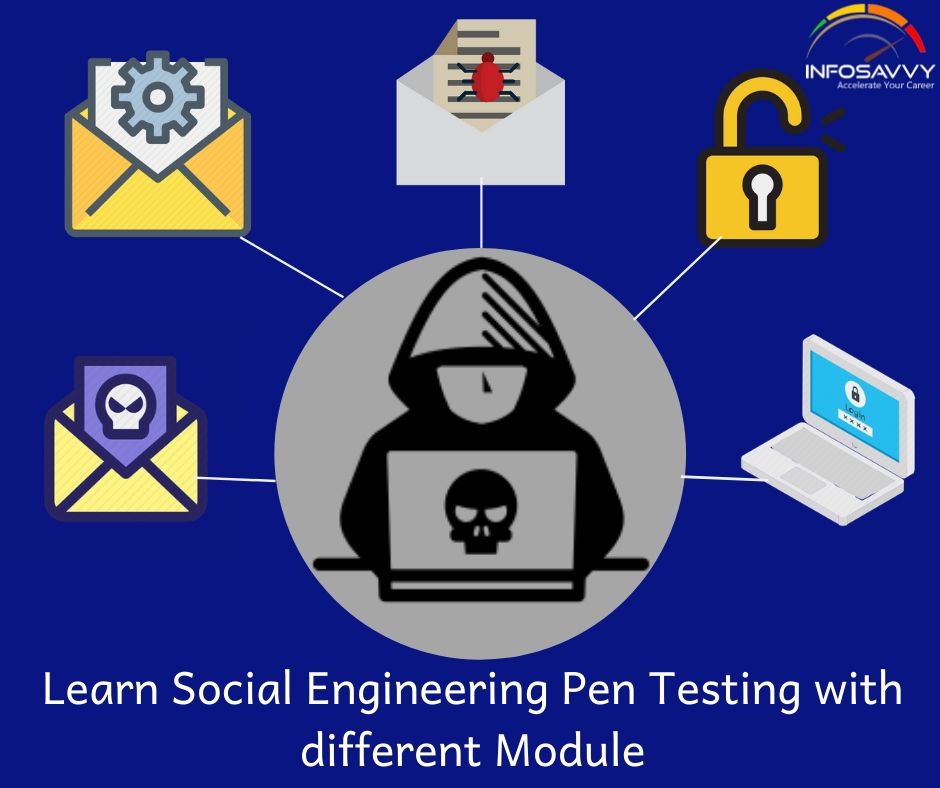
Learn Social Engineering Pen Testing with different Module

Learn Social Engineering Pen Testing with different Module-infosavvy

This article is explaining Whole concept of Social Engineering Pen Testing, There skills and Behaviors at risk of Attacks etc.

 What is Social Engineering Pen Testing?

Considering that you just are now familiar with all the mandatory concepts of social engineering, techniques to perform social engineering, and countermeasures to implement various threats, we are going to proceed to penetration testing. Social engineering pen testing is that the process of testing the target’s security against social engineering by simulating the actions of an attacker.This section describes social-engineering pen testing and also the steps to conduct the test.

The main objective of social-engineering pen testing is to check the strength of human factors during a security chain within the organization. Social-engineering pen testing helps to lift the extent of security awareness among employees. The tester should demonstrate extreme care and professionalism within the social engineering pen test, because it might involve legal issues like violation of privacy, and will lead to an embarrassing situation for the organization.

Pen Tester Skills:

  •  Good interpersonal skills
  •  Good communication skills
  •  Creative
  •  Talkative and friendly

 Social Engineering Concepts

There is no single security mechanism that can protect from social-engineering techniques employed by attackers. Only educating employees on a way to recognize and answer social-engineering attacks can minimize attackers’ chances of success. Before going ahead with this module, let’s first discuss various social engineering concepts.This section describes social-engineering, frequent targets of social-engineering, behaviors susceptible to attacks, factors making companies susceptible to attacks, why  It’s effective, and phases of a social-engineering attack.

Learn more in practical about network sniffing by becoming an EC-Council Certified Ethical Hacker from Infosavvy, Mumbai

“Social engineering bypasses all technologies, including firewalls.”

What are the Common Targets of Social Engineering?

A social engineer uses the vulnerability of human nature as their best tool, usually, people believe and trust others and derive fulfillment from helping the needy.

Discussed below are the foremost common targets of social engineering in an organization:

Receptionists and Help-Desk Personnel: Social engineers generally target service-desk or help-desk personnel of the target organization by tricking them into divulging tip about the organization. To extract information, like a number or a password, the attacker first wins the trust of the individual with the data. On winning their trust, the attacker manipulates them to induce valuable information. Receptionists and help-desk staff may readily share information if they feel they’re doing so to assist a customer.

Technical Support Executives: Another target of social-engineers are technical support executives, The social-engineers may take the approach of contacting technical support executives to get sensitive information by pretending to be a senior management, customer, vendor, and so on.

System Administrators: A computer user in a company is chargeable for maintaining the systems and thus he/she may have critical information like the sort and version of OS, admin passwords, and so on, that would be helpful for an attacker in planning an attack.

Users and Clients: Attackers could approach users and clients of the target organization, pretending to be a tech support person to extract sensitive information.

Vendors of the Target Organization: Attackers can also target the vendors of the organization to realize critical information that would be helpful in executing other attacks.

Click here for continue Reading:- https://www.info-savvy.com/learn-social-engineering-pen-testing-with-different-module/


This Blog Article is posted by
Infosavvy, 2nd Floor, Sai Niketan, Chandavalkar Road Opp. Gora Gandhi Hotel, Above Jumbo King, beside Speakwell Institute, Borivali West, Mumbai, Maharashtra 400092

Contact us – www.info-savvy.com

https://g.co/kgs/ttqPpZ

Information security

Best Cyber security career 2020 roadmap for IT Professionals

In this artical you will learn about best cyber security career for IT Professionals and how to create career plan, for that some points has given.

Looking to induce ahead in cybersecurity?

The economics of supply and demand shape today’s Cybersecurity job market. Each year, US employers post over 120,000 openings for information security analysts and roughly one-third go unfilled. Hiring managers are bracing for a continuation of this trend, with demand for Cybersecurity professionals expected to grow steadily through 2018.Unsurprisingly, Cybersecurity salaries reflect this severe talent scarcity. The median annual wages for information security analysts is over 10% greater than that for all computer occupations, and almost 150% above that of all US occupations, in line with the Bureau of Labor Statistics. And as high-ranking roles including chief security officers begin reporting on to CEO’s and corporate boards, compensation is probably going to leap further.

“Cyber-Security is much more than a Matter of IT”

For those with the correct skills and skill, it is a job-seeker’s market. But universal demand and negligible supply don’t change the actual fact that Cybersecurity is an evolving field. Strategies, threats, and also the skills to combat them can and can pivot over the approaching months, making it tougher for candidates to qualify — and stay relevant — for these lucrative opportunities.

Landing the task, and Rising through the Ranks

Faced with boundless opportunity and constant change, IT professionals ought to make strategic choices about their own development to create a long-term Cybersecurity career.Here are four areas to stay in mind as you create a five-year career plan.

  1. Progressive certifications: Technical certifications are valuable for any IT professional hoping to face call at an applicant pool, and also the same rules apply to Cybersecurity jobs. For entry-level, mid-career, and executive positions alike, employers increasingly want verification of job-seekers’ security chops. Foundational certifications like CompTIA’s Security+ are becoming a prerequisite for anyone starting a Cybersecurity career, demonstrating a solid grasp thereon threats, compliance, and identity management — but by no means should your education end there. From the International data system Security Certification Consortium’s Certified Information Systems Security Professional (CISSP) and CompTIA’s CyberSecurity Analyst (CSA+) and Advanced Security Practitioner to moral hacking certifications, there are ample opportunities for training and specialization targeted at experienced professionals looking to maneuver up the ladder.

    Hello, I really like your blog such a nice information thanks for sharing blog it's very useful information about CEH cource. you can also check on this website-https://bit.ly/2NZAie4
  2. Strategic communication skills: Cyber-security doesn’t fall only under a CISO or IT department’s purview. Responsibility (and accountability) for defending corporate data and devices lies, in part, with end users, C-suites, and boards of directors also . Cyber-security experts must be ready to communicate effectively with each audience, whether to teach employees about the hazards or secure buy-in for brand spanking new security investments. To graduate into senior leadership roles, cyber-security professionals got to demonstrate communication mastery with external audiences. As more organizations become embroiled in data breaches and legal matters (over issues like encryption), they’ll need experts with not only technical smarts but the capacity to navigate crisis communications and public sector partnerships.
  3. Government clearances: most industries are in need of more cyber-security manpower, but the general public sector is one vertical playing a fanatical game of catch-up. Per the Federal Cyber-security Workforce Strategy released last July, the govt is on the hook to more proactively identify internal cyber-security gaps, better recruit security experts, and develop career paths to retain top talent. Beyond technical certifications, public administration Cyber-security jobs are almost 3 times as likely to need security clearances as Cyber-security openings generally . Obtaining the acceptable clearances beforehand can set a resume apart, and expedite the hiring process.
  4. Digital forensics: As organizations and governments round the world accept the inevitability of cyber-attacks (or, at least, attempts), greater attention and resources must be paid to what happens in their wake. the sector of digital forensics — extracting “evidence” from devices and other IT systems to know , potentially prosecute, and later prevent, cyber-crimes — is in need of quite a couple of good recruits. As threats from state-sponsored actors, gangland groups and hacktivists rise, the general public and personal sectors need experts who concentrate on reverse-engineering attacks and threat hunting. Professionals who concentrate their training around digital forensics now are going to be invaluable because the Cyber-security landscape becomes more globalized and litigious.

click here for continue reading :-https://www.info-savvy.com/best-cyber-security-career-2020-roadmap-for-it-professionals-with-5-years-of-experience/

This Blog Article is posted by

Infosavvy2nd Floor, Sai Niketan, Chandavalkar Road Opp. Gora Gandhi Hotel, Above Jumbo King, beside Speakwell Institute, Borivali West, Mumbai, Maharashtra 400092

Contact us –www.info-savvy.com

https://g.co/kgs/ttqPpZ

Information security

Top IT Management Certifications of 2020 to Impress Recruiters

IT managers are often responsible not only for overseeing the IT infrastructure in a company but overseeing IT teams still. To succeed as an IT manager, you’ll got to understand the basics of security, data storage, hardware, software, networking and IT management frameworks.

IT Management Certifications

The certifications that you’ll want for an IT management position will vary counting on the kinds of technology you’re employed with and also the methodologies your organization subscribes to. But if you’re already on the management track, or have your eye on an IT management career, anyone of those 10 IT management certifications will give you a leg up within the industry.
The consensus: Certifications certainly can make a difference, but not all certifications are created equal. Below are some of the ones that recruiters say actually move the needle in their decision to hire a candidate — if one of them is relevant to your field, consider looking into it! 

https://www.info-savvy.com/top-it-management-certifications-of-2020-to-impress-recruiters/

1. AWS Certified Solutions Architect – Associate

The AWS Certified Solutions Architect Associate-level exam demonstrates an individual’s expertise in designing and deploying scalable systems on AWS. It’s unsurprising to ascertain this certification again in our top five thanks to the market need for skilled and licensed AWS solutions architects. This certification has been here for several years, showing what quantity demand there’s year after year because of the expansion within the cloud.This is the prerequisite step to achieving the AWS Certified Solutions Architect – Professional certification.

2. AWSCertified Developer – Associate

This certification cracks our top five for the second straight year. It validates technical expertise in developing and maintaining applications on AWS, as against designing the answer with the Solutions Architect certification. Achieving the AWS Certified Developer certification demonstrates the power to efficiently use AWS SDKs to interact with services from within applications and write code that optimizes AWS application performance. The explosion in popularity of the AWS Certified Developer certification is directly correlated with the rapid climb of organizations developing cloud-based applications to quickly advance their footprint and remain competitive. This is also associated with the explosive growth in IoT (Internet of Things) and mobile development, much of which is backed by resources within the cloud.

3. ITIL® Foundation

Over the last 30 years, ITIL has become the foremost widely used framework for IT management within the world. Why? It’s a group of best practices for aligning the services IT provides with the wants of the organization. It covers everything from availability and capacity management to vary and incident management, additionally to application and IT operations management. And this year, ITIL is getting an upgrade. ITIL 4 was released earlier this year and reflects new ways of working that have accompanied the digital revolution, like DevOps, Agile and Lean IT. ITIL Foundation is that the entry-level ITIL certification and provides a broad-based understanding of the IT service life-cycle.
This certification is accepted as a framework for managing the IT lifecycle. As such, it’s different from the opposite certifications on this list and is one among the few that focuses on the intersection of IT and also the needs of the business.

https://www.info-savvy.com/top-it-management-certifications-of-2020-to-impress-recruiters/

4. Certified Information Security Manager (CISM)

ISACA created and maintains the CISM certification. it’s a management-focused certification, aimed toward professionals who build and manage an enterprise’s information security. CISM promotes international security best practices.

5. Certified in Risk and data Systems Control (CRISC)

ISACA offers and manages this certification. When it involves risk management proficiency, CRISC is that the truest evaluation there’s. CRISC-certified professionals help organizations understand business risk, and possess the talents to implement, develop and maintain information systems controls.

“Management is doing things right; leadership is doing the right things”
– Peter F. Drucker

6. Certified Information Systems Security Professional (CISSP)

Offered by the International Information Systems Security Certification Consortium (ISC)² as a vendor-neutral credential, CISSP is meant to prove security expertise. like the opposite security-related certifications, demand is high and is projected to be so for several years to return.
CISSP may be a widely desired indicator of data , experience and excellence on the resume of the many IT professionals. CISSP isn’t just a recommendation by industry groups—it has achieved its respected position as a crucial IT certification through practical observation. The drive to realize this notable certification is evidenced in its appearance on a big number of job postings. Performing employment search in any moderate or larger metropolitan area reveals that an astounding number of IT and security positions request that the applicant be CISSP-certified.

7. Certified Ethical Hacker (CEH)

The International Council of E-Commerce Consultants (EC-Council) created and manages the CEH certification, which is geared toward security officers and auditors, site administrators, etal. liable for network and data security. The exam is meant to check a candidate’s abilities to prod for holes, weaknesses and vulnerabilities during a company’s network defenses using techniques and methods that hackers employ. The difference between a hacker and a CEH is that a hacker wants to cause damage, steal information, etc., while the CEH wants to repair the deficiencies found. The goal of this certification is to master ethical hacking methodology which will be utilized in penetration testing. These skills are in-demand and internationally-recognized. CEH applies equally to on-premises and cloud deployments. Given the numerous attacks and great volume of private data in danger and therefore the potential legal liabilities, the requirement for CEHs is high, hence the salaries reported. The CEH certification is continually being updated to match the tools and techniques employed by hackers and knowledge security professionals alike to interrupt into any computing system. you’ll be immersed into a “Hacker Mindset” so as to think sort of a hacker and better defend against future attacks.


This Blog Article is posted by

Infosavvy, 2nd Floor, Sai Niketan, Chandavalkar Road Opp. Gora Gandhi Hotel, Above Jumbo King, beside Speakwell Institute, Borivali West, Mumbai, Maharashtra 400092


Contact us www.info-savvy.com 

https://goo.gl/maps/vYF7s2sje1vUdi3S6

Information security

10 Types of Identity Theft You Should Know About

Identity Theft is an article to learn about This & its types, Indication with different types of techniques which is used by attackers etc.

What is identity theft?

Identity theft could be a problem that several consumers face today. Within the us, some state legislators have imposed laws restricting employees from providing their SSNs (Social Security Numbers) during their recruitment. Identity theft frequently figures in news reports. Companies should learn about identity theft, so they do not endanger their own anti-fraud initiatives.

This section discusses identity theft, identity theft statistics, techniques for obtaining personal information for fraud and therefore the various steps involved in stealing an identity.

The fraud and Assumption Deterrence Act of 1998 define identity theft as the illegal use of someone’s identification. Identity theft occurs when someone steals others personally identifiable information for fraudulent purposes. Attackers illegally obtain personally identifying information to commit fraud or other criminal acts. Learn more about identity theft in CEH from Infosavvy.

“The more quickly you detect Identity Theft, The Easier It is to Recover”

Types of personally identifiable information stolen by identity thieves:

Attacker steals people’s identity for fraudulent purposes such as:

  Opening a brand new credit card accounts within the name of the user without paying the bills
 Opening a new phone or wireless account in the user’s name, or running up charges on his/her existing account- Using victims’ information to get utility services like electricity, heating, or cable TV
  Opening bank accounts for writing bogus checks using victims’ information
  Cloning an ATM or open-end credit to form electronic withdrawals from victims’ accounts
Obtaining loans those victims are liable
  Obtaining driving licenses, passport, or other official ID cards that contain victims’ data but attackers’ photos
Using victims’ names and social security numbers to receive their government benefits
  Impersonating employees of a target organization to physically access its facility
–  Taking over insurance policies- Selling personal information
  Ordering goods online employing a drop-site
  Hijacking email accounts
  Obtaining health services
  Submitting fraudulent tax returns
 Committing other crimes, then providing victims’ names to the authorities during their arrest, rather than their own

What are the types of identity theft?

Identity theft is consistently increasing and the identity thieves are finding new ways or techniques to steal different sort of target’s information. a number of the identity theft types are as follow:

Child identity theft:- This type of identity theft occurs when the identity of a minor is stolen because it goes undetected for an extended time. After birth, parents apply for a SSN or Social Security Number of their child which along with a special date of birth is used by identity thieves to use for credit accounts, loans or utility services, or to rent an area to measure and apply for state benefits.

Criminal identity theft:- This is one in all the most common and damaging kind of fraud where a criminal uses identity of somebody else’s and escapes criminal charges. When he’s caught or arrested, he provides the fake identity. The simplest way of protection against criminal fraud is to stay your personal information secure that has following safe Internet practices and being cautious of “shoulder surfers”.

Financial identity theft:- This type of fraud occurs when a victim’s checking account and MasterCard information are stolen and used illegally by a thief. He can reach MasterCard and withdraw money from the account or he can use the stolen identity to open a replacement account, get new credit cards and take loans. The knowledge that’s required to hack into the victim’s account and steal his information is obtained by the thieves through viruses, phishing attacks or data breaches.

Driver’s License fraud:- This type of fraud is that the easiest because it requires touch sophistication. an individual can lose his/her driver’s license or it are often easily stolen. Once it falls into the incorrect hands, the perpetrator can sell the driver’s license or misuse the fake driver license by committing traffic violations, of which victim is unaware of and fails to pay fine, and find you in having his license suspended or revoked.

Insurance identity theft:- This type of identity theft is closely associated with medical fraud; it takes place when a perpetrator unlawfully takes the victim’s medical information so as to access his insurance for a medical treatment. Its effects include difficulties in settling medical bills, higher insurance premiums and doubtless trouble in acquiring medical coverage afterward.

Medical identity theft:- This is the foremost dangerous sort of identity theft where the perpetrator uses victim’s name or information without the victim’s consent or knowledge so as to get medical products and claim insurance or healthcare services. Medical fraud leads to frequent erroneous entries within the victim’s medical records, which could lead on to false diagnosis and life-threatening decisions by the doctors.

Tax identity theft:- This type of identity theft occurs when perpetrator steals the victim’s Social Security Number or SSN so as to file fraudulent tax returns and acquire fraudulent tax refunds. It creates difficulties for the victim in accessing the legitimate tax refunds and leads to a loss of funds. Phishing emails are one among the most ricks employed by the criminal to steals a target’s information, Therefore, protection from such fraud includes adoption of safe Internet practices.

Identity Cloning and Concealment:- This is a kind of identity theft which encompasses all sorts of identity theft where the perpetrators plan to impersonate somebody else so as to easily hide their identity. These perpetrators might be illegal immigrants or those hiding from creditors or just want to become “anonymous” thanks to another reasons.

Synthetic identity theft:- This is one among the foremost sophisticated sorts of identity theft where the perpetrator obtains information from different victims to make a replacement identity. Firstly, he steals a Social Security Number or SSN and uses it with a mixture of faux names, date of birth, address and other details required for creating new identity. The perpetrator uses this new identity to open new accounts, loans, credit cards, phones, other goods and services. Learn more about types of identity theft in CEH from infosavvy.

Social identity theft:- This is another most typical sort of identity theft where the perpetrator steals victim’s Social Security Number or SSN so as to derive various benefits like selling it to some undocumented person, use it to defraud the govt by getting a replacement checking account, loans, credit cards or for passport.

“If we don’t act now to safeguard our privacy, we could all become victims of identity Theft”
                                                                                                        – Bill Nelson

What are different techniques attackers use to get personal information for identity theft?

Discussed below are some methods by which attackers steal targets’ identities, which successively allow them to commit fraud and other criminal activities.
Theft of wallets, computers, laptops, cell phones, backup media, and other sources of private information Physical theft is common. Attackers steal hardware from places like hotels and recreational places, like clubs, restaurants, parks, and beaches. Given adequate time, they will recover valuable data from these sources.

Internet Searches:- Attackers can gather a substantial amount of sensitive information via legitimate websites, using search engines like Google, Bing, and Yahoo!

Social Engineering:- Social engineering is that the art of manipulating people into performing certain actions or divulging personal information, and accomplishing the task without using cracking methods.

Dumpster Diving and Shoulder Surfing:- Attackers rummage through household garbage and trash bins of a corporation, ATM centers, hotels, and other places to get personal and financial information for fraudulent purposes.

Criminals may find user information by glancing at documents, personal identification numbers (PINS) typed into an cash machine (ATM), or by overhearing conversations.

Phishing:- The “fraudster” may pretend to be from a financial organization or other reputable organization and send spar or pop-up messages to trick users into revealing their personal information.

Skimming:- Skimming refers to stealing credit/debit card numbers by using special storage devices called skimmers or wedges when processing the cardboard.

Pretexting:- Fraudsters may pose as executives from financial institutions, telephone companies, and so on, who believe “smooth talking” and win the trust of a private to reveal sensitive information.

Pharming:- Pharming also referred to as domain spoofing, is a complicated sort of phishing during which the attacker redirects the connection between the IP address and its target server. The attacker may use cache poisoning (modifying the web address thereto of a rogue address) to do so. When the users type within the Internet address, it redirects them to a rogue website that resembles the first website.

Hacking:- Attackers may compromise user systems and route information using listening devices like sniffers and scanners. They gain access to an abundance of knowledge, decrypt it (if necessary), and use it for identity theft.

Key loggers and Password Stealers (Malwares):- An attacker may infect the user’s computer with Trojans, viruses, and so on, and then collect the keyword strokes to steal passwords, user names, and other sensitive information of private, financial, or business importance.

Attackers can also use err ails to send fake forms like tax income Service (IRS) forms to collect information from the victims.

War driving:- Attackers look for unsecure Wi-Fi wireless networks in moving vehicles containing laptops, smartphones, or PDAs. Once they find unsecure networks, they access sensitive information stored in users’ devices on those networks.

Mail Theft and Rerouting:- Often, mailboxes contain bank documents (credit cards or account statements), administrative forms, and more. Criminals use this information to get MasterCard information, or to reroute the mail to a replacement address. 

What are Indications of identity theft?

People don’t realize that they’re the victim of identity theft until they experience some unknown and unauthorized issues occurring thanks to their stolen identity. Therefore, it’s of paramount importance that folks should be careful for the warning signs for his or her identities that are compromised. Listed below are a number of signs showing you’re a victimof an identity theft?

click here for continue blog:- https://www.info-savvy.com/10-types-of-identity-theft-you-should-know-about/

This Blog Article is posted byInfosavvy, 2nd Floor, Sai Niketan, Chandavalkar Road Opp. Gora Gandhi Hotel, Above Jumbo King, beside Speakwell Institute, Borivali West, Mumbai, Maharashtra 400092

Contact us – www.info-savvy.comhttps://goo.gl/maps/vYF7s2sje1vUdi3S6

https://goo.gl/maps/vYF7s2sje1vUdi3S6

Information security

Introduction of USB Spyware and It’s types

In this Spyware artical you will learn about USB, Spyware Engendering, Types of USB,Types of Spyware like Desktop, Email,Child-Observing, Internet etc.

What is USB Spyware ?
USB spyware screens and breaks down information moved between any USB gadget associated with a PC and its applications. It helps in application improvement, USB gadget driver or equipment advancement and offers an incredible stage for successful coding, testing, and streamlining.

Coming up next is the rundown of USB spyware:
• USB Analyzer
• USB Screen
• USB Review
• Advanced USB Port Screen
• USB Screen Professional
• Free USB Analyzer
• USBlyzer
• Usb Sniffer for Windows
• USB Trace
• Key Carbon LAB
• USB 2GB Key logger Wife

USB spyware may be a program intended for keeping an eye on the PC that duplicates spyware records from a USB gadget onto the hard circle with no solicitation and warning. It runs in concealed mode, so clients won’t know about the spyware or the observation.
USB spyware gives a multifaceted arrangement within the area of USB interchanges, because it is fit checking USB devices’ movement without making extra channels, gadgets, etc which will harm the framework driver structure.
USB spyware allows you to catch, show, record, and examine the information moved between any USB gadget associated and a PC and its applications. This empowers it to require a shot at gadget drivers or equipment improvement, therefore giving an incredible stage to viable coding, testing, and advancement, and makes it an extraordinary instrument for investigating programming.
Learn in Details about Investigation techniques in CEH Mumbai,

“The purpose of technology is not to confuse the brain but to serve the body”

It catches all of the correspondences between a USB gadget and its host and spares it into a shrouded document for later audit. A nitty gritty log displays an outline of each datum exchange, alongside its help data. The USB spyware utilizes low framework assets of the host PC. This works with its own timestamp to log all of the exercises within the correspondence succession. USB spyware doesn’t contain any adware or other spyware.

It works with latest variations of Windows.
• USB spyware duplicates records from USB gadgets to your hard plate in concealed mode with no solicitation
• It makes a shrouded document/index with this date and starts the foundation replicating process
• It enables you to catch, show, record, and break down information moved between any USB gadget related to a PC and applications

What are types of USB Spyware?

Audio Spyware
Sound spyware may be a sound reconnaissance program intended to record sound onto the PC. The aggressor can introduce the spyware on the PC without the authorization of the PC client during a quiet way without sending any notice to the client. The sound spyware runs out of sight to record circumspectly. Utilizing sound spyware doesn’t require any regulatory benefits.
Sound spyware screens and records an assortment of sounds on the PC, sparing them during a concealed document on the neighborhood circle for later recovery. Subsequently, assailants or malignant clients utilize this sound spyware to snoop and screen gathering accounts, telephone calls, and radio stations which will contain the private data.
It is fit recording and spying voice visit messages of different well known moment couriers. With this sound spyware, individuals can look out for their workers or kids and see with whom they’re discussing.
It screens advanced sound gadgets, for instance , different delivery people, amplifiers, and mobile phones. It can record sound discussions by spying and screen all ingoing and active calls, instant messages, etc. they allow ive call checking, sound observation, track SMS, logging all calls, and GPR5 following.

Video Spyware Video spyware is programming for video reconnaissance introduced on the target PC without the user’s information. All video movement are often recorded by a modified timetable. The video spyware runs straightforwardly out of sight, and furtively screens and records webcams and video IM transformations. The remote access highlight of video spyware enables the aggressor to accompany the remote or target framework to actuate alarms and electric gadgets, and see recorded pictures during a video document or maybe get live pictures from all of the cameras related to this framework utilizing an online browser, for instance , Web Adventurer.

Print Spyware
Aggressors can screen the printer use of the target association remotely by utilizing print spyware. Print spyware is printer use checking programming that screens printers within the association. Print spyware gives exact data about print exercises for printers within the workplace or nearby printers, which helps in advancing printing, sparing expenses, etc. It records all data identified with the printer exercises, spares the info in encoded log, and sends the log document to a predetermined email address over the web. The log report comprises of the definite print work properties, for instance , number of pages printed, number of duplicates, content printed, the date and time at which the print move made spot.
Print spyware records the log reports in various arrangements for various purposes, for instance , a web position for sending the reports to an email through the web or the web and in covered up scrambled organization to store on the neighborhood plate. The log reports produced MI help assailants in examining printer exercises. The log report shows what number of records every representative or workstation printed, alongside the time frame. These aides in checking printer utilization and to make a decision how representatives are utilizing the printer. This software also allows limiting access to the printer. This log report helps attackers to trace out information about sensitive and secret documents printed.

Telephone/Mobile phone Spyware
Phone/mobile phone spyware may be a product instrument that provides you full access to screen a victim’s telephone or cell. it’ll totally conceal itself from the client of the telephone. it’ll record and log all action on the telephone, for instance , Web use, instant messages, and telephone calls. At that time you’ll get to the logged data by means of the software’s principle site, or you can likewise get this following data through SMS or email. Typically, this spyware screens and track telephone utilization of workers. In any case, assailants are utilizing this spyware to follow data from their objective person’s or organization’s phones/PDAs. Utilizing this spyware doesn’t require any approved benefits.

“Know who you are buying from. These are interesting times with loats of risks.”

Most normal phone cell phone spyware highlights include:Call History: Enables you to see the whole call history of the telephone (both approaching and active calls).
View Instant messages: Empowers you to see all approaching and active instant messages. It even shows erased messages in the log report.
Web Webpage History: Records the whole history of all sites visited through the telephone in the log report document.
GPS Following: Gives you where the telephone is progressively. There is additionally a log of the cell phone’s area so you can see where the telephone has been.

Click here for continue blog– https://www.info-savvy.com/introduction-of-usb-spyware-and-its-types/

This Blog Article is posted by,
Infosavvy, 2nd Floor, Sai Niketan, Chandavalkar Road Opp. Gora Gandhi Hotel, Above Jumbo King, beside Speakwell Institute, Borivali West, Mumbai, Maharashtra 400092


Contact us – www.info-savvy.com

Information security

Learn more about GPS Spyware & Apparatuses

What is GPS Spyware?

GPS spyware may be a gadget or programming application that uses the Worldwide Situating Framework (CPS) to make a decision the area of a vehicle, individual, or other connected or introduced resource. An aggressor can utilize this product to follow the objective individual.

This spyware enables you to follow the telephone area focuses and spares or stores them during a log record and sends them to the predefined email address. you’d then be ready to watch the target client area focuses by signing into the predefined email address, and it displays the associated point’s hint of the telephone area history on a guide. It likewise sends email warnings of area vicinity cautions. An aggressor follows the area of the target individual utilizing GPS spyware, as appeared within the accompanying figure.

Spyware Apparatuses

Spytech SpyAgent: Spytech Spy Specialist is PC spy programming that enables you to screen everything clients do on your PC in absolute mystery. Spy Agent gives an enormous cluster of fundamental PC observing highlights, even as site, application, and visit customer blocking, logging booking, and remote conveyance of logs by means of email or FTP.

It can likewise enable you to screen following things on a user’s PC:

• it can uncover all sites visited
• It records every online inquiry performed
• It screens what projects and applications are being used
• It can follow all document use and printing data
• It records online visit discussions
• It is likewise ready to see each email correspondence on the user’s PC
• It encourages you figure out what the client is transferring and downloading
• It reveals mystery client passwords
• It screens long range interpersonal communication practices
• Power SpyForce Spy may be a PC-client action checking programming. it runs and performs checking subtly out of sight of PC framework. It logs all clients on the framework and clients won’t know its reality. After you introduce the product on the PC you would like to screen, you’ll get log reports by means of email; or celebrity from a remote area, as an example , each hour. during this manner, you’ll peruse these reports anyplace, on any gadget whenever as long as you’ve got Web get to. Force Spy tells you exactly what others do on the PC while you’re away.

Email Recording: Force Spy records all emails read in Microsoft Viewpoint, Microsoft Standpoint Express, In Mail, and Windows Live Mail.

GPS Important Highlights

Screen Recording: Force Spy Programming consequently catches screen captures of whole desktop or dynamic windows at set interim, spares screen captures as JPEG position pictures on your hard plate, or sends them to you with content logs and naturally stops screen capture when observed clients are dormant.

Keylogger: The product logs all keystrokes, including discretionary non-alphanumeric keys, with a period stamp, Windows username, and application name and window inscription. This incorporates all client names and passwords composed with program window inscription.

Text and Visit Recording: It screens and records IM and talks in Skype, Yippee Delivery person, and Point. It incorporates both approaching and active data with time stamps and client IDs, Spyware.

Learn More about Investigation techniques in ECIHV2 from Infosavvy, Mumbai

What are the types of Spyware?

Audio Spyware: Sound spyware screens sound and voice recorders on the framework. It imperceptibly begins recording once it identifies sound and naturally quits account when the voice vanishes. it very well may be utilized in recording meetings, checking telephone calls, radio telecom logs, spying and representative observing, and so on.

Video Spyware:Video Spyware is utilized for mystery video reconnaissance. An aggressor can utilize this product to furtively screen and record webcams and video IM transformations. An aggressor can utilize video spyware to remotely see webcams so as to get live film of mystery correspondence. With the assistance of this spyware, aggressors can record and play anything showed on victims screen.

Cellphone Spyware:Like Versatile Government agent, an aggressor can likewise utilize the accompanying programming programs as phone/mobile phone spyware to record all action on a telephone, for example, Web utilization, instant messages and telephone calls, etc.

GPS Spyware: There are different programming programs that go about as GPS spyware to follow the area of specific cell phones. Assailants can likewise utilize the accompanying GPS spyware programming to tack the area of target mobiles.

Click here for continue reading:-https://www.info-savvy.com/learn-more-about-gps-spyware-apparatuses/


This Blog Article is posted by

Infosavvy2nd Floor, Sai Niketan, Chandavalkar Road Opp. Gora Gandhi Hotel, Above Jumbo King, beside Speakwell Institute, Borivali West, Mumbai, Maharashtra 400092

Contact us – www.info-savvy.com
Information security

Everything You Need To Know About Sniffing – Part 2

Vulnerable to sniffing

The following protocols are vulnerable to sniffing. The most reason for vulnerable to Sniffing these protocols is to accumulate passwords:

Telnet and Rlogin

Telnet may be a protocol used for communicating with a remote host (via port no. 23) on a network by using a instruction terminal. Rlogin enables an attacker to log into a network machine remotely via TCP connection. The protocols fail to supply encryption; therefore the data traversing between the clients connected through any of those protocols is in plain text and vulnerable to Sniffing, Attackers can sniff keystrokes including usernames and passwords.

HTTP

Due to vulnerabilities within the default version of HTTP, websites implementing HTTP transfer user data across the network in plain text, which the attackers can read to steal user credentials,

SNMP

SNMP may be a TCP/IP based protocol used for exchanging management information between devices connected on a network. The primary version of SNMP (SNMPv1) doesn’t offer strong security, which results in transfer of knowledge in clear text format. Attackers exploit the vulnerabilities during this version so as to accumulate passwords in plain text.

  • Network News Transfer Protocol (NNTP) distributes, inquires, retrieves, and posts news articles employing a reliable stream-based transmission of news among the ARPA-Internet
  • NNTP community, the protocol fails to encrypt the data which provides an attacker the chance to sniff sensitive information.

POP

The Post Office Protocol (POP) allows a user’s workstation to access mail from a mailbox server. A user can send mail from the workstation to the mailbox server via the simple Mail Transfer Protocol (SMTP). Attackers can easily sniff the data flowing across a POP network in clear text due to the protocol’s weak security implementations.

FTP

File Transfer Protocol (FTP) enables clients to share files between computers during a network. This protocol fails to supply encryption; so attackers sniff data also as user credentials by running tools like Cain & Abel.

IMAP

Internet Message Access Protocol (IMAP) allows a client to access and manipulate electronic message messages on a server. This protocol offers inadequate security, which allows attackers to get data and user credentials in clear text.

Sniffing within the data link Layer of the OSI Model

The Open Systems Interconnection (OSI) model describes network functions as a series of severs layers. Each layer provides services to the layer above it and receives services from the layer below.

The Data Link layer is that the second layer of the OSI model. During this layer, data packets are encoded and decoded into bits. Sniffers operate at the data Link layer and may capture the packets from the data Link layer. Networking layers within the 051 model are designed to work independently of every other; if a sniffer sniffs data within the data link layer, the upper OSI layer won’t be aware of the vulnerable to Sniffing.

Read more for continue blog:-https://www.info-savvy.com/everything-you-need-to-know-about-sniffing-part-2/

This Blog Article is posted byInfosavvy2nd Floor, Sai Niketan, Chandavalkar Road Opp. Gora Gandhi Hotel, Above Jumbo King, beside Speakwell Institute, Borivali West, Mumbai, Maharashtra 400092

visit:- https://www.info-savvy.com/

Information security

Everything You Need To Know About Sniffing – Part 1

What is a sniffer in hacking?This section describes network sniffing and threats, how a sniffer works, active and passive sniffing, how an attacker hacks a network using sniffers, protocols susceptible to sniffing, sniffing within the data link layer of the OSI model, hardware protocol analyzers, SPAN ports, wiretapping, and lawful interception.

Network SniffingPacket sniffing may be a process of monitoring and capturing all data packets passing through a given network sniffer by using a software application or a hardware device, Sniffing is simple in hub-based networks, because the traffic on a segment passes through all the hosts related to that segment. However, most networks today work on switches. A switch is a complicated computer networking device.

the main difference between a hub and a switch is that a hub transmits line data to every port on the machine and has no line mapping, whereas a switch looks at the Media Access Control (MAC) address related to each frame passing through it and sends the data to the specified port.

A MAC address may be a hardware address that uniquely identifies each node of a network,An attacker must manipulate the functionality of the switch so as to see all the traffic passing through it. 

packet sniffing program (also known as a Ip sniffer) can capture data packets only from within a given subnet, which suggests that it cannot sniff packets from another network. Often, any laptop can plug into a network and gain access to it. Many enterprises’ switch ports are open.

A packet sniffer placed on a network in promiscuous mode can capture and analyze all of the network traffic. Sniffing programs close up the filter employed by Ethernet network interface cards (NICs) to stop the host machine from seeing other stations’ traffic. Thus, sniffing programs can see everyone’s traffic.Though most networks today employ switch technology, packet sniffing remains useful.

This is often because installing remote sniffing programs on network components with heavy traffic flows like servers and routers is comparatively easy. It allows an attacker to watch and access the whole network traffic from one point. Packet sniffers can capture data packets containing sensitive information like passwords, account information, syslog traffic, router configuration, DNS traffic, Email traffic, web traffic, chat sessions, FTP password, etc. It allows an attacker to read passwords in clear-text, the particular emails, credit card numbers, financial transactions, etc.

It also allows an attacker to smell SMTP, POP, IMAP traffic, POP, IMAP, HTTP Basic, Telnet authentication, SQL database, SMB, NFS, and FTP traffic. An attacker can gain a lot of data by reading captured data packets then use that information to interrupt into the network.An attacker carries out attacks that are simpler by combining these techniques with the active transmission. You can learn more in practical about network sniffing by becoming an EC-Council Certified Ethical Hacker from Infosavvy, Mumbai.

Read more for continue blog:- https://www.info-savvy.com/everything-you-need-to-know-about-sniffing-part-1/

This Blog Article is posted byInfosavvy2nd Floor, Sai Niketan, Chandavalkar Road Opp. Gora Gandhi Hotel, Above Jumbo King, beside Speakwell Institute, Borivali West, Mumbai, Maharashtra 400092

visit:- https://www.info-savvy.com/