Cyber-security

The fall of security questions or password reset question

The fall of security questions or password reset question based on this topic article is written basically security this very important from anywhere and any field also for maintaining security we create the password but some time it happens to forgot  password at that time there should be some questions to maintain security zone once asked question would be right then and then only that particular user can create a new password.

I think we’ve reached some extent during which organizations and individuals need their security inquiries to produce more formidable hurdles for would-be hackers. The challenge for organizations is to not make the safety questions so difficult that users are unable to recollect their answers later.

To be useful, a far better security question should:

  • Be fairly easy to recollect , even years later.
  • Contain thousands of possible answers, so it isn’t easily guessed.
  • Not be a subject frequently found on social media.
  • Have a solution that never changes

There could also be times once you forget your password. you’ll recover it by answering secret questions that you simply found out yourself. you’ll add up to 3 secret questions. one among these questions are going to be presented if you click the Forgot Password? Suppose you forgot the solution to a specific question, system will ask another one among your secret questions. After you answer the key question, you’ll receive e-mail notification of your new password. It is recommended that you simply found out the key questions in order that you’ll reset your own password.

“Security Can Protect Your Business”

There are some questions with answers related to security question and why it is need, password reset question is secure or not such type of thing explained.

1. What is security question and answer?

A security question is sort of shared secret used as an authenticator. it’s commonly employed by banks, cable companies and wireless providers as an additional security layer. Financial institutions have used inquiries to authenticate customers since a minimum of the first 20th century.

2. Why can we ask security questions?

Security questions can add an additional layer of certainty to your authentication process. Security questions are an alternate way of identifying your customers once they have forgotten their password, entered the incorrect credentials too repeatedly , or tried to log in from an unfamiliar device or location.

Also Read :- Top cyber security certifications of 2020 in India

3. What is purpose of security?

The purpose of security is to stay you, your family, and your properties safe from burglaries, theft and other crimes. Private residential security guards make sure the safety of all the residents living within the community they serve.

4. Why is security so important?

Information security performs four important roles: Protects the organisation’s ability to function. Enables the safe operation of applications implemented on the organisation’s IT systems. Protects the info the organisation collects and uses.

5. What is a password reset question?

Password recovery questions, more commonly called security questions (or secret questions and answers), are wont to verify you because the legitimate owner of a web account when you’ve forgotten your password or are otherwise trying to recover a web account.

Related Product :- Certified Ethical Hacker | CEH Certification

the problem with all security questions, regardless of how difficult they’re , is that they are intended to be simpler to use than passwords because the question itself is meant to trigger your memory. To combat the more simplistic nature of security questions administrators often ask, end users might consider protecting themselves further by providing random answers that can’t be researched or guessed. In effect, we are suggesting that your answers be more random in order that they act more sort of a password.

Read More : https://info-savvy.com/the-fall-of-security-questions-or-password-reset-question/


This Blog Article is posted by

Infosavvy, 2nd Floor, Sai Niketan, Chandavalkar Road Opp. Gora Gandhi Hotel, Above Jumbo King, beside Speakwell Institute, Borivali West, Mumbai, Maharashtra 400092

Contact us – www.info-savvy.com

Cyber-security

For a hacker, chaos isn’t a pit, Chaos is ladder

For a hacker, chaos isn’t a pit, Chaos is ladder this idea is explained during this article with the assistance of some hacker and their terms.

“To better describe hacking, one needs to first understand hackers.” 

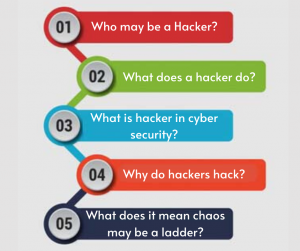
Who may be a Hacker?

A hacker is a private who uses computer, networking or other skills to beat a technical problem. The term hacker may ask anyone with technical skills, but it often refers to an individual who uses his or her abilities to realize unauthorized access to systems or networks so as to commit crimes. A hacker may, for instance , steal information to harm people via fraud , damage or bring down systems and, often, hold those systems hostage to gather ransom.

What does a hacker do?

Computer hackers are unauthorized users who forced an entry computer systems so as to steal, change or destroy information, often by installing dangerous malware without your knowledge or consent. Their clever tactics and detailed technical knowledge help them access the knowledge you actually don’t need them to possess.

“Most hackers are young because children tend to be adaptable. As long as you remain adaptable, you’ll always be an honest hacker.”
? Emmanuel Goldstein

What is hacker in cyber security?

A hacker is a private who uses computer, networking or other skills to beat a technical problem. The term hacker may ask anyone with technical skills, but it often refers to an individual who uses his or her abilities to realize unauthorized access to systems or networks so as to commit crimes

Related Product:- Certified Ethical Hacker | CEH Certification

Why do hackers hack?

Motives. Four primary motives are proposed as possibilities for why hackers plan to forced an entry computers and networks. First, there’s a criminal gain to be had when hacking systems with the precise purpose of stealing mastercard numbers or manipulating banking systems.

What does it mean chaos may be a ladder?

The climb may be a metaphor for achieving power, and therefore the ladder (chaos) is how Littlefinger climbs. When things are in disarray it allows him to control in order that he’s ahead. Chaos means the good houses overlook his birth, because they have him.

Also Read:- what’s Ethical Hacking? & sorts of Hacking

Hacking is an attempt to exploit a computer system or a private network inside a computer. Simply put, it is the unauthorised access to or control over computer network security systems for some illicit purpose.

Infosavvy CEH certification training course provides you the hands-on training required to master the techniques hackers use to penetrate network systems and fortify your system against it. This ethical hacking course is aligned with the latest CEHv10 training and certification with Infosavvy in Mumbai Location and accreditation by EC-COUNCIL will adequately prepare you to increase skills.

 “Chaos isn’t a pit. Chaos may be a ladder.”
-Petyr Baelish

Chaos isn’t a pit. Chaos may be a ladder. many that attempt to climb it fail, and never get to undertake again. the autumn breaks them. and a few are given an opportunity to climb, but refuse. They hold close the realm, or love, or the gods…illusions. Only the ladder is real. The climb is all there’s . But they’ll never know this. Not until it’s too late.

What hackers do is find out technology and experiment with it in ways many of us never imagined. They even have a robust desire to share this information with others and to elucidate it to people whose only qualification could also be the will to find out .

Read More : https://info-savvy.com/for-a-hacker-chaos-isnt-a-pit-chaos-is-ladder/


This Blog Article is posted by

Infosavvy, 2nd Floor, Sai Niketan, Chandavalkar Road Opp. Gora Gandhi Hotel, Above Jumbo King, beside Speakwell Institute, Borivali West, Mumbai, Maharashtra 400092

Contact us – www.info-savvy.com
Cyber-security

Top 12 Common Cybersecurity Analyst Interview Questions with Answers

This article is based on Top 12 Common cybersecurity analyst Interview Questions with Answers as well as job related Introduction.

Introduction

Cybersecurity jobs became one among the foremost in-demand jobs within the IT industry today. With demand, there’s also competition, and to urge employment in Cybersecurity, you would like to be one among the simplest . While having the required Cybersecurity skills is half job done, cracking the interview is another chapter altogether. And to assist you crack the interview, we’ve compiled this list of top Cybersecurity interview questions and answers.

“Skills matter then does Certification!”

Through Live Online cybersecurity training and certifications  Learn skills and upgrade yourself. There are lots of courses in cyber security certification, Infosavvy is offering in Mumbai that are CCISOCEHCTIAECIH, and ECSA .

Top 12 Common Cybersecurity Analyst Interview Questions with Answers

1. How does one define risk, vulnerability and threat on a network?

  • Threat: A threat is takes on many various forms. It might be one individual, a technology like malware or maybe natural disasters like earthquakes and floods. Anything that has the potential to cause damage to a computing system like a network, server or a corporation as an entire might be classified as a threat
  • Vulnerability: A vulnerability may be a gap within the security of a system that would be employed by cybercriminals or malware (threats) to realize unauthorized entry into a system, like an unpatched server, a weak password or an open port on an unsupervised computer on your network
  • Risk: Risk might be seen because the potential for loss or damage when a threat is administered against a vulnerability on your network. this is often the worst-case scenario and is employed as a way to assist motivate for any security-related issues to be detected, prevented or resolved.

2. What does one realize cybersecurity frameworks?

  • PCI-DSS
  • ISO 27001/27002
  • CIS Critical Security Controls
  • NIST Cybersecurity Framework

3. what’s a DDoS attack? How is it mitigated?

This is one among the foremost common attacks on the web and is typically wont to take down an internet site . DDoS stands for distributed denial of service. The attack uses an outsized number of clients that flood the affected server with numerous requests that it eventually stops responding to them. This makes actual users that are just sending standard requests to access the web resource unable to attach , thus taking the server offline.

In this scenario, there are a couple of techniques that you simply can use to mitigate a DDoS attack on an internet site . the primary thing that you simply should try is minimize your website’s exposure to potential attacks. this is often done by reducing the amount of ports and resources that are exposed on to the web . Only essential services that expect communications should be internet-facing; everything else should be locked down.

Also Read:-  Concepts of Denial-of-Service Attack & Distributed Denial of Service Attack

4. Why does one need DNS monitoring?

DNS monitoring is just how for you to check connectivity between your local connections and therefore the remainder of the web . DNS monitoring is vital because it gives you a far better idea of the present state of your connections, helping you to troubleshoot issues once they occur. this is often especially helpful from a cybersecurity perspective if you think any malicious activity.

5. what’s the CIA triad?

CIA stands for Confidentiality, Integrity, and Availability. CIA may be a model that’s designed to guide policies for Information Security. it’s one among the foremost popular models employed by organizations.

Confidentiality:-The information should be accessible and readable only to authorized personnel. It shouldn’t be accessible by unauthorized personnel. the knowledge should be strongly encrypted just just in case someone uses hacking to access the info in order that albeit the info is accessed, it’s not readable or understandable.

Integrity:- Making sure the info has not been modified by an unauthorized entity. Integrity ensures that data isn’t corrupted or modified by unauthorized personnel. If a licensed individual/system is trying to switch the info and therefore the modification wasn’t successful, then the info should be reversed back and will not be corrupted.

Read More : https://info-savvy.com/top-12-common-cybersecurity-analyst-interview-questions-with-answers/


This Blog Article is posted by

Infosavvy, 2nd Floor, Sai Niketan, Chandavalkar Road Opp. Gora Gandhi Hotel, Above Jumbo King, beside Speakwell Institute, Borivali West, Mumbai, Maharashtra 400092

Contact us – www.info-savvy.com

Cyber-security

Climbing the Cyber Security Certification Ladder

Cyber Security in India

Climbing the Cyber Security Certification Ladder It is a way of Cyber Security in India ranks 3rd in terms of the highest number of internet users in the world after USA and China, the number has grown 6-fold between 2012 and 2017 with a compound annual growth rate of 44%. India secures a spot among st the highest ten spam-sending countries in the world alongside USA, India was graded among the highest 5 countries to be affected by cyber crime, consistent with a 22 October report by online security firm ”Symantec Corp”.

  • Information Security and Cyber Security are the most demanding areas of current and future Information Technology space.
  • There is a huge demand in Cyber Security space in all domains like Finance Services
  • Communication
  • Media & Entertainment
  • High Technology
  • Healthcare
  • Public service
  • Natural Resources
  • Retail & CPG
  • Travel & Hospitality Infrastructure
  • Manufacturing & Ind Equipment
  • Energy & Utility
  • Automotive
  • Education

Also Read:- https://www.info-savvy.com/category/cybersecurity/

If you wish to start a career in Cyber Security then CEHv10ECSAv10 and CCISO are the 3 main Certifications from EC-Council to consider.

Certified Ethical Hacker | CEHv10

CEH v10 is a course which is well known and trusted, ethical in Hacking Training Program which is obtained by demonstrating knowledge of assessing the security of computer systems. This program is legitimate and lawfully allows you to practice in any company which needs to access and assess the security of any target system.
Infosavvy raises the bar again for certification and training of ethical hacking programs with the all new C|EH v10! This program will make you involve deeply into Hacker Mindset which will teach you how to think like a hacker, it puts you in a position where you have all the commands and knowledge in employing the ethical hacking process.

EC Council Security Analyst v10 | ECSA

ECSA training from Infosavvy provides an absolute learning progress continuing where the CEH program left off. This new ECSAv10 program has updated syllabus and an industry recognized comprehensive penetration testing methodology.
Inclusive of all the above mentioned topics certifies the learner to elevate their abilities by applying these skills learned through intensive practical labs and challenges.
Various methods are covered by ECSA in this course which has different requirements across all the verticals. ECSA is an amalgamation of both manual and automated penetration testing.

EC Council Certified Chief Information Security Officer | CCISO

CCISO Certification is an up skill to be succeeded at the highest levels of information security. It’s first of its kind training certification program aimed at producing top-level information security executives. It not only concentrates on technical knowledge but also on the application security management principles from an executive management point of view.
The program consists of three committees: Training, Body of Knowledge and the C|CISO Exam. Every element of this program was developed with the aspiring CISO keeping in minds and looks to spread the knowledge of seasoned professionals to the next generation in the arena that are most critical in the growth sector and maintenance of a successful information securityprogram.
For more information on Cyber Security courses, please visit www.Info-savvy.com

Read More : https://www.info-savvy.com/climbing-the-cyber-security-certification-ladder/

————————————————————————————————————

This Blog Article is posted by

Infosavvy2nd Floor, Sai Niketan, Chandavalkar Road Opp. Gora Gandhi Hotel, Above Jumbo King, beside Speakwell Institute, Borivali West, Mumbai, Maharashtra 400092

Contact us –www.info-savvy.com

https://g.co/kgs/ttqPpZ

Cyber-security

Top 5 Key Elements of an Information Security

Top 5 Key Elements of an Information Security and its critical elements, including systems and hardware that use, store, and transmit that information. Necessary tools: policy, awareness, training, education, technology etc. IS is the application of measures to ensure the safety and privacy of data by managing its storage and distribution. Information security has both technical and also social implications. Information security system is the process of protecting and securing the data from unauthorized access, disclosure, destruction or disruption.An organization that attempt to compose a operating ISP must have well-defined objectives regarding security And strategy. On that management have reached an agreement. Any existing dissonances during this context could render the data security policy project dysfunctional. The foremost necessary factor that a security skilled should bear in mind is that his knowing. The protection management practices would allow him to include them into the documents. He’s entrusted to draft, and that could be a guarantee for completeness, quality and work ability.Simplification of policy language is one factor that will smooth away the variations and guarantee accord among management workers. Consequently, ambiguous expressions are to be avoid. Beware also of the proper that means of terms or common words. For example, “musts” categorical negotiability, whereas “should” denote certain level of discretion. Ideally, the policy should be shortly develop to the purpose. Redundancy of the policy’s wording (e.g., pointless repetition in writing) ought to be avoided. Moreover because it would create documents windy and out of correct, with illegibility that encumbers evolution. In the end, a lot of details may impede the entire compliance at the policy level.So however management views IT security looks to be one in every of the primary steps. Once someone intends to enforce new rules during this department. Security skilled ought to certify that the ISP has AN equal institutional gravity as different policies enacted within the corporation. In case corporation has size able structure, policies could take issue and so be segregated. So as to define the dealings within the supposed set of this organization.
IS is defined as “a state of well information and infrastructure in which the possibility of theft, tampering, and disruption of information and services is kept low or tolerable”. It relies on five major elements: confidentiality, integrity, availability, authenticity, and non-repudiation.

Also Read  :What is Ethical Hacking? & Types of Hacking
Related Product : Certified Ethical Hacker | CEH Certification

Following Top 5 Key Elements of an Information Security

1. Confidentiality

Data and information assets should be confine to individuals license to access and not be disclose to others; I Confidentiality assurance that the information is accessible those who are authorize to have access. Confidentiality breaches may occur due to improper data handling or a hacking attempt. It controls include data classification, data encryption, and proper equipment disposal (i.e. of DVDs, CDs, etc.), Confidentiality is roughly adore privacy. Measures undertaken to confirm confidentiality are design to prevent sensitive data from reaching the incorrect people. Whereas ensuring the correct people will really get it: Access should be restricted those licensed look at information in question. It’s common for information to be categorize consistent with quantity and kind of injury might be done. It make up unintended hands. A lot of or less rigorous measures will then be implement according to those classes.

2. Integrity

Keeping the information intact, complete and correct, and IT systems operational; Integrity is the trustworthiness of data or resources in the prevention of improper and unauthoriz changes the assurance that information is sufficiently accurate for its purpose. Measures to maintain data integrity may include a checksum (a number produced by a mathematical function to verify that a given block of data is not changed) and access control (which ensures that only the authorized people can update, add, and delete data to protect its integrity). Integrity involves maintaining the consistency, accuracy, and trustworthiness of information over its entire life cycle.Information should not be modified in transit, and steps should be taken to confirm that information can’t be altered by unauthorized people (for example, in a breach of confidentiality). These measures include file permissions and user access controls. Version management maybe won’t be able to prevent incorrect changes or accidental deletion by licensed users becoming a problem. Additionally, some means that should be in place to discover any changes in information that may occur as a results of non-human-caused events like an electromagnetic pulse (EMP) or server crash. Some information would possibly include checksum, even cryptographic checksum, for verification of integrity. Backups or redundancies should be offer to revive the affected information to its correct state.

3. Availability

An objective indicating that data or system is at disposal of license users once require. Availability is the assurance that the systems responsible for delivering, storing, and processing information are accessible when required by authorized users. Availability means data is accessible by licensed users.If AN attacker isn’t able to compromise the primary components of data security (see above) they’ll try and execute attacks like denial of service that will bring down the server, creating the web site unavailable to legitimate users because of lack of availability. Measures to maintain data availability can include redundant systems’ disk arrays and clustered Machines, anti-virus software to stop malware from destroying networks, and distributed denial-of-service (DDoS) prevention systems.

4. Authenticity

A security policy includes a hierarchical pattern. It means inferior workers is typically certain to not share the small quantity of data they need unless explicitly approved. Conversely, a senior manager might have enough authority to create a choice what information is shared and with whom, which implies that they’re not tied down by an equivalent data security policy terms. That the logic demands that ISP ought to address each basic position within the organization with specifications which will clarify their authoritative standing. Authenticity refers to the characteristic of a communication, document, or any data that ensures the quality of being genuine or corrupted. The major role of authentication is to confirm that a user is genuine, one who he / she claims to be. Controls such as bio metrics, smart cards, and digital certificates ensure the authenticity of data, transactions, communications, or documents.

Read More : https://www.info-savvy.com/top-5-key-elements-of-an-information-security/
————————————————————————————————————————–

This Blog Article is posted by

Infosavvy, 2nd Floor, Sai Niketan, Chandavalkar Road Opp. Gora Gandhi Hotel, Above Jumbo King, beside Speakwell Institute, Borivali West, Mumbai, Maharashtra 400092

Contact us – www.info-savvy.comhttps://g.co/kgs/ttqPpZ

Cyber-security

Concept of Security, Cyber Space & Cyber Crime

Concept of Security Cyber Space & Cyber Crime in this Cyber crime refers to the series of social group attacking each cyber space and cyber crime security. Cyber crime refers to criminal activity done exploitation computers and also the net. It conjointly involves criminal access (unauthorized access, transmissions of pc knowledge, to, from or at intervals a computing system .

Understanding Security as a process

Security is a process, not an end state.
Security is the process of maintaining standard level of apparent risk. No organization can be considered “secure” for any time beyond the last verification of adherence to its security policy. If your manager asks, “Are we secure?” you should answer, “Let me check.” If he or she asks, “Will we have a tendency to be secure tomorrow?” you should answer, “I don’t know.” Such honesty will not be popular, but this mind-set will produce greater success for the organization in the long run

Security Features

Confidentiality: It is roughly equivalent to privacy. Measures undertaken to confirm confidentiality are designed to stop sensitive data from reaching the incorrect folks, whereas ensuring that the proper folks will actually get it: Confidentiality is assurance that data is shared solely among approved persons or organizations.

Integrity: Assurance that the information is authentic and complete. Integrity In information security, data integrity means maintaining and assuring the accuracy and consistency of data over its entire life-cycle

.• Availability: Assurance that the systems responsible for delivering, storing and processing information are accessible when needed, by those who need them. Availability of knowledge refers to making sure that approved parties are able to access the data once required.

Concept of Cyberspace:

With the arrival and growth of electronic transmission, the word “cyberspace” has entered into everyday formulation. But what does this word signify? I begin by sketching equivalence between physical area and Internet, showing that they share the ideas of place, distance, size and route in common. With this mutual framework in place, I’m going on to look at numerous theories substantial, relational, physicist and Kantian concerning the character of physical area. We see that, whereas Internet shares a number of the properties of physical area isolated by every of those theories, still it cannot be subsumed under any one theory. We also see that cyberspace exhibits several novel properties, projecting it far beyond the scope of any existing theory and setting it apart as an exciting Cyberspace is “the environment in which communication over computer network happens.“And almost everybody in one way or the other is connected to it.

Also Read this Blog: 10 Steps to Cyber Security

Related Product: Certified Ethical Hacker | CEH Certification

Concept of Cybercrime

Computer crime, or cybercrime, is any offence committed over a computer and a network. Computers are utilized in the commission of a criminal offense, or it may be the target.To better cybercrime understand, you can refer to below example.Commonwealth bank, australia – march 2011:- automatic teller machines (atms) spat outtens of thousands of free dollars in sydney tuesday after a computer glitch turned into a nightmare for the commonwealth bank. It security believe that it is a consequence of hacking.As per University of Maryland, Cyber security, also referred to as information technology security, focuses on protecting computers, networks, programs and data from unintended or unauthorized access, change or destruction.The state of being protected against the criminal or unauthorized use of electronic information, or the measures taken to achieve this.‘Some folks have argued that the threat to cyber security has been somewhat inflated’.

Read More : https://www.info-savvy.com/concept-of-security-cyber-space-cyber-crime/

————————————————————————————————————

This Blog Article is posted by

Infosavvy, 2nd Floor, Sai Niketan, Chandavalkar Road Opp. Gora Gandhi Hotel, Above Jumbo King, beside Speakwell Institute, Borivali West, Mumbai, Maharashtra 400092

Contact us – www.info-savvy.com

https://g.co/kgs/ttqPpZ

Cyber-security

Top cyber security certifications of 2020 in India

Top cyber security certifications

Top cyber security certifications of 2020 in India on this topic we’ll discuss in this article  like Cyber Security Certifications, their benefits, prerequisites, cost and average salaries of various Cyber Security roles intimately all things will comes in Top cyber security certifications of 2020 in India. Nowadays in our world, the technology is rising so much that every other person has at least one or two devices such as phones, laptops, computers, etc. and because of that, there are more devices than the actual population.
Nowadays people are not that scared about their accidents but are more scared about someone hacking their devices. And this cyber hacking is not just happening on a small scale but it is also affecting the bigger organizations and businesses because nowadays hackers are getting more innovative and that is where the need for cyber security is rising. Cyber security is about practicing to protect systems, networks, applications, and programs from digital attacks. These cyber attacks are usually aimed at accessing, changing, or destroying sensitive information, not just this but extorting money from people and interrupting normal business functionality. But people are becoming innovative and adopting smart decisions in order to keep their lives and organizations cyber attack free. Their approach has taken place into creating multiple layers of protection spread across the computers, networks, programs or data to keep them safe. Likewise in an organization, the people, the processes, and technology should complement each other to create an effective defense system against cyber attacks.Cyber security attacks can be of anything, it can be identity theft, extortion attempts, loss of important data, theft of money and much more. Everyone relies on crucial infrastructures like business, hospitals, power plants and financial services companies and securing these and other organizations is essential to keep our society functioning. Because of such high demand in cyber security lot of people are looking forward to opting for this path and learn the principals and techniques about cyber security and are looking forward to applying them, practice them and help people and organizations to be cyber attack free. That is why a lot of institutions have come up with cyber security certifications that teach people how to keep ourselves and others safe. But it’s just about learning, it’s about understanding those principals and learning and developing that understanding about where to implement the learning of cyber security and, there is one institution that is Infosavvy which not only offers varied cyber security certification courses but also gives an amazing learning experience and helps to develop understanding about coming up with creative solutions to solve such problems. There are a lot of courses in cyber security certification Infosavvy is offering in Mumbai that are CCISO, CEH, CTIA, ECIH, and ECSA. All these are the Top cyber security certifications of 2020 in India.

Also Read:- The 10 Secrets You Will Never Know About Cyber Security And Its Important?

EC-Council Certified Chief Information Security Officer (CCISO)

EC-Council Certified Chief Information Security Officer (CCISO) is a certification course for professionals who are aiming to build a successful information security program. In this certification, professionals will get a bigger picture for the knowledge and training required in a networking role to build networking strategies that help to interact to form a secure platform. Over here in Infosavvy, they will learn to develop and understand the best practices and techniques required to generate secure IT networking and environment. In this certification, one will learn to define, implement and manage an information security program that includes leadership, organizational structures, and processes. Also one will be able to design and develop a program to monitor firewalls and identify firewall configuration issues. Also, it will help in gaining knowledge about deploying and managing anti-virus systems. This certification will help to understand various system engineering practices. It will help the candidate to develop and manage an organizational digital forensic program. The professionals will be able to identify volatile and persistent system information.They will be able to gain the knowledge to allocate financial resources to projects, processes, and units within the information security program. Infosavvy helps professionals to identify the best practices to acquire, store and process digital evidence. It will help to understand the IA security requirements to be included in statements of work and other documents in the CCISO certification training program. Also in Infosavvy candidates will be able to experience training from the professionals in the IT industry. Infosavvy not only trains but also helps candidates to have the best learning experience,It provide Top cyber security certifications of 2020 in India.

Certified Ethical Hacker certification(CEH)

Certified Ethical Hacker certification is the most desired information security training program any information security professional will ever want to be in. To master these hacking technologies one much become a hacker but an ethical one! This course in Infosavvy provides advanced hacking tools and techniques used by hackers and information security professionals. Usually how they put it is, “to beat a hacker, you need to think like a hacker”. This course will put one into a hacker mindset so that they will be able to defend the future attacks. This ethical hacking course puts you in a driver’s seat of a hands-on environment with a systematic process. The professionals will get a very different experience of achieving information security in any organization, by hacking it! One will be able to learn to hack, scan, test and secure any information on the systems. Infosavvy’s CEH certification also helps to understand and develops skills on how to look for weaknesses and vulnerabilities in the target systems and to use hacking tools as a hacker but in a lawful way to assess the particular target in systems. And not only this but Infosavvy climbed one more step towards giving the best, therefore it is providing training and certification of ethical hacking with all new C|EH v10 which is the best training module for ethical hacking.It creates the purpose of CEH credential that is: To establish minimum standards for professional information security specialists in ethical hacking. To inform the public that credentialed individuals meet or exceed the minimum standards. To reinforce ethical hacking as a unique and self-regulating profession. And because of all this offering, Infosavvy is the best institute in Mumbai to offer this course and help people to develop an interest in it and which helps people use this knowledge and skill effectively to help people and organizations to save them from bad hackers. Not only Infosavvy provides this big platform but it also let candidates experience and learns from the training provided by the professional ethical hackers in the industry because of which the course becomes more knowledgeable and interesting.

Cyber threat incidents(CTIA)

Cyber threat incidents have been drastically increased. Nowadays a lot of organizations are concerned about losing their personally identifiable information which can be targeted by the cyber attack. It is scary that cyber threats can surprise organizations at any moment from any unexpected sources. To overcome this, organizations need to adopt Threat Intelligence (TI). Threat Intelligence is like a shred of evidence based knowledge including contexts, mechanisms, indicators, implications, and actionable advice about an existing or emerging menace or hazard to IT or information assets.An organization must be aware of attack trends in order to know the threats they are likely to face, and this is where threat intelligence comes into play. Therefore Infosavvy’s Certified Threat Intelligence Analyst (C|TIA) allows students to enhance their skills in building effective organizational cyber threat intelligence. Cyber threat intelligence includes reliable data collection from numerous sources, context analysis, production of useful intelligence, and distributing the information to stakeholders. Certified Threat Intelligence Analyst (C|TIA) is a training program designed and developed in collaboration with cyber security and threat intelligence experts across the globe to help organizations identify and mitigate business risks by converting unknown internal and external threats into known threats. Infosavvy has a structured approach which teaches of building effective threat intelligence. In this ever-changing threat landscape C|TIA is a highly professional program for those who deal with cyber security threats on a daily basis. Infosavvy is a method-driven approach that uses a holistic approach covering concepts from planning the threat intelligence to building a report to disseminate threat intelligence. This program provides the solid, professional knowledge that is required for a career in threat intelligence, and enhances your skills as a Threat Intelligence Analyst, increasing your employ ability. If you are interested in Threat Intelligence and keen towards implicating it Info-savvy’s C|TIA Certification is a way to go.

Read More : https://www.info-savvy.com/top-cybersecurity-certifications-of-2020-in-india/

————————————————————————————————————

This Blog Article is posted by

Infosavvy, 2nd Floor, Sai Niketan, Chandavalkar Road Opp. Gora Gandhi Hotel, Above Jumbo King, beside Speakwell Institute, Borivali West, Mumbai, Maharashtra 400092

Contact us – www.info-savvy.com

https://g.co/kgs/ttqPpZ