AWS

Introduction of Amazon Elastic Compute Cloud (EC2)

You will learn in this blog EC2 It’s an Amazon Elastic Compute Cloud and will explore the tools and practices wont to fully leverage the ability of the EC2 ecosystem.

Introduction

The ultimate focus of a standard data centre/server room is its precious servers. But, to create those servers useful, you’ll got to add racks, power supplies, cabling, switches, firewalls, and cooling. AWS’s Elastic Compute Cloud (EC2) is intended to copy the info centre/server room experience as closely as possible. At the middle of it all is that the EC2 virtual server, referred to as an instance. But, just like the local server room I just described, EC2 provides a variety of tools meant to support and enhance your instance’s operations.

This chapter will explore the tools and practices wont to fully leverage the ability of the EC2 ecosystem, including the following:
– Provisioning an EC2 instance with the proper hardware resources for your project
– Configuring the proper base OS for your application needs
– Building a secure and effective network environment for your instance
– Adding scripts to run because the instance boots to support (or start) your application
– Choosing the simplest EC2 pricing model for your needs
– Understanding the way to manage and leverage the EC2 instance lifecycle
– Choosing the proper storage drive type for your needs
– Securing your EC2 resources using key pairs, security groups, and Identity and Access Management (IAM) roles
– Accessing your instance as an administrator or end-user client

EC2 Instances

An EC2 instance may only be a virtualized and abstracted subset of a physical server, but it behaves a bit like the important thing. It’ll have access to storage, memory, and a network interface, and its primary drive will accompany a fresh and clean OS running. It’s up to you to make a decision what quite hardware resources you would like your instance to possess , what OS and software stack you’d love it to run, and, ultimately, what quantity you’ll buy it. Let’s see how all that works.

Provisioning Your Instance

You configure your instance’s OS and software stack, hardware specs (the CPU power, memory, primary storage, and network performance), and environment before launching it. The OS is defined by the Amazon Machine Image (AMI) you select , and therefore the hardware follows the instance type.

EC2 Amazon Machine Images

An AMI is basically just a template document that contains information telling EC2 what OS and application software to incorporate on the basis data volume of the instance it’s close to launch. There are four sorts of AMIs.

Amazon Quick Start AMIs

Amazon Quick Start images appear at the highest of the list within the console once you start the method of launching a replacement instance. the fast Start AMIs are popular choices and include various releases of Linux or Windows Server OSs and a few specialty images for performing common operations (like deep learning and database). These AMIs are up-to-date and officially supported.

AWS Marketplace AMIs

AMIs from the AWS Marketplace are official, production-ready images provided and supported by industry vendors like SAP and Cisco.

Community AMIs

There are quite 100,000 images available as Community AMIs. Many of those images are AMIs created and maintained by independent vendors and are usually built to satisfy a selected need. this is often an honest catalog to look if you’re planning an application built on a custom combination of software resources.

Private AMIs

You can also store images created from your own instance deployments as private AMIs. Why would you would like to try to that? you would possibly , as an example , want the power to proportion the amount of instances you’ve got running to satisfy growing demand. Having a reliable instance image as an AMI makes incorporating auto scaling easy. you’ll also share images as AMIs or import VMs from your local infrastructure (by way of AWS S3) using the AWS VM Import/Export tool. a specific AMI are going to be available in just one region—although there’ll often be images with identical functionality altogether regions. Keep this in mind as you propose your deployments: invoking the ID of an AMI in one region while performing from within a special region will fail.

Instance Types

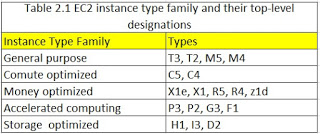
AWS allocates hardware resources to your instances consistent with the instance type—or hardware profile—you select. the actual workload you’re planning for your instance will determine the sort you select . the thought is to balance cost against your need for compute power, memory, and space for storing . Ideally, you’ll find a kind that gives precisely the amount of every to satisfy both your application and budget. Should your needs change over time, you’ll easily move to a special instance type by stopping your instance, editing its instance type, and starting it copy again.
There are currently quite 75 instance types organized into five instance families, although AWS frequently updates their selection. you’ll view the foremost recent collection at https://aws.amazon.com/ec2/instance-types/.
Read More : https://www.info-savvy.com/introduction-of-amazon-elastic-compute-cloud-ec2/

————————————————————————————————————

This Blog Article is posted by

Infosavvy, 2nd Floor, Sai Niketan, Chandavalkar Road Opp. Gora Gandhi Hotel, Above Jumbo King, beside Speakwell Institute, Borivali West, Mumbai, Maharashtra 400092

Contact us – www.info-savvy.com
https://g.co/kgs/ttqPpZ

AWS

Introduction to Cloud Computing and AWS

You will learn into this regarding cloud computing and their six advantages as well as types of cloud computing in detail.

What is Cloud Computing?

Cloud computing is that the on-demand delivery of compute power, database storage, applications, and other IT resources through a cloud services platform via the web with pay-as-you-go pricing. Whether you’re running applications that share photos to many mobile users or you’re supporting the critical operations of your business, a cloud services platform provides rapid access to flexible and low-cost IT resources. With cloud computing, you don’t got to make large upfront investments in hardware and spend tons of your time on the work of managing that hardware. Instead, you’ll provision precisely the right type and size of computing resources you would like to power your newest bright idea or operate your IT department. you’ll access as many resources as you would like , almost instantly, and only buy what you employ . Cloud computing provides an easy thanks to access servers, storage, databases and a broad set of application services over the web . A cloud services platform, like Amazon Web Services, owns and maintains the networkconnected hardware required for these application services, while you provision and use what you would like via an internet application.

Six Advantages of Cloud Computing

• Trade capital expense for variable expense – rather than having to take a position heavily in data centers and servers before you recognize how you’re getting to use them, you’ll pay only you consume computing resources, and pay just for what proportion you consume.
• enjoy massive economies of scale – By using cloud computing, you’ll achieve a lower variable cost than you’ll get on your own. Because usage from many thousands of consumers is aggregated within the cloud, providers like AWS are able to do higher economies of scale, which translates into lower pay as-you-go prices.
• Stop guessing capacity – Eliminate guessing on your infrastructure capacity needs. once you make a capacity decision before deploying an application, you regularly find yourself either sitting on expensive idle resources or handling limited capacity. With cloud computing, these problems get away . you’ll access the maximum amount or as little capacity as you would like , and proportion and down as needed with only a couple of minutes’ notice.
• Increase speed and agility – during a cloud computing environment, new IT resources are only a click away, which suggests that you simply reduce the time to form those resources available to your developers from weeks to only minutes. This leads to a dramatic increase in agility for the organization, since the value and time it takes to experiment and develop is significantly lower.
• Stop pocket money running and maintaining data centers – specialise in projects that differentiate your business, not the infrastructure. Cloud computing allows you to specialise in your own customers, instead of on the work of racking, stacking, and powering servers.
• Go global in minutes – Easily deploy your application in multiple regions round the world with just a couple of clicks. this suggests you’ll provide lower latency and a far better experience for your customers at minimal cost.“Cloud Computing is a great euphemism for centralization of computer services under one server”
-Evgeny Morozov

Types of Cloud Computing

provides developers and IT departments with the power to specialise in what matters most and avoid undifferentiated work like procurement, maintenance, and capacity planning. As cloud computing has grown in popularity, several different models and deployment strategies have emerged to assist meet specific needs of various users. Each sort of cloud service and deployment method provides you with different levels of control, flexibility, and management. Understanding the differences between Infrastructure as a ServicePlatform as a Service, and Software as a Service, also as what deployment strategies you’ll use, can assist you decide what set of services is true for your needs.

Infrastructure as a Service (IaaS)

Infrastructure as a Service (IaaS) contains the essential building blocks for cloud IT and typically provide access to networking features, computers (virtual or on dedicated hardware), and data space for storing. IaaS provides you with the very best level of flexibility and internal control over your IT resources and is most almost like existing IT resources that several IT departments and developers are accustomed to today.

Platform as a Service (PaaS)

Platform as a Service (PaaS) removes the necessity for your organization to manage the underlying infrastructure (usually hardware and operating systems) and allows you to specialise in the deployment and management of your applications. This helps you be more efficient as you don’t got to worry about resource procurement, capacity planning, software maintenance, patching, or any of the opposite undifferentiated work involved in running your application.

Software as a Service (SaaS)

Software as a Service (SaaS) provides you with a completed product that’s run and managed by the service provider. In most cases, people concerning Software as a Service are concerning end-user applications. With a SaaS offering you are doing not got to believe how the service is maintained or how the underlying infrastructure is managed; you simply need to believe how you’ll use that specific piece of software. a standard example of a SaaS application is web-based email which you’ll use to send and receive email without having to manage feature additions to the e-mail product or maintain the servers and operating systems that the e-mail program is running on.

Cloud Computing Deployment Models

Cloud

A cloud-based application is fully deployed within the cloud and every one parts of the appliance run within the cloud. Applications within the cloud have either been created within the cloud or are migrated from an existing infrastructure to require advantage of the advantages of cloud computing. Cloud-based applications are often built on low-level infrastructure pieces or can use higher level services that provide abstraction from the management, architecting, and scaling requirements of core infrastructure.

Hybrid

A hybrid deployment may be a thanks to connect infrastructure and applications between cloud-based resources and existing resources that aren’t located within the cloud. the foremost common method of hybrid deployment is between the cloud and existing on-premises infrastructure to increase , and grow, an organization’s infrastructure into the cloud while connecting cloud resources to the interior system. For more information on how AWS can assist you along with your hybrid deployment, please visit our hybrid page.

On-premises

The deployment of resources on-premises, using virtualization and resource management tools, is usually called the “private cloud.” On-premises deployment doesn’t provide many of the advantages of cloud computing but is usually looked for its ability to supply dedicated resources. In most cases this deployment model is that the same as legacy IT infrastructure while using application management and virtualization technologies to undertake and increase resource utilization.

Read More : https://www.info-savvy.com/introduction-to-cloud-computing-and-aws/

————————————————————————————————————

This Blog Article is posted by

Infosavvy, 2nd Floor, Sai Niketan, Chandavalkar Road Opp. Gora Gandhi Hotel, Above Jumbo King, beside Speakwell Institute, Borivali West, Mumbai, Maharashtra 400092

Contact us – www.info-savvy.com
https://g.co/kgs/ttqPpZ