Blog Feed

ISO 27001

ISO 27001 Annex : A.15.1.2 Addressing Security Within Supplier Agreements & A.15.1.3 Information and Communication Technology Supply Chain

In this article explain ISO 27001 Annex : A.15.1.2 Addressing Security Within Supplier Agreements & A.15.1.3 Information and Communication Technology Supply Chain this controls.

A.15.1.2  Addressing Security Within Supplier Agreements

Control- Any suppliers that view, process, store, communicate or provide IT infrastructure component information for the organization should be defined and agreed with all applicable information security requirements.

Implementation Guidance- Supplier agreements should be defined and recorded so that the organization and the supplier do not misinterpret the obligations of the two parties to meet the applicable information security requirements.

Related Product : ISO 27001 Lead Auditor Training And Certification ISMS

To meet the information security requirements identified, the following points should be considered for inclusion in the agreements:

  1. Description of information and methods of supply and access to the information to be provided or accessed;
  2. classification of information by the classification scheme of an organization (see 8.2); mapping, where possible, between the classification scheme for that organization and that for the supplier’s scheme of classification;
  3. legal and regulatory requirements, including data protection, copyright and intellectual property rights, and a description of how they will be complied with;
  4. obligation to enforce an agreed control plan, including access management, performance analysis, monitoring, reporting and auditing for each contracting party;
  5. Rules for acceptable use of information and, where necessary, unacceptable use;
  6. either an explicit list of providers’ staff authorized to receive or access information or procedures, authorization conditions, and the removal, access or receipt by supplier personnel of the information of the organization;
  7. Information security measures relating to a specific contract;
  8. Requirements and procedures for incident management (in particular, communication and collaboration in the remediation of incidents);
  9. Specific protocols and information protection criteria, such as for emergency response, authorization protocols, training and awareness criteria;
  10. Sub-contracting related legislation, including the controls to be applied;
  11. Applicable business partners, like the IT contact person;
  12. screening needs of supplier workers, including test and notification responsibilities, if there is no completion of the test, or where the results give rise to doubts or concerns;
  13. right to audit the contracting supplier processes and controls;
  14. Failure to resolve and resolve conflicts;
  15. The obligation of the supplier to submit an independent report on the efficiency of controls and the timely correction agreement for the relevant issues raised in the report periodically;
  16. The obligations of the supplier to meet the security requirements of the organization.

Other Information- Conventions can differ significantly between different organizations and various types of providers. Therefore, all applicable security information threats and specifications should be taken into consideration. Other parties (e.g. sub-providers) can also include supplier arrangements.

In order to prevent any delay in arranging replacement products or services, the processes for continued processing where the service supplier is unable to offer its products or services need to be considered in this arrangement.

Read More : https://info-savvy.com/iso-27001-annex-a-15-1-2-a-15-1-3/


This Blog Article is posted by

Infosavvy, 2nd Floor, Sai Niketan, Chandavalkar Road Opp. Gora Gandhi Hotel, Above Jumbo King, beside Speakwell Institute, Borivali West, Mumbai, Maharashtra 400092

Contact us – www.info-savvy.com

ISO 27001

ISO 27001 Annex : A.15 Supplier Relationships

ISO 27001 Annex : A.15 Supplier Relationships in this article explaining Information Security in Supplier Relationships, and there policies .

A.15.1  Information Security in Supplier Relationships

It’s objective is ensuring the security of assets accessible to suppliers of the organization.

A.15.1.1  Information Security Policy for Supplier Relationships

Control- The supplier should be agreed with and documented information security requirements related to the risk mitigation of access by suppliers to organizational assets.

“The company becomes more safe and happy if it has better Stakeholders.”

Related Product : ISO 27001 Lead Auditor Training And Certification ISMS

Implementation Guidance – In order to specifically address supplier access to information from the organization, the organization must identify and require security information controls in its policy. These checks should address the organization’s processing and procedures as well as the processes and procedures to be abided by the organization, including the following points: 

  1. Identification and reporting of supplier forms, e.g. IT services, logistics services, financial services, IT infrastructure components, which are accessible to the organization;
  2. standardized supplier relationship management framework and lifecycle;
  3. define the types of access to information allowed by distinct types of suppliers and monitor and control the access;
  4. Minimum information protection standards for any category of information and method of access to provide the basis for each supplier agreement based on the business needs and requirements and risk profile of the organization;
  5. Processes and procedure for monitoring compliance, including third-party evaluation and product validation, with defined information security standards for any type of supplier and type of access;
  6. Controls for accuracy and completeness of information and transmission received by any party to ensure the quality of information;
  7. the types of obligations applicable for providers to protect information of the organization;
  8. handling of customer control events and contingencies, including company and customer responsibilities;
  9. Resilience and, if necessary, recovery and contingency plans to ensure the availability by all parties of information or processing;
  10. Training in awareness of applicable policies, processes and procedures for the organization staff involved in acquisitions;
  11. Training in awareness of how the organization’s staff interacts with supplier staff on appropriate rules of engagement and behavior based on provider type and level of supplier access to the system and information of the organization;
  12. Conditions to document the security of information and control requirements in an agreement signed by both parties;
  13. Management and maintenance of the information security during the transition phase of the required information changes, information processing, and everything else that needs transfer.

Read More : https://info-savvy.com/iso-27001-annex-a-15-supplier-relationships/


This Blog Article is posted by

Infosavvy, 2nd Floor, Sai Niketan, Chandavalkar Road Opp. Gora Gandhi Hotel, Above Jumbo King, beside Speakwell Institute, Borivali West, Mumbai, Maharashtra 400092

Contact us – www.info-savvy.com

Cyber-security

The fall of security questions or password reset question

The fall of security questions or password reset question based on this topic article is written basically security this very important from anywhere and any field also for maintaining security we create the password but some time it happens to forgot  password at that time there should be some questions to maintain security zone once asked question would be right then and then only that particular user can create a new password.

I think we’ve reached some extent during which organizations and individuals need their security inquiries to produce more formidable hurdles for would-be hackers. The challenge for organizations is to not make the safety questions so difficult that users are unable to recollect their answers later.

To be useful, a far better security question should:

  • Be fairly easy to recollect , even years later.
  • Contain thousands of possible answers, so it isn’t easily guessed.
  • Not be a subject frequently found on social media.
  • Have a solution that never changes

There could also be times once you forget your password. you’ll recover it by answering secret questions that you simply found out yourself. you’ll add up to 3 secret questions. one among these questions are going to be presented if you click the Forgot Password? Suppose you forgot the solution to a specific question, system will ask another one among your secret questions. After you answer the key question, you’ll receive e-mail notification of your new password. It is recommended that you simply found out the key questions in order that you’ll reset your own password.

“Security Can Protect Your Business”

There are some questions with answers related to security question and why it is need, password reset question is secure or not such type of thing explained.

1. What is security question and answer?

A security question is sort of shared secret used as an authenticator. it’s commonly employed by banks, cable companies and wireless providers as an additional security layer. Financial institutions have used inquiries to authenticate customers since a minimum of the first 20th century.

2. Why can we ask security questions?

Security questions can add an additional layer of certainty to your authentication process. Security questions are an alternate way of identifying your customers once they have forgotten their password, entered the incorrect credentials too repeatedly , or tried to log in from an unfamiliar device or location.

Also Read :- Top cyber security certifications of 2020 in India

3. What is purpose of security?

The purpose of security is to stay you, your family, and your properties safe from burglaries, theft and other crimes. Private residential security guards make sure the safety of all the residents living within the community they serve.

4. Why is security so important?

Information security performs four important roles: Protects the organisation’s ability to function. Enables the safe operation of applications implemented on the organisation’s IT systems. Protects the info the organisation collects and uses.

5. What is a password reset question?

Password recovery questions, more commonly called security questions (or secret questions and answers), are wont to verify you because the legitimate owner of a web account when you’ve forgotten your password or are otherwise trying to recover a web account.

Related Product :- Certified Ethical Hacker | CEH Certification

the problem with all security questions, regardless of how difficult they’re , is that they are intended to be simpler to use than passwords because the question itself is meant to trigger your memory. To combat the more simplistic nature of security questions administrators often ask, end users might consider protecting themselves further by providing random answers that can’t be researched or guessed. In effect, we are suggesting that your answers be more random in order that they act more sort of a password.

Read More : https://info-savvy.com/the-fall-of-security-questions-or-password-reset-question/


This Blog Article is posted by

Infosavvy, 2nd Floor, Sai Niketan, Chandavalkar Road Opp. Gora Gandhi Hotel, Above Jumbo King, beside Speakwell Institute, Borivali West, Mumbai, Maharashtra 400092

Contact us – www.info-savvy.com

Cyber-security

For a hacker, chaos isn’t a pit, Chaos is ladder

For a hacker, chaos isn’t a pit, Chaos is ladder this idea is explained during this article with the assistance of some hacker and their terms.

“To better describe hacking, one needs to first understand hackers.” 

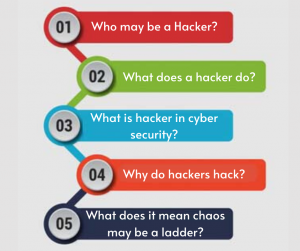
Who may be a Hacker?

A hacker is a private who uses computer, networking or other skills to beat a technical problem. The term hacker may ask anyone with technical skills, but it often refers to an individual who uses his or her abilities to realize unauthorized access to systems or networks so as to commit crimes. A hacker may, for instance , steal information to harm people via fraud , damage or bring down systems and, often, hold those systems hostage to gather ransom.

What does a hacker do?

Computer hackers are unauthorized users who forced an entry computer systems so as to steal, change or destroy information, often by installing dangerous malware without your knowledge or consent. Their clever tactics and detailed technical knowledge help them access the knowledge you actually don’t need them to possess.

“Most hackers are young because children tend to be adaptable. As long as you remain adaptable, you’ll always be an honest hacker.”
? Emmanuel Goldstein

What is hacker in cyber security?

A hacker is a private who uses computer, networking or other skills to beat a technical problem. The term hacker may ask anyone with technical skills, but it often refers to an individual who uses his or her abilities to realize unauthorized access to systems or networks so as to commit crimes

Related Product:- Certified Ethical Hacker | CEH Certification

Why do hackers hack?

Motives. Four primary motives are proposed as possibilities for why hackers plan to forced an entry computers and networks. First, there’s a criminal gain to be had when hacking systems with the precise purpose of stealing mastercard numbers or manipulating banking systems.

What does it mean chaos may be a ladder?

The climb may be a metaphor for achieving power, and therefore the ladder (chaos) is how Littlefinger climbs. When things are in disarray it allows him to control in order that he’s ahead. Chaos means the good houses overlook his birth, because they have him.

Also Read:- what’s Ethical Hacking? & sorts of Hacking

Hacking is an attempt to exploit a computer system or a private network inside a computer. Simply put, it is the unauthorised access to or control over computer network security systems for some illicit purpose.

Infosavvy CEH certification training course provides you the hands-on training required to master the techniques hackers use to penetrate network systems and fortify your system against it. This ethical hacking course is aligned with the latest CEHv10 training and certification with Infosavvy in Mumbai Location and accreditation by EC-COUNCIL will adequately prepare you to increase skills.

 “Chaos isn’t a pit. Chaos may be a ladder.”
-Petyr Baelish

Chaos isn’t a pit. Chaos may be a ladder. many that attempt to climb it fail, and never get to undertake again. the autumn breaks them. and a few are given an opportunity to climb, but refuse. They hold close the realm, or love, or the gods…illusions. Only the ladder is real. The climb is all there’s . But they’ll never know this. Not until it’s too late.

What hackers do is find out technology and experiment with it in ways many of us never imagined. They even have a robust desire to share this information with others and to elucidate it to people whose only qualification could also be the will to find out .

Read More : https://info-savvy.com/for-a-hacker-chaos-isnt-a-pit-chaos-is-ladder/


This Blog Article is posted by

Infosavvy, 2nd Floor, Sai Niketan, Chandavalkar Road Opp. Gora Gandhi Hotel, Above Jumbo King, beside Speakwell Institute, Borivali West, Mumbai, Maharashtra 400092

Contact us – www.info-savvy.com
Cyber-security

Top 12 Common Cybersecurity Analyst Interview Questions with Answers

This article is based on Top 12 Common cybersecurity analyst Interview Questions with Answers as well as job related Introduction.

Introduction

Cybersecurity jobs became one among the foremost in-demand jobs within the IT industry today. With demand, there’s also competition, and to urge employment in Cybersecurity, you would like to be one among the simplest . While having the required Cybersecurity skills is half job done, cracking the interview is another chapter altogether. And to assist you crack the interview, we’ve compiled this list of top Cybersecurity interview questions and answers.

“Skills matter then does Certification!”

Through Live Online cybersecurity training and certifications  Learn skills and upgrade yourself. There are lots of courses in cyber security certification, Infosavvy is offering in Mumbai that are CCISOCEHCTIAECIH, and ECSA .

Top 12 Common Cybersecurity Analyst Interview Questions with Answers

1. How does one define risk, vulnerability and threat on a network?

  • Threat: A threat is takes on many various forms. It might be one individual, a technology like malware or maybe natural disasters like earthquakes and floods. Anything that has the potential to cause damage to a computing system like a network, server or a corporation as an entire might be classified as a threat
  • Vulnerability: A vulnerability may be a gap within the security of a system that would be employed by cybercriminals or malware (threats) to realize unauthorized entry into a system, like an unpatched server, a weak password or an open port on an unsupervised computer on your network
  • Risk: Risk might be seen because the potential for loss or damage when a threat is administered against a vulnerability on your network. this is often the worst-case scenario and is employed as a way to assist motivate for any security-related issues to be detected, prevented or resolved.

2. What does one realize cybersecurity frameworks?

  • PCI-DSS
  • ISO 27001/27002
  • CIS Critical Security Controls
  • NIST Cybersecurity Framework

3. what’s a DDoS attack? How is it mitigated?

This is one among the foremost common attacks on the web and is typically wont to take down an internet site . DDoS stands for distributed denial of service. The attack uses an outsized number of clients that flood the affected server with numerous requests that it eventually stops responding to them. This makes actual users that are just sending standard requests to access the web resource unable to attach , thus taking the server offline.

In this scenario, there are a couple of techniques that you simply can use to mitigate a DDoS attack on an internet site . the primary thing that you simply should try is minimize your website’s exposure to potential attacks. this is often done by reducing the amount of ports and resources that are exposed on to the web . Only essential services that expect communications should be internet-facing; everything else should be locked down.

Also Read:-  Concepts of Denial-of-Service Attack & Distributed Denial of Service Attack

4. Why does one need DNS monitoring?

DNS monitoring is just how for you to check connectivity between your local connections and therefore the remainder of the web . DNS monitoring is vital because it gives you a far better idea of the present state of your connections, helping you to troubleshoot issues once they occur. this is often especially helpful from a cybersecurity perspective if you think any malicious activity.

5. what’s the CIA triad?

CIA stands for Confidentiality, Integrity, and Availability. CIA may be a model that’s designed to guide policies for Information Security. it’s one among the foremost popular models employed by organizations.

Confidentiality:-The information should be accessible and readable only to authorized personnel. It shouldn’t be accessible by unauthorized personnel. the knowledge should be strongly encrypted just just in case someone uses hacking to access the info in order that albeit the info is accessed, it’s not readable or understandable.

Integrity:- Making sure the info has not been modified by an unauthorized entity. Integrity ensures that data isn’t corrupted or modified by unauthorized personnel. If a licensed individual/system is trying to switch the info and therefore the modification wasn’t successful, then the info should be reversed back and will not be corrupted.

Read More : https://info-savvy.com/top-12-common-cybersecurity-analyst-interview-questions-with-answers/


This Blog Article is posted by

Infosavvy, 2nd Floor, Sai Niketan, Chandavalkar Road Opp. Gora Gandhi Hotel, Above Jumbo King, beside Speakwell Institute, Borivali West, Mumbai, Maharashtra 400092

Contact us – www.info-savvy.com

CEH

2020 Top 10 Cyber Attacks in India

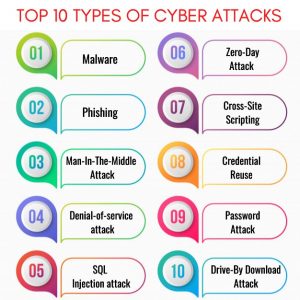
2020 Top 10 Cyber Attacks in India most typical forms of It like MalwarePhishingMan-In-The-Middle Attack, Denial-of-service attack etc. Such are the Attacks that you’ll learn in this article as well as you’ll get to understand what are cyber attacks with the assistance of its types.

What are the Cyber Attacks?

Cyber Attack is defined as an attack originated by a digital system against another digital device, website, or the other digital system and compromises its privacy, reliability or the info stored in it. A cyber attack can maliciously disable computers, steal data, or use a breached computer as a launch point for other attacks.

Types of Cyber Attacks

Cyber-attacks are often of varied types. you would like to remember of all those sorts of cyberattacks to ensure your highest safety and security.

Related Product: Certified Ethical Hacker | CEH Certification

1) Malware

Malware is taken under consideration as software that’s intentionally developed to disrupt computer, server, client, or network.
Malware is often within the type of scripts, executable codes, active content, and other malicious software.

These codes are often computer worms, viruses, ransomware, Trojan horses, adware, spyware, or scareware. Malware, because the name suggests, is meant with a malicious intent to cause damage to the website/computer user.

The most prominent damages caused by malware are:

  • As ransomware, it blocks access to key components of the network.
  • Installs harmful software/malware
  • As spyware, they’re going to steal valuable information from your system (spyware) ;
  • They will damage certain hardware components of your system and make them inoperable.

2) Phishing

The main aim of Phishing is to steal restricted and private information like MasterCard details, login ids, and passwords, etc.
By impersonating oneself as a reliable establishment in transmission. it’s usually done through email spoofing or instant messaging.
They carry a link that directs users to a fake website which looks almost like the legitimate site and asks them to enter personal and secure information. it’s a fraudulent activity intended to cheat users.
They bait the users by claiming to be from a reliable third group like auction sites, online payment processors, social internet sites, banks, or IT administrators.
You need to be aware and acknowledged with such fraudulent activities to bypass any such fraud activities.

3) Man-In-The-Middle Attack

In Man-in-the-middle (MitM) the invader covertly modifies the chats and dialogues between two people that are communicating with one another.
In a Man-in-the-middle attack, the communicators are made to believe that they’re directly communicating with one another with none interference from any third party.
But the reality is that the entire communication is controlled by the invader while making the communicators believe that they’re talking to one another. it’s also referred to as eavesdropping.

The Entry Points For MITM

  • The invaders can easily take control of o private chats over an unsecured public Wi-Fi. Invaders can inset between the device and therefore the network and may take control of the private hats within the network. The communicators without having any idea pass all the conversation to the invaders.
  • It also can be done through malware. In such cases, the invader installs software on the victim’s device to process all his information.

What are the Cyber attack  is a part Certified Ethical Hacking v10(CEH v10) training you learn the cyber security attacks and their impact.

4) Denial-of-service attack

In denial-of-service attack (DoS attack) the offender tries to form digital assets inaccessible to its anticipated users. The offender provisionally interrupts services of a number who is linked to the online. It involves overflowing the besieged machine with surplus applications to burden it from fulfilling the legitimate requests.

Also Read:  Concepts of Denial-of-Service Attack & Distributed Denial of Service Attack

5) SQL Injection attack

A Structured command language (SQL) injection attack allows the intruders to run malicious SQL statements. These SQL statements can require over the database server.
Using SQL injection intruders can overcome application security measures.
It allows them to undergo the validation and approval process of any web application.
It also allows them to recover the whole data from their database. It also gives access to intruders to feature, modify, and delete data within the database.
An SQL Injection allows intruders to fiddle with various databases including MySQL, Oracle, SQL Server, or others. it’s widely used by attackers to urge access over:

  • Personal data
  • Intellectual property
  • Customer information
  • Trade secrets and more

Read More : https://info-savvy.com/2020-top-10-cyber-attacks-in-india/


This Blog Article is posted by

Infosavvy, 2nd Floor, Sai Niketan, Chandavalkar Road Opp. Gora Gandhi Hotel, Above Jumbo King, beside Speakwell Institute, Borivali West, Mumbai, Maharashtra 400092

Contact us – www.info-savvy.com

ISO 27001

ISO 27001 Annex : A.14.3 Test data

ISO 27001 Annex : A.14.3  Test data its objective is to ensure that data used for research are secured.

A.14.3.1  Protection of test data

Control – Careful collection, security, and review of test data should be performed.

Implementation Guidance – It should be avoided the use of operational information containing personal information or any other confidential information for test purposes. Where personal information or otherwise confidential information for testing purposes is used, all sensitive information and content should be protected either by deletion or modification.

When used for testing purposes, the following guidelines should be used for the protection of operational data:

  1. The access management protocols applicable to the running application systems should also refer to the application control systems;
  2. Every time operational information is copied to the test setting, separate authorization should be granted;
  3. Operational information should be deleted immediately after completion of the test environment from a test environment;
  4. In order to include an audit trail, copying and using operational details should be logged.

Related Product : ISO 27001 Lead Auditor Training And Certification ISMS

Other Information – System testing and acceptance testing usually involve significant volumes of test data as close to operational data as possible.

A well-known ISO 27001 Lead Auditor and ISO 27001 Lead Implementer certificate that mainly covers information security clauses and their implementation, i.e., controls which should be implemented by the organization to preserve the CIA triad, Confidentiality, Integrity, and Availability to maintain their critical, sensitive information in a secure manner. Infosavvy, an institute in Mumbai conducts training and certification for multiple domains in Information Security which includes IRCA CQI ISO 27001:2013 Lead Auditor (LA)ISO 27001 Lead Implementer (LI) (TÜV SÜD Certification). Infosavvy will help you to understand and recognize the full scope of your organization’s security checks to protect your organization’s activities and information equipment (assets) from attacks, and also to illustrate the controls for securing system engineering principles and also controls for maintaining and testing software packages and systems. We have trainers with extensive expertise and experience to ensure the efficient handling of the security of information. Consequently, the applicant will gain the necessary skills for the ISMS audit by using commonly agreed audit concepts, procedures and techniques.

Read More : https://info-savvy.com/iso-27001-annex-a-14-3-test-data/


This Blog Article is posted by
Infosavvy, 2nd Floor, Sai Niketan, Chandavalkar Road Opp. Gora Gandhi Hotel, Above Jumbo King, beside Speakwell Institute, Borivali West, Mumbai, Maharashtra 400092

Contact us – www.info-savvy.com
ISO 27001

ISO 27001 Annex : A.14.2.6 Secure Development Environment, A.14.2.7 Outsourced Development, A.14.2.8 System Security Testing & A.14.2.9 System Acceptance Testing

In this article explain ISO 27001 Annex : A.14.2.6 Secure Development Environment, A.14.2.7 Outsourced Development, A.14.2.8 System Security Testing & A.14.2.9 System Acceptance Testing.

A.14.2.6  Secure Development Environment

Control – ISO 27001 Annex : A.14.2.6 Secure Development Environment in this Organizations should create secure development environments and integration efforts for the entire life cycle of system development and should be adequately protected.

Implementation Guidance – A secure development environment includes people, processes, and technology in the development and integration of systems.

Organizations should evaluate the risks associated with the development of individual systems and establish secure development environments for specific system development efforts, taking into account the following points:

  1. Sensibility of processing, storage and transmission of data through the system;
  2. External and internal guidelines applicable, e.g. laws or policies;
  3. Security controls already carried out by the organization that endorses the development of the system;
  4. the reliability of personnel working in the environment;
  5. The level of outsourcing associated with the production of the system;
  6. The need for segregation between different environments for development;
  7. Access control to the environment for development;
  8. Monitoring environmental changes and the code contained in them;
  9. Secure offsite locations of backups are stored;
  10. Data transfers from and to the environment are controlled.

When the level of security is established for a specific development context, organizations will record and provide the corresponding processes to all or any individual who needs them in secure development processes.

Related Product : ISO 27001 Lead Auditor Training And Certification ISMS

A.14.2.7  Outsourced Development

Control – The organization must monitor and monitor activity for the development of the outsourced system.

Implementation Guidance – If system development is outsourced, it is necessary to consider the following points across the entire external supply chain of the organization;

  1. Outsourced content licensing arrangements, code ownership and intellectual rights;
  2. Secure design, coding and testing requirements; contractual requirements;
  3. Providing the external developer with the approved threat model;
  4. Quality and accuracy of deliverables acceptance testing;
  5. Provide evidence that security criteria have been used for minimum appropriate security and privacy standards;
  6. provide evidence that enough testing has been applied to prevent both deliberate and unintentional malicious content from being delivered;
  7. provide proof that adequate research was used to defend against known vulnerabilities; collection of data;
  8. escrow schemes, for example, when source code is no more available
  9. Contractual right to inspect processes and controls for development;
  10. Efficient development environment documents used to construct deliverables;
  11. Compliance with applicable laws and monitoring effectiveness verification shall remain a responsibility of the organization.

Other Information – Additional information on provider relations is frequently available in ISO / IEC 27036.

Also Read : ISO 27001 Annex : A.14.2.3 , A.14.2.4  & A.14.2.5 

A well-known ISO 27001 Lead Auditor and ISO 27001 Lead Implementer certificate that mainly covers information security clauses and their implementation, i.e., controls which should be implemented by the organization to preserve the CIA triad, Confidentiality, Integrity, and Availability to maintain their critical, sensitive information in a secure manner. Infosavvy, an institute in Mumbai conducts training and certification for multiple domains in Information Security which includes IRCA CQI ISO 27001:2013 Lead Auditor (LA)ISO 27001 Lead Implementer (LI) (TÜV SÜD Certification). Infosavvy will help you to understand and recognize the full scope of your organization’s security checks to protect your organization’s activities and information equipment (assets) from attacks, and also to illustrate the controls for securing system engineering principles and also controls for maintaining and testing software packages and systems. We have trainers with extensive expertise and experience to ensure the efficient handling of the security of information. Consequently, the applicant will gain the necessary skills for the ISMS audit by using commonly agreed audit concepts, procedures and techniques….

Read More : https://info-savvy.com/iso-27001-annex-a-14-2-6-a-14-2-7-a-14-2-8-a-14-2-9/


This Blog Article is posted by

Infosavvy, 2nd Floor, Sai Niketan, Chandavalkar Road Opp. Gora Gandhi Hotel, Above Jumbo King, beside Speakwell Institute, Borivali West, Mumbai, Maharashtra 400092

Contact us – www.info-savvy.com

ISO 27001

ISO 27001 Annex : A.14.2.3 Technical Review of Applications after Operating Platform Changes , A.14.2.4 Restrictions on Changes to Software Packages & A.14.2.5 Secure System Engineering Principles

In this article explain ISO 27001 Annex : A.14.2.3 Technical Review of Applications after Operating Platform Changes , A.14.2.4 Restrictions on Changes to Software Packages & A.14.2.5 Secure System Engineering Principles this controls.

A.14.2.3  Technical Review of Applications after Operating Platform Changes

Control- In changing operating platforms, critical applications of business should be revised and tested to ensure no adverse impacts on business or security.

Implementation Guidance – The following points should be covered in the process:

  • Review of application control and processes of integrity to ensure that changes to the operating platform have not compromised them;
  • Ensure that operating platform changes are communicated at the right time to enable proper tests and reviews prior to implementation;
  • Ensuring that the business continuity plans are properly amended.

Other Information – Operating environments are operating systems, databases, and applications for middleware. API modifications should also be tracked.

Related Product : ISO 27001 Lead Auditor Training And Certification ISMS

A.14.2.4  Restrictions on Changes to Software Packages

Control- Software package modifications should be discouraged, restricted to the modifications necessary, and all changes controlled strictly.

Implementation Guidance – The vendor-supplied software packages should be used without alteration to the extent necessary and feasible. The following points should be considered where a software package needs to be modified:

  • the possibility of conflict with built-in controls and processes of integrity;
  • Whether Vendor’s consent has been obtained;
  • the opportunity, in regular system updates, to receive the necessary vendor changes;
  • impacts when the organization becomes responsible as a result of changes for the future maintenance of software;
  • Additional software compatibility in use.

The original software should be kept if changes are necessary and the modifications applied to the specified copy. To ensure that the most up to date approved patches and application updates are installed for all permitted software, a software update management process should be implemented. All modifications should be carefully checked and reported, in order to reapply to potential software updates if necessary. If required, a separate evaluation body will check and verify the modifications.

A well-known ISO 27001 Lead Auditor and ISO 27001 Lead Implementer certificate that mainly covers information security clauses and their implementation, i.e., controls which should be implemented by the organization to preserve the CIA triad, Confidentiality, Integrity, and Availability to maintain their critical, sensitive information in a secure manner.  Infosavvy, an institute in Mumbai conducts training and certification for multiple domains in Information Security which includes IRCA CQI ISO 27001:2013 Lead Auditor (LA)ISO 27001 Lead Implementer (LI) (TÜV SÜD Certification). Infosavvy will help you to understand and recognize the full scope of your organization’s security checks to protect your organization’s activities and information equipment (assets) from attacks, and also to illustrate the controls for securing system engineering principles and also controls for changes in software packages. We have trainers with extensive expertise and experience to ensure the efficient handling of the security of information. Consequently, the applicant will gain the necessary skills for the ISMS audit by using commonly agreed audit concepts, procedures and techniques.

Also Read : ISO 27001 Annex : A.14.2 Security in Development and Support Processes

A.14.2.5  Secure System Engineering Principles

Control- In the implementation of any information system implementation project, standards for secure system engineered must be established, documented, maintained, and implemented.

Implementation Guidance – Secure IT Engineering procedures based on the principles of security engineering should be established, documented, and applied in in-house IT Engineering. The need for data security and accessibility should be balanced in all architecture layers (e.g., business, data, applications, and technology).   New technology for security threats needs to be evaluated and the design for documented attack patterns should be reviewed.

Such principles and the developed engineering processes should be reviewed periodically, to ensure that they contribute effectively to improved safety standards in the engineering phase. They should also be reviewed on a regular basis to ensure that they remain relevant as concerning the combat against any new potential threats and remain applicable to technical advancements and implemented solutions.

Where appropriate, the established principles of security engineering should be applied to outsourced information systems through the agreements and other binding agreements between the organization and its suppliers to whom the organization outsources.   The business must ensure that the rigor of the security engineering standards of suppliers is comparable to its own.

Read More : https://info-savvy.com/iso-27001-annex-a-14-2-3-a-14-2-4-a-14-2-5/


This Blog Article is posted by

Infosavvy, 2nd Floor, Sai Niketan, Chandavalkar Road Opp. Gora Gandhi Hotel, Above Jumbo King, beside Speakwell Institute, Borivali West, Mumbai, Maharashtra 400092

Contact us – www.info-savvy.com